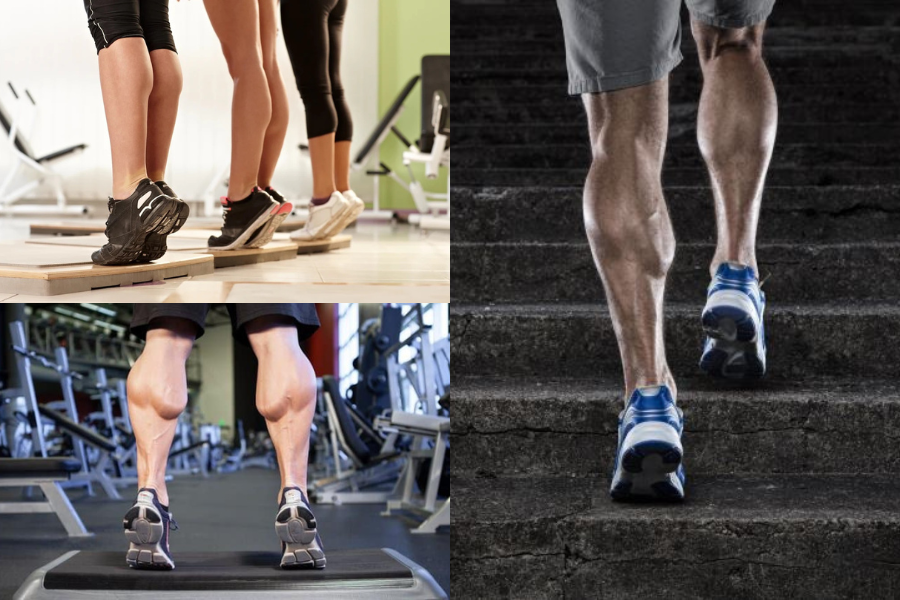
A well performed set of seated calf raises can build strong, stable lower legs that support everything from walking to sprinting. The catch is that small form errors add up quickly. They reduce how much your calves work and they increase your risk of cranky Achilles tendons and stiff ankles.
Below, you will learn the most common mistakes people make with seated calf raises, how to fix each one, and simple ways to adjust the exercise so your calves finally respond.
Rushing the movement
If you move too quickly, momentum does the work instead of your muscles.
During seated calf raises you want slow, controlled repetitions. A useful guideline is a tempo of about 2 seconds down, a 1 second pause, 2 seconds up, and another 2 second stretch at the bottom. This controlled pace keeps tension on the calves and protects your Achilles tendons.
When you bounce, you lose that tension. Your heels drop and spring back up without the calf muscles fully engaging. Over time this can irritate the tendons around your ankles.
To correct this, count your tempo in your head and think of your reps as smooth arcs instead of quick hops. If you cannot control the weight, you are probably using too much resistance.
Using too much (or too little) weight
Seated calf raises respond best to the right amount of load. Too heavy, and your range of motion shrinks. Too light, and your calves never get a real training signal.
If the weight is too heavy, you will notice that your heels barely move, your toes grip the platform for dear life, and you might rock your upper body to cheat the weight up. This limited motion means your calves never reach a full stretch or full contraction.
On the other hand, if the weight is too light, you can easily fly through high reps without any real fatigue. Your calves will burn a little but they will not be challenged enough to get stronger.
Try this approach:
- Choose a weight that lets you move through a full range of motion for at least 12 controlled reps.
- The last 2 to 3 reps should feel difficult, but your form should stay solid.
- When you can perform more than 20 slow, clean reps, increase the resistance slightly.
Because the calf muscles are rich in slow twitch fibers, they respond well to a mix of repetition ranges, from about 6 to 20 reps. The key is that every set feels purposeful and controlled.
Cutting the range of motion short
One of the biggest mistakes with seated calf raises is stopping the movement halfway. You might lift only part of the way up onto your toes or avoid letting your heels drop into a true stretch.
Your calves work hardest when you move from a deep stretch to a strong peak contraction. Research on calf training emphasizes that a full range of motion, where your heel drops below the ball of your foot then rises as high as possible, helps maximize muscle activation and tension for better results.
When you shorten the motion, you miss that powerful stretch at the bottom and the squeeze at the top. Over time this means less strength, less muscle growth, and stiffer ankles.
Focus on three checkpoints for each rep:
- Start with your heels as low as they can comfortably go so you feel a stretch in the calves.
- Press through the balls of your feet until your heels are as high as possible.
- Pause briefly at both the bottom and the top instead of bouncing.
If your heels cannot rise very high, it may be a sign of fatigue or tightness. Rest a bit longer between sets or reduce the load so you can achieve full heel height on each rep.
Letting your toes curl or claw
When the weight gets heavy, your body looks for shortcuts. One common compensation is toe clawing. Instead of staying relaxed, your toes curl tightly around the edge of the platform or floor.
This often means your long toe flexor muscles are taking over to help lift the weight, while your calves underperform. It can also cause cramping in the bottom of your feet.
A simple fix is to position your toes so they can relax. If you are using a step or plate, let your toes hang slightly off the edge. This setup encourages you to push through the ball of your foot instead of gripping with your toes. Focus on keeping equal pressure from the big toe joint through to the little toe joint so the load spreads across your forefoot.
If your toes keep clawing despite your efforts, drop the weight, reestablish a smooth foot position, and rebuild the load from there.
Ignoring your foot pressure
How you press into the platform matters just as much as how you move. If all the pressure sits under your big toe or only under your little toe, your ankles will roll inward or outward, and your calves will not load evenly.
Proper technique means maintaining equal pressure across the forefoot, from the base of the big toe to the base of the little toe. This balanced pressure lines up your ankle and encourages both sides of the calf to work.
During your next set, look at your shoes or bare feet. If your ankle collapses inward or your foot rolls out to the side, pause and reset. It can help to imagine that your big toe, little toe, and heel form a tripod that stays stable as you lift and lower your heels.
Sitting with poor posture
It is tempting to slump when you sit on a machine or chair, but your upper body position affects your lower legs more than you might think.
If you round your back and let your knees drift around, the weight can shift unpredictably. This reduces how well your calves contract and can put extra pressure on your knees and hips.
For safer and more effective seated calf raises, set up with:
- A tall, neutral spine, as if you are gently lifting the crown of your head toward the ceiling
- Your knees bent roughly at 90 degrees, stacked over your ankles
- Your core lightly braced so your torso stays still as your heels move
Try not to rock your body to help the weight up. If you need to lean and jerk, it is a sign that the load is too heavy or you are getting fatigued.
Training only one type of calf raise
Seated calf raises are excellent for targeting the soleus, the deep calf muscle that lies under the larger gastrocnemius. Because your knees are bent, the gastrocnemius cannot contract as strongly around the ankle. This is known as active insufficiency, and it shifts more of the work to the soleus.
The soleus is crucial for walking, postural support, and running. It can absorb forces of 6.5 to 8 times your body weight during running, which highlights how important it is for everyday movement and performance.
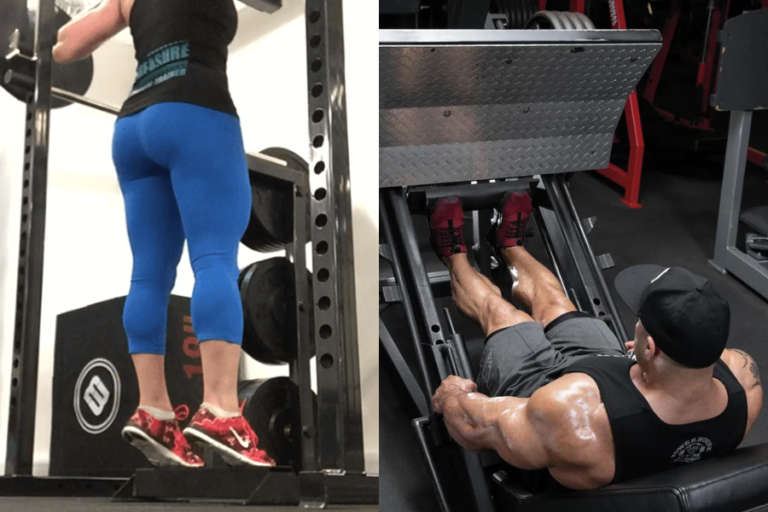
However, if you only do seated calf raises, you may neglect the larger, more visible gastrocnemius. Standing calf raises place your knees in a straighter position and tend to engage the gastrocnemius more. Many lifters prefer them when they want bigger calves, while others notice strong results from both types.
For balanced calf development, include both variations in your routine. You might perform seated calf raises first to emphasize the soleus, then finish with a few sets of standing raises to target the gastrocnemius.
Skipping progression and variety
Your calves are used to working all day. They help you stand, walk, and climb stairs, so they adapt quickly if your training never changes.
If you perform the same seated calf raises with the same weight and reps week after week, your progress will stall. You can keep your calves progressing by gradually increasing the challenge in at least one of these ways:
- Add more resistance with heavier weights or stronger bands
- Increase your total reps per set, up to around 20 while keeping the tempo slow
- Add a pause of 2 to 3 seconds at the top or bottom of each rep
- Move from two leg to single leg seated calf raises
Varying repetition ranges, such as having one day focused on moderate reps (6 to 12) and another day with higher reps (12 to 20), helps recruit more motor units and keeps the muscles responsive.
Aim to train your calves two to three times per week, and leave at least a day of rest between hard sessions so your muscles and tendons can recover.
Forgetting that seated calf raises help more than looks
It is easy to think of seated calf raises only as a way to build bigger calves, but they offer broader benefits for your daily life.
A chair based calf raise improves strength in both the gastrocnemius and soleus, and it also trains your ankles. For older adults in particular, these raises are used to improve walking ability, circulation, and balance, and to reduce lower leg stiffness and swelling. Because the movement is supported and stable, it is a gentle way to build strength safely.
Beginners can start by lifting their heels only a small amount and performing fewer reps. Hands can rest on the thighs for added stability. Over time, you can progress by pressing down lightly on your thighs for extra resistance, placing small dumbbells or water bottles on your legs, and eventually trying single leg raises.
If you feel uncertain about where to start or how much resistance to use, consider discussing calf strengthening with a physical therapist or qualified trainer who can tailor the exercise to your needs and any existing ankle or Achilles issues.
Putting it all together
When you slow down your reps, use the right amount of weight, and move through a full range of motion, seated calf raises become a powerful lower leg exercise rather than a throwaway machine in the corner.
To recap the key habits:
Move with control, use a weight that challenges you without breaking your form, let your heels fully stretch and fully rise, and keep your feet relaxed but stable on the platform.
From there, add variety, combine seated and standing raises, and give your calves the same focused attention you give the rest of your body. Your walking, running, and overall balance will be stronger for it.
About the Author