Understand beginner bicep workouts
If you are new to strength training, bicep workouts for beginners can feel confusing. One video tells you to lock your elbows in place. Another trainer lets the elbows move and even uses some shoulder. So which one is right and how should you get started safely?
Your biceps sit at the front of your upper arm and are responsible for bending your elbow and helping with some shoulder movement. According to Mayo Clinic expert Edward R. Laskowski, M.D., the classic biceps curl is designed to build strength in this muscle group by slowly bending and straightening your elbow with a dumbbell in hand. When you train this area consistently, you do more than build arm size. You also support everyday tasks like carrying groceries or lifting kids and you help protect your shoulders and elbows, as Planet Fitness explains in its beginner guides.
This guide walks you through simple bicep exercises, a starter workout plan, and clear form tips so you can train with confidence even if you have no experience.
Learn why biceps training matters
Before you pick up a weight, it helps to know what you are working and why.
Key muscles you work
Beginner bicep workouts primarily target:
- Biceps brachii
The large two headed muscle at the front of your upper arm that bends your elbow and helps rotate your forearm. - Supporting muscles
Smaller muscles under the biceps, muscles around the shoulder that help move your arm, and the forearm muscles that support your grip and wrist stability.
When you curl a weight, all of these work together. You feel the burn in your biceps, but your grip, forearms, and even your core help keep the movement controlled.
Everyday benefits for you
For beginners, consistent bicep training can:
- Build upper body strength for daily tasks like carrying bags, moving boxes, or lifting children, as highlighted by Planet Fitness.
- Improve elbow joint range of motion and control, which helps with comfort during pushing and pulling movements.
- Reduce injury risk at the shoulder by strengthening the muscles that support arm position.
- Increase bone density in your arms through resistance training, which becomes more important as you age.
You are not just training for the mirror. You are also making your arms more capable and resilient in daily life.
Master the basics of bicep curls
Most beginner bicep workouts start with some type of curl. Getting this one movement right will make every variation more effective and safer.
Standard dumbbell biceps curl
The Mayo Clinic describes a simple and safe way to perform a biceps curl with dumbbells. You can do this seated or standing.
- Start position
- Hold a dumbbell in one or both hands.
- Let your arms hang at your sides.
- Turn your palm so it faces forward or slightly inward.
- Keep your elbow close to your body.
- Curl up
- Bend your elbow and bring the weight toward your shoulder.
- Move in a smooth controlled path.
- Keep your wrist straight and rigid as Mayo Clinic suggests so you avoid stressing the joint.
- Avoid swinging your arm or using your hips to help.
- Lower down
- Slowly straighten your elbow and return the weight to the starting position.
- Try to control the entire lowering phase instead of dropping the weight.
- Breathe
- Exhale as you lift.
- Inhale as you lower.
Beginners can perform this exercise seated for more stability or standing for a bit more core engagement. Alternating arms can make balance and core work a little more challenging while still focusing on your biceps.
Common beginner form cues
Across expert sources, these points come up again and again:
- Move slowly
Planet Fitness and other trainers emphasize smooth controlled reps. Quick, jerky curls usually mean you are using momentum instead of muscle. - Keep elbows near your sides
This keeps tension on the biceps and reduces unwanted shoulder strain. - Avoid swinging
Using your hips, back, or shoulders to throw the weight up takes work away from your biceps and raises injury risk. - Choose manageable weight
You want the last few repetitions to feel challenging but not so hard that your form falls apart.
For most people, one set of 12 to 15 controlled repetitions can start building strength, according to Mayo Clinic guidance.
Understand different curl styles and confusion
If you have already searched for bicep workouts for beginners, you have probably seen conflicting advice about how to curl. That is normal and there is a reason.
Elbows locked vs elbows moving
In a 2023 online discussion, beginners noticed that some articles told them to keep their elbows completely still and avoid any shoulder movement, while a professional trainer allowed some elbow travel and shoulder involvement.
-
Traditional beginner advice
-
Keep elbows pinned to your sides.
-
Stop the curl roughly at the midpoint or when your forearm is vertical to limit shoulder activation.
-
Goal: isolate the biceps and make technique simple.
-
More advanced or athletic style
-
Allow a small natural elbow shift or shoulder movement, especially near the top of a curl.
-
Goal: work through a slightly different angle, or squeeze a bit more at the top.
Community feedback in that discussion suggested that both techniques can be effective. As a beginner, your priority isnot choosing a perfect style. Your priority is learning to feel your biceps work with safe controlled mechanics. You can experiment with slight variations later.
The role of rep speed and wrist position
Jeff Cavaliere of Athlean X, a physical therapist and well known trainer, recommends slowing your curls significantly, about four seconds up and four seconds down, to increase biceps activity and reduce injury risk for beginners. He also suggests using wrist extension instead of insisting on completely straight wrists, because the wrist is naturally strong in that position and it can improve leverage.
This differs from Mayo Clinic guidance that focuses on keeping your wrist straight and rigid to protect the joint. As a new lifter, you can:
- Start with the more conservative version, a neutral straight wrist.
- Gradually explore a small amount of wrist extension once you are comfortable and pain free and only if it feels natural.
If any wrist position causes discomfort, return to the neutral straight wrist and reduce the weight.
Use essential beginner bicep exercises
You do not need a long list of exercises to get started. The research describes a compact beginner routine built around three main movements.
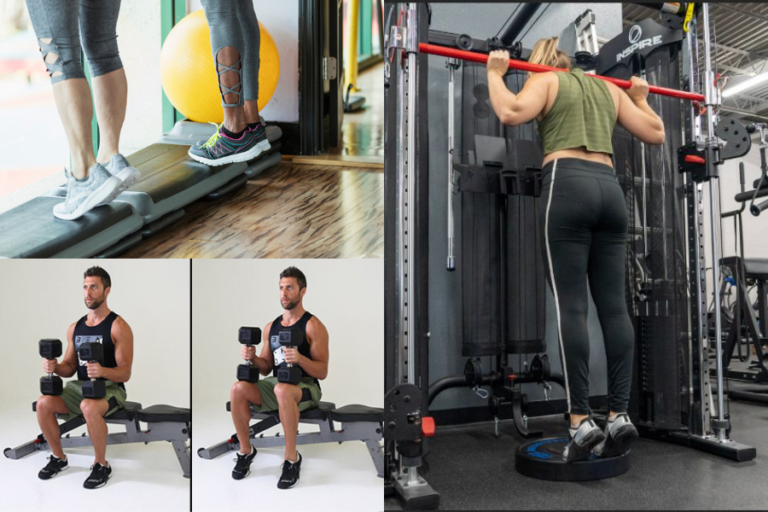
1. Seated dumbbell curls
This variation makes it easier to keep your form strict because your lower body is stable.
How to do it:
- Set a bench nearly vertical.
- Sit tall with your back supported and feet flat.
- Hold a dumbbell in each hand with palms facing forward.
- Keep your elbows close to your sides.
- Curl both weights up toward your shoulders, then lower slowly.
Guidelines:
- Aim for 3 sets of 10 to 12 repetitions.
- Focus on not letting your elbows drift forward. This reduces help from your shoulders and lower back so your biceps do more of the work.
2. Standing barbell curls
Standing curls with a barbell are a classic mass building exercise once your form is solid.
How to do it:
- Stand with feet about hip width apart.
- Grip a barbell with palms facing up and hands about shoulder width apart.
- Let the bar rest against your thighs with arms straight.
- Brace your core and keep your chest tall.
- Curl the bar up toward chest level without swinging.
- Pause briefly, then lower the bar under control.
Guidelines:
- Aim for 3 sets of 8 to 10 repetitions.
- Keep momentum low and elbow movement minimal as the research suggests.
- If you catch yourself rocking or swinging, the weight is probably too heavy.
3. Single arm preacher curls
Preacher curls focus on the short head of the biceps by placing your elbow in front of your body on a pad or bench.
How to do it:
- Sit on a preacher bench or set an incline bench and lean your upper arm against it.
- Hold a dumbbell in one hand with palm facing up.
- Start with your arm nearly straight, but not locked.
- Curl the weight up until your forearm is vertical.
- Squeeze at the top, then lower slowly until you feel a stretch in the biceps.
Guidelines:
- Perform 2 to 3 sets of 10 to 12 repetitions per arm.
- Working one arm at a time can help correct size or strength differences between sides.
You can treat these three exercises as your main bicep workout for several weeks as you learn technique and build a base.
Explore other beginner friendly bicep moves
Once you feel comfortable with basic curls, you can add variety. Planet Fitness recommends several effective bicep exercises for beginners. You do not need all of these at once, but they provide options as you progress.
Useful variations to rotate in
- Hammer curls
Hold dumbbells with palms facing each other and curl. This shifts some emphasis to your brachialis and forearms and can feel better on some elbows. - Cable curls
Use a cable machine with a straight or EZ bar handle. The constant tension can make it easier to feel your biceps working through the whole rep. - Incline dumbbell curls
Lie back on an incline bench and let your arms hang behind your body. This position stretches the long head of the biceps and can create a strong contraction. - Concentration curls
Sit on a bench, brace your elbow against your inner thigh, and curl a dumbbell. This setup encourages strict, focused reps. - Pull up variations
Underhand grip pull ups or assisted pull ups involve your back and biceps together. For beginners, assisted machine pull ups or banded pull ups are often more realistic. - Cable or machine preacher curls
A preacher bench with a cable or machine can give you guided range of motion and controlled tension, which is helpful when you are learning.
Jeff Cavaliere also suggests changing curl types to work different positions of the biceps, such as incline curls or drag curls for more long head stretch, and preacher curls to emphasize the short head. The key idea is not to rely on only one curl forever. A mix of angles and grips will challenge more fibers over time.
Build a simple beginner bicep workout plan
You do not have to train arms every day. In fact, research suggests that less can be more, especially at the start.
How often to train your biceps
A 2016 study by Brad Schoenfeld found that training a muscle group two to three times per week led to roughly double the muscle growth compared with once per week. For biceps that means:
- Base strength and skill
- Train your biceps about two times per week at first, as recommended by a 2024 guide on beginner training.
- Muscle size focus
- Move to two to three sessions per week once your form feels solid and you recover well.
You do not need full bicep only days. You can plug these exercises into your existing routine, such as a push pull legs split, and work biceps on pull days.
Sample beginner week
Here is a simple structure that respects recovery:
Day 1, Pull or upper body
- Seated dumbbell curls, 3 sets of 10 to 12 reps
- Hammer curls, 2 sets of 10 to 12 reps
Day 2, Rest or lower body
- No direct biceps work to allow recovery.
Day 3, Pull or upper body
- Standing barbell curls, 3 sets of 8 to 10 reps
- Single arm preacher curls, 2 sets of 10 to 12 reps per arm
Day 4, Rest or active recovery
- Light cardio or mobility work, no heavy arm training.
Over time, you can rotate in cable curls, incline curls, or assisted pull ups to keep your training interesting.
Recovery and time between workouts
Proper recovery is critical especially when you are new. Research based guidance suggests:
- Rest 24 to 48 hours between direct biceps sessions so your muscles can repair.
- Sleep enough and eat enough protein to support muscle growth.
- Notice joint discomfort. Sharp or lingering pain is a signal to back off and reassess form or load.
If your biceps are still very sore when the next workout comes around, add another rest day or reduce the number of sets.
Warm up and cool down the right way
A little preparation before your bicep workouts for beginners can make your sets feel better and lower injury risk.
Suggested warm up sequence
A recommended warm up routine in the research includes movements that take your arms through a full range of motion without reaching failure. For example:
- Banded chin ups
Use a light resistance band to help you up, perform slow controlled reps that gently wake up your back and biceps. - Rotational dumbbell curls
Use very light weights and rotate your palms from facing inward to facing up as you curl. This warms up your biceps and forearms. - Inverted plank
Sit on the floor with hands behind you and fingers pointing forward, then lift your hips so your body forms a straight line from shoulders to heels. This engages your shoulders, arms, and core. - Straight arm behind the back bicep stretch
Clasp your hands behind you or hold a light band and gently lift your arms away from your back to stretch the front of your arms.
The goal is to feel warm, not tired. You should never hit muscle failure during your warm up.
Stretching for flexibility and recovery
Stretching your biceps can help you move with better range and recover more comfortably.
- Before your workout
Dynamic stretches like arm circles or light band pull aparts prepare your joints and muscles for movement. - After your workout
Static stretches like holding a gentle biceps stretch for 20 to 30 seconds help your muscles relax.
Research notes that pre workout stretching can increase range of motion, while post workout stretching supports relaxation and recovery. Keep both gentle. You should feel a mild stretch, not pain.
Avoid common beginner mistakes
It is easy to get carried away when you want bigger arms quickly. Watching for a few common traps will save you a lot of frustration.
Using too much weight and momentum
Many beginners pick weights that are too heavy and then:
- Swing their arms and use their hips to lift the load.
- Let the weight drop quickly instead of controlling it.
- Stop feeling their biceps work because the front of their shoulders and back take over.
This early “cheating” shifts tension away from your biceps and cuts into your results. If you cannot pause for a second at the top of each curl with control, the weight is probably too heavy.
Overtraining a small muscle group
Your biceps are much smaller than big muscles like your back or legs. Trying to match the same number of sets and exercises can easily lead to overtraining.
Signs you may be doing too much include:
- Persistent soreness that does not improve between sessions.
- Decreasing strength or performance from one workout to the next.
- Elbow or shoulder irritation.
Start on the low end of sets and move up slowly. Quality matters more than volume, especially at the beginning.
Believing in “secret” shape changing exercises
There are plenty of myths around bicep training, such as:
- Preacher curls only grow the lower biceps.
- Concentration curls are the only way to build a peak.
Experts point out that you cannot selectively isolate different parts of the same muscle to change its shape. You can emphasize slightly different angles and positions, but overall size grows from consistent tension and progressive overload over time.
So instead of chasing a magic exercise, focus on:
- Solid form on a few key movements.
- Gradually adding reps or weight.
- Staying consistent week after week.
Put it all together
When you are starting bicep workouts for beginners, your plan does not have to be complicated:
- Learn the standard dumbbell curl first, as described by Mayo Clinic, and practice smooth controlled reps.
- Train your biceps two times a week at the start with 2 to 3 exercises per session and allow 24 to 48 hours between those sessions.
- Use a mix of curls over time, like seated dumbbell curls, standing barbell curls, preacher curls, and simple variations from Planet Fitness’ beginner list.
- Warm up before you lift and stretch gently afterward.
- Avoid the urge to use heavy weights, lots of momentum, or marathon arm workouts.
Choose one curl variation, pick a light weight, and try one or two sets today. As you build confidence and control, you can layer in more volume and variety while keeping your movements slow, steady, and focused on feeling your biceps do the work.
About the Author