Understand your tricep heads
If you want your tricep heads workout to actually change how your arms look and feel, it helps to know what you are training. Your triceps make up around 70% of your upper arm mass, so developing them has a bigger impact on arm size and strength than biceps alone, according to a Gymshark article updated in June 2024.
Your triceps are not just one lump of muscle. They are three distinct heads that work together:
- Long head
- Largest of the three
- Runs from your shoulder blade down to your elbow
- Crucial for overall size, shape, and overhead strength
- Lateral head
- Sits on the outer side of your arm
- Creates that visible “horseshoe” look when flexed
- Important for powerful pushing movements
- Medial head
- Smaller and deeper, closer to your torso
- Helps stabilize your elbow during presses and extensions
Each head responds best to slightly different joint positions and grips. A smart tricep heads workout will include movements that emphasize all three, so your arms grow evenly and your pressing strength improves.
Why training all three heads matters
You can build stronger arms with basic push-ups and bench presses, but when you train each tricep head on purpose, you unlock more benefits:
-
Better arm size and shape
The long head adds bulk to the back of your arm, the lateral head adds width and definition, and the medial head smooths out weak spots so your arm looks strong from every angle. -
Stronger presses and push movements
Well-trained triceps help you lock out heavier weights on bench presses, overhead presses, and push-ups. This means better performance in the gym and in day-to-day lifting. -
More balanced development
If you only ever train with one grip or angle, you might overwork one head and neglect another. Over time you feel this as nagging elbow stress or stubborn weak points at the top of a press. -
Improved shoulder and elbow stability
The long head crosses the shoulder joint, so strengthening it helps with shoulder control in overhead movements. A strong medial head supports the elbow through repeated pressing.
Building your triceps is not about endless random exercises. It is about picking the right moves and using them with intention.
How each tricep head works
Understanding how each head functions will help you choose the right exercises during your tricep heads workout.
Long head: Size and overhead strength
The long head is the largest head and crosses both the shoulder and elbow. It is involved in:
- Elbow extension
- Shoulder extension, like pulling your arm behind your body
- Assisting with shoulder stability during overhead movements
Research suggests the long head is especially active during sustained force and when your arm is in positions that stretch it, like overhead work or when your arm moves down and back behind you.
You emphasize the long head when you:
- Lift your arms overhead and then bend and straighten the elbows
- Let your arms move down and slightly behind your torso as you extend
Lateral head: Power and “horseshoe” shape
The lateral head sits on the outer side of your upper arm. It is:
- Heavily involved in powerful elbow extension
- Most visible when you flex or straighten your arm under load
- A key contributor to that “horseshoe” look on well-trained arms
The lateral head responds well to high-intensity force and is active during heavier presses and pushdowns, especially when your arms are by your sides and you use a pronated, or overhand, grip.
Medial head: Stability and support
The medial head is the smallest and is less visible, but it:
- Helps control the elbow throughout the full range of motion
- Works hard at the bottom portion of presses and extensions
- Supports the other heads in nearly all elbow extension work
You emphasize the medial head more when your arms are by your sides and you use a supinated, or underhand, grip, like reverse grip pushdowns.
Core exercises for each tricep head
Your tricep heads workout will be most effective when you match exercise selection to each head’s preferred position and role.
Best long head tricep exercises
The long head thrives on a good stretch followed by a full contraction. That means you want exercises that place your arms overhead or allow your upper arm to move behind your torso.
Effective long head options from recent guides and fitness articles include:
-
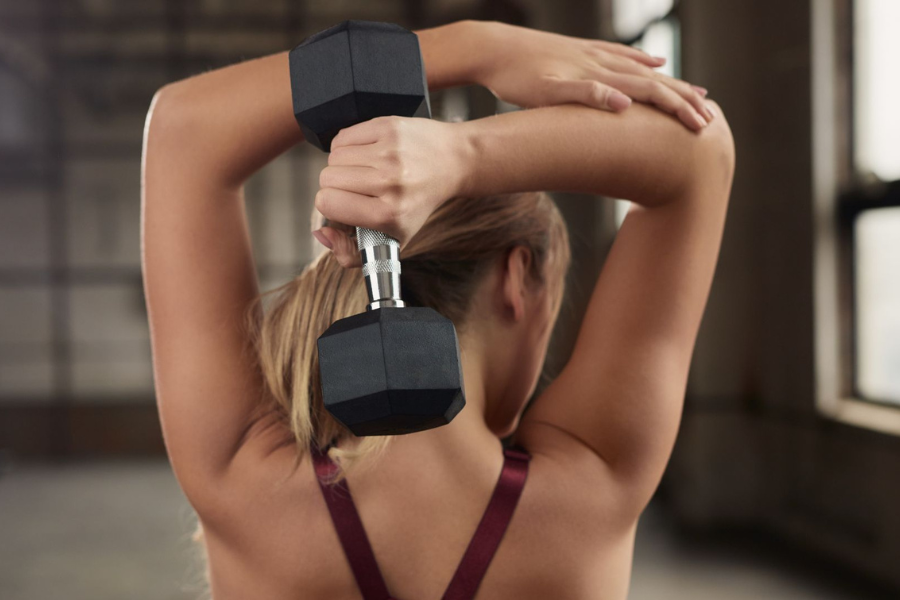
Overhead tricep extensions
-
Variations: dumbbell, cable, kettlebell, or weight plate
-
Why they work: They put your long head in a lengthened position which encourages growth.
-
Skull crushers (lying triceps extensions)
-
You lie on a bench and lower the weight toward your forehead or slightly behind your head.
-
Slightly angling your arms back keeps constant tension on the long head.
-
Pullover-style tricep movements
-
For example, pullovers that transition into a tricep extension, such as PRJ pullovers.
-
These combine shoulder and elbow extension, which the long head handles well.
-
Overhead cable extensions
-
Standing or seated with the cable behind you.
-
The constant cable tension keeps your long head working through the whole range.
Best lateral head tricep exercises
You hit the lateral head hardest with heavier loads, elbows close to your sides, and overhand or neutral grips. Research-based fitness guides point to these as strong choices:
-
Cable tricep pushdowns
-
Use a straight bar or rope with a pronated grip.
-
Keep your elbows tucked in and drive your hands down.
-
Dumbbell skull crushers
-
Particularly when you adjust your grip slightly so your palms face each other.
-
Heavier sets in the moderate rep range can bring out the lateral head.
-
Close-grip bench press
-
Hands a little narrower than shoulder width, elbows tucked.
-
Shifts emphasis away from chest and toward triceps, especially the lateral head.
-
Diamond push-ups
-
Hands close together under your chest, forming a diamond shape with your fingers.
-
A bodyweight option that lights up the lateral head when done with good form.
-
Tricep dips
-
On parallel bars or between benches.
-
The outer head contributes a lot as you press out of the bottom.
Best medial head tricep exercises
The medial head responds when your hands are underhand and close, and your arms are by your sides. Good options include:
-
Reverse grip cable pushdowns
-
Underhand, or supinated, grip with elbows locked to your sides.
-
Great for feeling that deep stabilizing burn near the elbow.
-
Lighter close-grip presses
-
For example, close-grip push-ups or machine presses with a controlled tempo.
-
Focus on range of motion and smooth control rather than maximal load.
While there are fewer direct medial head isolation moves, it is heavily involved any time you control the weight instead of bouncing it.
Combine compound and isolation moves
A well-rounded tricep heads workout combines:
-
Compound exercises
-
Work multiple muscle groups at once
-
Let you lift heavier and build overall strength
-
Isolation exercises
-
Focus tension on the triceps
-
Help you feel and target specific heads
Examples of compound moves that hit all three heads include:
- Bench press and close-grip bench press
- Overhead press and close-grip military press
- Push-ups and diamond push-ups
- Dips
According to a December 2019 Gymshark article updated in June 2024, combining compound lifts like barbell bench press with targeted isolation afterward is one of the most efficient ways to build tricep mass and strength.
You can think of it as:
- Use compound lifts to load your triceps heavy.
- Use isolation work to finish each head thoroughly.
Sample tricep heads workout
Here is a simple, balanced tricep session that you can add after a chest or upper body day. Adjust the weights so the last 2 reps of each set feel challenging but doable with good form.
Step 1: Heavy compound focus
- Close-grip bench press
- 3 to 4 sets of 6 to 8 reps
- Rest 1.5 to 2 minutes between sets
- Keep elbows close, lower with control, and press through the whole hand.
This targets all three heads, with increased emphasis on the lateral and medial heads.
Step 2: Long head emphasis
- Overhead dumbbell tricep extension
- 3 sets of 8 to 12 reps
- Rest 60 to 90 seconds
- Sit or stand tall, keep your elbows pointing forward, and lower the weight until you feel a strong but comfortable stretch.
- Skull crushers
- 3 sets of 10 to 12 reps
- Rest 60 to 90 seconds
- Slightly angle your arms back instead of straight up so your triceps keep tension at the top.
Both of these place the long head in a lengthened position, which current hypertrophy research suggests is ideal for growth.
Step 3: Lateral and medial head finisher
- Cable tricep pushdowns
- 3 sets of 10 to 15 reps
- Overhand grip, elbows tight by your ribs
- Rest 45 to 60 seconds
- Focus on a hard squeeze at the bottom for 1 or 2 seconds each rep.
- Reverse grip cable pushdowns
- 2 to 3 sets of 12 to 15 reps
- Underhand grip, lighter weight
- Control the lowering phase to let the medial head work.
If you prefer bodyweight, swap in diamond push-ups or bench dips as a burnout set to near technical failure.
Set, rep, and frequency guidelines
To turn your tricep heads workout into real growth, you need the right mix of volume, load, and recovery.
Recommended rep ranges and load
A 2024 Gymshark guide highlights common hypertrophy research that supports training in moderate rep ranges with moderate to heavy loads:
-
8 to 12 reps per set
-
Around 60 to 80% of your one-rep max
-
Ideal for most compound and heavier isolation work
-
12 to 15 reps per set
-
Light to moderate weights
-
Useful for finishers and exercises where joint comfort matters, like overhead extensions.
You can rotate between these ranges across the week. For example:
- Workout A: Slightly heavier, 8 to 10 reps.
- Workout B: Slightly lighter, 10 to 15 reps with extra focus on form and tension.
Weekly training volume
For most people looking to grow their triceps:
- Aim for 12 to 28 total sets per week for triceps
- Spread over at least 2 sessions per week
If you are newer to focused tricep training, start closer to 12 to 15 sets per week and gradually build toward the higher end if you recover well.
Form tips to protect your elbows
Because your triceps cross the elbow joint, form and control matter a lot. Common mistakes in tricep heads workouts include flaring elbows, using momentum, and skipping full range of motion.
Keep these cues in mind:
-
Lock in your elbows
During pushdowns and extensions, your upper arms should mostly stay still. Let your forearms do the moving. -
Avoid elbow flare
Flaring out to the sides shifts tension to your shoulders. Keep your elbows tucked but not jammed in. -
Use a full but comfortable range
Lower the weight until you feel a stretch but not pain, then extend fully without snapping your joint straight. -
Choose manageable loads
If you have to swing your body or cheat the first rep, the weight is too heavy. You want tension on the muscle, not strain on your joints. -
Breathe consistently
Exhale as you press or extend, inhale as you lower. Holding your breath on every rep can spike blood pressure and make form harder to control.
Listening to small warning signs like sharp elbow pain or grinding is important. Adjust grip, range, or weight before it becomes a real issue.
Progress, recovery, and support habits
Muscles grow when you combine smart training with enough recovery and nutrition. Your tricep heads workout is only part of the picture.
Progress gradually
- Increase weight once you can complete the top end of your rep range with good form on all sets.
- If you cannot add weight safely, slow your lowering phase to increase time under tension.
- Rotate exercise variations every 6 to 8 weeks to keep progress moving and joints happy.
Make recovery a priority
Your triceps need time to repair and grow:
- Leave at least 48 hours between hard tricep sessions.
- Sleep enough so your body can rebuild muscle tissue.
- Ease off volume if your elbows or shoulders stay sore for days.
Support growth with nutrition and hydration
Hypertrophy depends on more than just your workout plan:
- Eat enough total calories to support your training goal.
- Get sufficient protein across the day to help muscle repair.
- Drink water regularly so your joints and muscles function smoothly.
You do not need an extreme diet to grow your triceps. Consistently decent choices, paired with consistent training, will move you forward.
Putting it all together
When you build your tricep heads workout around how each head actually functions, you get more from every rep. To recap:
- Your triceps have three heads, and each responds best to specific positions and grips.
- The long head loves overhead and stretched positions, like skull crushers and overhead extensions.
- The lateral head stands out with heavy presses and pushdowns with elbows at your sides.
- The medial head supports and stabilizes, and responds well to underhand pushdowns and controlled pressing.
- Training in moderate rep ranges, with 2 or more sessions per week and 12 to 28 weekly sets, lines up with current hypertrophy research.
- Form, recovery, and sensible progression are what turn effort into visible, lasting results.
Choose two or three of the exercises that appeal to you most, plug them into your next upper body day, and pay attention to how your triceps feel. Over a few consistent weeks, you will notice your arms not only look fuller but also feel stronger whenever you push, press, or lift.
About the Author