Understand what builds a big chest
If you want a chest workout for muscle mass that actually transforms how you look and feel, it helps to know what you are trying to grow. Your chest is mainly the pectoralis major, which has three key regions:
- Upper chest (clavicular head)
- Mid chest (sternal head)
- Lower chest (abdominal head)
You build a bigger chest by:
- Training each region through different angles
- Using a mix of heavy compound lifts and lighter isolation work
- Working in a wide intensity range, roughly 30% to 90% of your one rep max (1RM), as long as your sets get close to failure
- Increasing volume and load over time with progressive overload
Research on hypertrophy training shows that you can grow muscle across that whole intensity range if you push your sets near failure and keep your total weekly volume high enough to stimulate growth while still allowing recovery.
Set your chest training plan
You can follow an effective chest workout for muscle mass by focusing on:
- 4 to 6 total chest exercises per week if you are an intermediate lifter who prioritizes hypertrophy
- Around 3 to 4 different chest exercises per workout when you train chest
- A mix of compound and isolation movements to hit your chest from multiple angles
If you are newer to lifting, start on the lower end with 2 to 3 dumbbell chest exercises per session using lighter weights to reduce injury risk and build good technique before you push harder.
Choose core exercises for chest mass
To grow every part of your chest, base your workouts on compound lifts, then add isolation moves to increase volume without beating up your whole body.
Mid chest focus
These moves emphasize the main body of your chest:
-
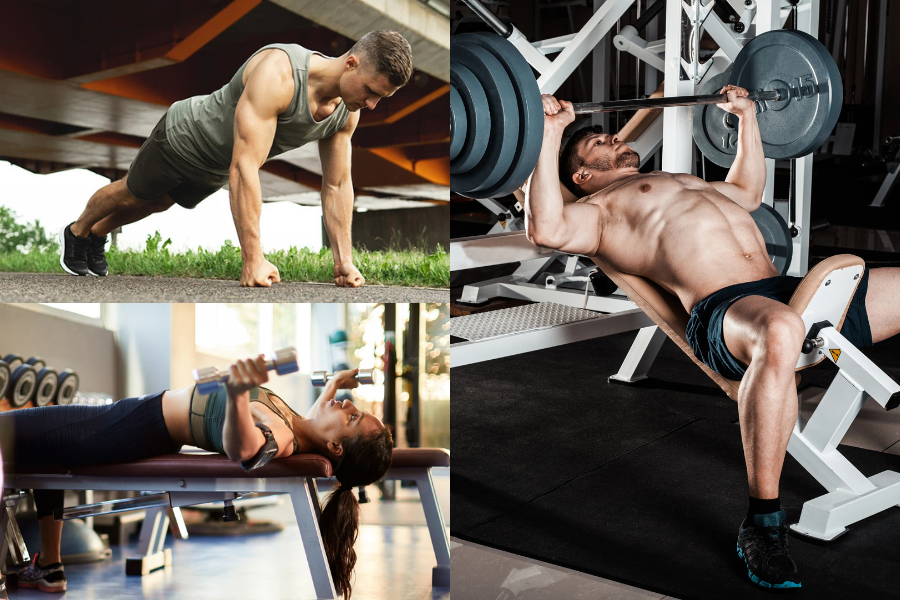
Barbell bench press
-
Great for overload on the mid chest.
-
Training idea: 3 to 5 sets of 6 to 8 reps, leaving 1 to 2 reps in reserve on most sets.
-
Dumbbell bench press
-
Similar muscle activation to barbell bench but with more range of motion and less fixed path.
-
Recommended 3 to 4 sets of 6 to 8 reps for strength and mass according to 2024 guidance from Men’s Health.
-
Dumbbells also allow each arm to work independently, which can help with imbalances and improve shoulder comfort.
-
Horizontal cable crossover
-
Works the chest fibers across the midline, which improves activation of the mid chest.
-
Use moderate weight and higher reps to really feel the squeeze.
-
One arm dumbbell bench press
-
Adds a unilateral challenge and forces your core and glutes to stabilize.
-
Helps correct left to right strength differences while still targeting the chest.
-
Dumbbell pullover
-
Stretches and then squeezes the chest through a large range of motion.
-
Focus on control and a strong contraction at the top.
Upper chest focus
To bring up the area under your collarbones:
-
Incline bench press (barbell or dumbbell)
-
Set the bench at about 15 to 30 degrees.
-
This angle lines up better with upper chest fibers so they do more of the work.
-
Low to high cable crossover
-
Start with the cables low and move up and in toward shoulder height.
-
This follows the fiber direction of the upper chest and keeps tension high.
-
Upper chest “upper cut” cable move
-
Think of driving your fist up and in like an uppercut.
-
Helps you feel a very focused squeeze high on the chest.
-
Lean back cable presses
-
Lean slightly back so the cables provide forward resistance.
-
This angle can improve upper chest activation compared with a flat push.
Lower chest focus
For the lower edge of your chest:
-
Weighted dips
-
Excellent overload for the lower chest when you lean slightly forward.
-
Keep your shoulders down and elbows a bit out to stay in the chest rather than triceps only.
-
High to low cable crossover
-
Start high and pull down and across your body.
-
This matches the downward fiber direction of the lower chest.
-
Jackhammer pushdowns
-
The elbow position targets the lower chest fibers more specifically.
-
Use smooth tempo and avoid jerking the weight.
-
Standing cable LC press
-
The path of the cable follows the natural direction of the lower chest fibers.
-
Another option to keep constant tension while sparing your shoulders.
Plan your weekly chest workout for mass
You can grow a bigger chest with a simple weekly plan that fits around the rest of your training. Here is a sample structure you can adapt.
Weekly structure
- Frequency: 1 to 2 chest focused sessions per week
- Total chest exercises: 4 to 6 different chest moves across the week for intermediates
- Volume:
- Compound lifts: 3 to 5 working sets
- Isolation lifts: 2 to 4 working sets
- Rep ranges:
- Compounds: 6 to 10 reps
- Isolation: 10 to 15 reps
- Effort: Take most sets close to failure, where you have about 0 to 3 reps left in the tank
You can keep all your chest work in one day, or split it across two days. Spreading your volume over multiple sessions can reduce fatigue and help you keep performance high across sets, as long as your weekly volume stays the same.
Follow a focused 28 day chest plan
If you prefer a structured short term push, you can use a 28 day plan that alternates two focused chest sessions that mix German volume style work and high effort bodyweight training.
Session one: Heavy press plus push up finisher
This session prioritizes overload and high effort:
- Barbell bench press
- 10 sets of 6 reps
- Rest 60 seconds between sets
- Choose a load that is challenging but lets you hit all sets with good form
- Push up variations, 60 seconds each
- Reverse grip push ups
- Incline push ups
- Clap press ups
- Rest 90 seconds between each 60 second effort
This mix floods the chest with blood and forces a lot of mechanical tension and metabolic stress, both of which drive hypertrophy.
Session two: Stretch and expand the chest
This session combines stretching and high rep work:
- Pectoral stretch
- Hold each side until the set time is up
- Focus on a comfortable stretch, not pain
- 45 degree incline dumbbell chest press
- 4 sets of 12 reps
- Rest 60 seconds between sets
- Flat dumbbell flye
- 3 sets of 12 reps
- Rest 60 seconds between sets
- Dumbbell incline fly
- 3 sets of 12 reps
- Rest 60 seconds between sets
- Dips
- 4 sets of 12 reps
- Rest 60 seconds between sets
Alternate session one and session two with two full rest days between each chest session to allow recovery and growth. This spacing gives your muscles time to repair and adapt during the 28 day period.
Try a dumbbell focused chest workout
If you train at home or just prefer dumbbells, you can still build serious chest muscle mass. Dumbbell training offers a greater range of motion than barbells and demands more stability, which can promote hypertrophy and coordination.
Dumbbell chest workout template
Use this as a stand alone chest session, 1 to 2 times per week:
- Flat dumbbell bench press
- 3 to 4 sets of 6 to 8 reps
- Focus on controlled lowering and a strong squeeze at the top
- Incline dumbbell press (15 to 30 degrees)
- 3 sets of 8 to 10 reps
- Targets the upper chest effectively when you control the range
- Dumbbell flyes (flat or incline)
- 3 sets of 10 to 15 reps
- Slight elbow bend, stretch under control, do not bounce at the bottom
- Crush grip dumbbell press
- 2 to 3 sets of 10 to 12 reps
- Hold two dumbbells pressed together and push straight up, focusing on squeezing your chest
- Decline dumbbell press (around 15 degrees) or floor press
- 3 sets of 8 to 10 reps
- Emphasizes the lower chest and can feel easier on the shoulders
If you are a beginner:
- Start with just 2 to 3 of these exercises per workout
- Use lighter weights and stop your sets with 2 to 3 reps left in reserve
- Focus on learning a smooth, pain free motion before you increase load or volume
Hypertrophy focused dumbbell training usually relies on higher total volume, higher rep sets, and more isolation work like flyes, taken close to failure compared with heavier, lower rep strength programs.
Build your chest at home without equipment
You can still follow a chest workout for muscle mass at home, even if you do not have a barbell or dumbbells. Bodyweight and resistance band moves can create a lot of tension and fatigue.
Home chest exercises
Try combining these:
-
Hands elevated press ups
-
Place your hands on a bench, step, or sturdy surface.
-
Good if regular push ups are still very challenging, or as a warm up.
-
Standard and decline push ups
-
Decline position (feet raised) shifts more work to the upper chest.
-
Typewriter press ups
-
Lower to one side, move across at the bottom, then press up on the other side.
-
Increases time under tension and hits each side more intensely.
-
Band resisted press ups
-
Loop a band across your back and hold the ends in your hands.
-
Makes the top of the movement harder where your chest is mechanically stronger.
Treat these like you would weight training: use multiple sets, push close to failure, and aim to improve by adding reps, slowing the tempo, or increasing band resistance over time.
Use progressive overload and smart volume
No chest workout for muscle mass will work for long if you repeat the same weights and reps forever. Progressive loading is what keeps your body adapting.
You can increase overload by:
- Adding small amounts of weight to the bar or dumbbells
- Doing more total reps with the same weight
- Adding an extra set for one or two key exercises
- Slowing the lowering phase to increase time under tension
- Shortening rest slightly once you can maintain performance
Training volume has a direct relationship with hypertrophy. More volume usually means more growth, up to a point. If you push volume so high that you are always sore, tired, or your performance drops sharply, you have gone past your recovery capacity.
Isolation exercises like cable flyes or dumbbell flyes are useful to increase volume without overloading the whole system, because they are less taxing than very heavy presses.
Dial in technique for better chest activation
How you perform each rep matters as much as which exercise you choose. A few technique cues can dramatically improve how much your chest is doing compared with your shoulders or triceps.
Use these form tips across most pressing and fly movements:
-
Engage your glutes and abs
-
Squeeze your glutes and brace your core lightly.
-
This stabilizes your body so your chest can push more safely and efficiently.
-
Control the lowering phase
-
Do not let the weight just drop.
-
Aim for 2 to 3 seconds down, then a powerful but controlled press up.
-
Keep shoulder blades tucked
-
Gently pull your shoulder blades back and down into the bench.
-
This opens your chest and protects your shoulders.
-
Squeeze your chest at the top
-
Actively contract your chest at the top of every rep.
-
This simple habit increases activation and helps you focus on the muscle you want to grow.
-
Stay close to failure, safely
-
On most working sets, stop when you feel you only have 0 to 3 clean reps left.
-
You do not need to fail every set to grow, especially on heavy barbell presses.
Put it all together
To grow big chest muscles with a focused workout, you need three things working together:
- Smart exercise selection
- Mix heavy presses and targeted isolation moves for upper, mid, and lower chest.
- Enough effort and volume
- Train in a wide rep and intensity range, but take your sets close to failure and accumulate solid weekly volume.
- Consistent progression and recovery
- Gradually increase load or reps, monitor fatigue, and give yourself enough rest, such as two days between demanding chest sessions in a high focus phase.
Pick one plan, such as the 28 day two session rotation or the dumbbell focused template, and commit to it for at least a month. Track your weights and reps, pay attention to how your chest feels, and adjust volume slightly up or down based on your recovery. With steady effort, you will see your chest size and strength move in the right direction.
About the Author