Understand what the “inner chest” really is
If you have ever stared at the mirror wishing the middle of your chest looked fuller or your “chest gap” were smaller, then you are already interested in inner chest exercises. The key is understanding what you can and cannot actually target.
Your inner chest is not a separate muscle. It is part of the pectoralis major, mainly the sternocostal head that attaches along your breastbone. You cannot isolate it completely, but you can choose exercises and angles that place more emphasis on the fibers that run close to the center of your chest.
Two principles guide every effective inner chest workout:
- Movements where your arms come together or cross your midline (adduction)
- Solid form, especially shoulder positioning and controlled range of motion
Once you keep those ideas in mind, the exercises below will feel a lot more purposeful and you will understand why certain tweaks in grip or angle make such a big difference.
Why inner chest work matters
Focusing on the inner chest does more than change your reflection.
- A fuller center line makes your entire chest look bigger and more “complete”
- Stronger pecs help with vertical and lateral movements in sports and everyday tasks
- Balancing inner and upper chest work reduces the “droopy” look that comes from only doing flat barbell bench presses
Now let us walk through specific movements that build a stronger, more defined inner chest.
Set up your chest safely
Before you jump into new inner chest exercises, it is worth setting up your body to handle more work without irritation or injury.
Warm up your chest properly
Cold, tight muscles limit range of motion and increase injury risk. A short warmup can help you feel your pecs working right away instead of just your shoulders and elbows.
Try this quick sequence before heavy pressing or fly movements:
- 3 to 5 minutes of light cardio to increase blood flow
- Shoulder circles and arm swings, front to back and side to side
- A couple of easy sets of wall or elevated push ups
According to experts at the Hospital for Special Surgery, a well rounded strength routine and attention to posture are essential to keep your chest muscles healthy, especially if you spend a lot of time at a computer or on your phone.
Protect your shoulders and posture
How you position your shoulders affects how much your inner chest contributes to each rep.
- Pinch your shoulder blades together before pressing. Retracting your scapulae and “locking” them into the bench or onto your ribcage creates a stable base and lets your pecs drive the movement.
- Keep your chest gently lifted, not flared. Picture a proud posture, not an exaggerated arch.
- Avoid shrugging. If your shoulders creep toward your ears, reset between sets.
Experts also recommend chest stretches, such as the doorway stretch or lying on a foam roller to open the front of the shoulders and chest, to combat tightness from daily device use and to help prevent overuse injuries like tendonitis or thoracic outlet syndrome.
Build a strong base with presses
Pressing movements are still the foundation of your chest routine, even when your goal is more inner pec definition. The trick is choosing variations and cues that favor the middle of the chest and upper fibers rather than just the lower pecs.
1. Dumbbell bench press
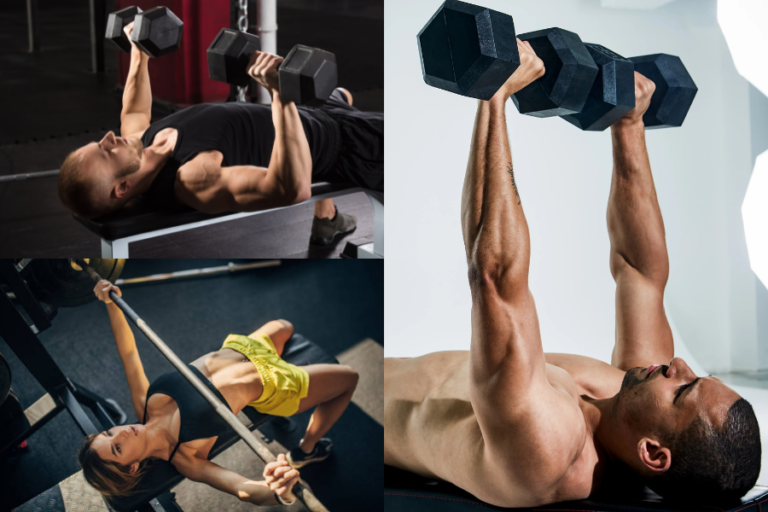
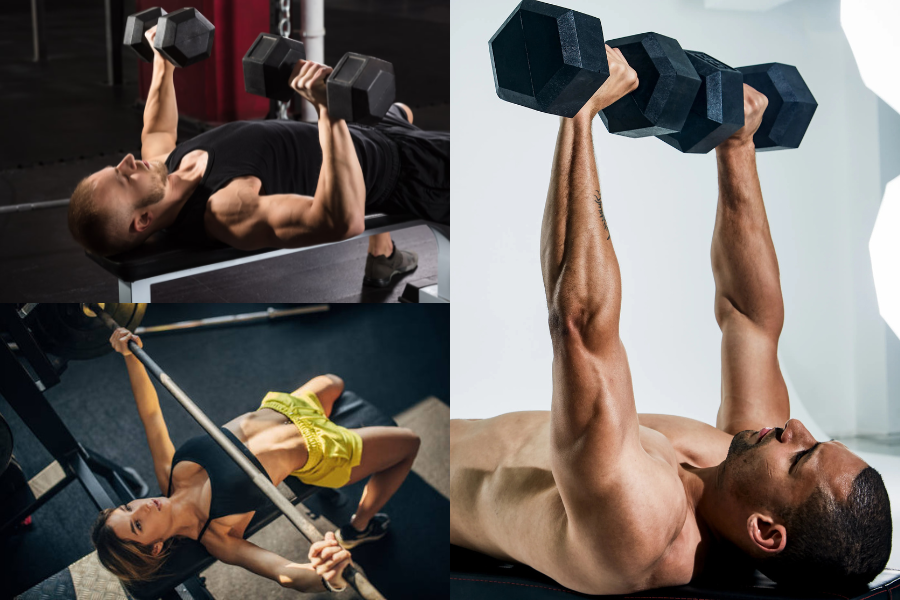
The dumbbell bench press is one of the best inner chest exercises for most people. Dumbbells allow a natural arc where your hands move slightly toward each other as you press, which encourages inner pec activation.
How to do it
- Lie on a flat bench with a dumbbell in each hand, feet planted. Pinch your shoulder blades together.
- Start with your arms bent and elbows slightly below shoulder level, palms facing forward.
- Press the weights up and slightly inward like you are tracing a narrow triangle with your hands. Stop just before the dumbbells touch.
- Lower under control until your elbows are just below the bench, feeling a stretch across the chest.
Form tips
- Think “squeeze chest, not lock elbows” at the top.
- Use a weight you can control for 8 to 12 reps without your shoulders rolling forward.
2. Incline dumbbell bench press
Your upper chest is naturally thinner than your lower chest. If you skip incline work, you can end up with a bottom heavy look that some people describe as “droopy.” An incline hits the clavicular fibers of the pecs and contributes to a higher, more athletic looking chest.
How to do it
- Set a bench to a low to moderate incline, about 20 to 30 degrees.
- Use the same setup as the flat dumbbell press: shoulder blades tight, feet planted.
- Lower the weights toward your upper chest, around the line of your armpits.
- Press up and slightly inward, again stopping just shy of the dumbbells touching.
Why it helps the inner chest
Incline pressing places more emphasis on shoulder flexion, which brings the upper and inner chest into play. Over time this balances out development from heavy flat pressing.
3. Close grip incline bench press
If you want to feel your inner chest firing, the close grip incline press is a powerful choice.
How to do it
- Set the bench to a low incline.
- Grip the barbell or EZ bar with hands placed just inside shoulder width. Avoid a very narrow “triceps only” grip.
- Lower the bar to the top of your chest, keeping your elbows under your wrists.
- Press up, focusing on squeezing your chest together as you extend.
Programming suggestion
- 3 to 4 sets of 6 to 8 reps with a challenging but controlled weight
The close grip and incline angle together increase inner upper chest recruitment, and the heavier loading helps build thickness through the middle of the chest.
4. Chest press machines and variations
Machine chest presses can be useful for building general chest strength and size, especially if free weights feel unstable at first. Strong pecs also provide better protection from impact and can even change how your clothing fits around your torso.
Use machines as a complement, not a replacement, for free weights. Free weight work usually engages more stabilizing muscles and was the backbone of many legendary chest physiques.
Key cues
- Keep the seat height so the handles line up with mid chest.
- Press with your elbows slightly tucked, not flared wide.
- At the end of each rep think “draw my biceps together in front of my chest” to enhance adduction.
Add fly style moves for direct inner chest focus
Presses build mass, but fly style inner chest exercises really emphasize the adduction you need near the sternum. These movements will not isolate the inner chest completely, but they are your best tools to highlight that area.
5. High to low cable fly
The high to low cable fly keeps constant tension on the pecs and makes it easy to adjust the line of pull so you feel the inner fibers working.
How to do it
- Set the cable pulleys slightly above shoulder height. Attach single handles.
- Stand in the center, one foot forward, slight lean into the cables.
- Start with arms out to your sides and elbows softly bent.
- Sweep your hands down and in, finishing around the level of your front pockets.
- Squeeze your chest hard at the bottom and slowly return to the starting position.
Why it works
The downward and inward path mimics the natural fiber direction of much of the pec major. Cables keep resistance on the muscles even when your hands come close together, which can be a weak point for dumbbell flyes.
6. Standard cable fly and cable crossover
Cable fly variations are classic inner chest builders because they revolve around bringing your arms toward or across your midline.
Standing cable fly
- Set the pulleys around shoulder height.
- With a slight forward lean, bring your hands together in front of your chest, palms facing each other.
- Focus on the squeeze, not how far back you can stretch.
Back supported cable fly (cable crossover)
- Place a bench between the cable stacks and sit with your back supported.
- Perform the same fly motion but let the bench control your posture.
Back support can be helpful if your shoulders feel irritated during standing flyes, and both versions can be programmed for 3 sets of 10 to 12 reps as suggested in some fitness guides.
7. Dumbbell chest fly and T bench fly
Dumbbell flyes are familiar, but they have a downside. The resistance drops off at the top when the dumbbells are directly over your chest, which is exactly where you want maximum inner chest tension.
Two simple tweaks can help:
Traditional dumbbell fly
- Stop the movement when the dumbbells are a few inches apart so you keep some load on the chest.
- Think of hugging a big tree: arms curved, elbows soft, chest doing the work.
T bench fly
The T bench fly is a variation where you lie across a bench sideways, forming a “T” shape with your body. This can let you use heavier weights while still protecting your shoulders and focusing on adduction.
- Position your upper back across the bench with hips slightly dropped.
- Perform flyes with slow, controlled lowering and a powerful squeeze at the top.
- Aim for about 3 sets of 10 to 12 reps.
8. Single arm chest fly
Unilateral work is a smart way to build the inner upper pec region while keeping stress on the shoulder joints manageable.
How to do it
- Set one cable pulley around shoulder height or slightly higher.
- Stand sideways to the stack, with the working arm holding the handle.
- With a slight bend in your elbow, pull the handle across your body until your hand reaches just past your midline.
- Think about drawing your bicep across your chest and pausing for a strong squeeze.
Single arm flyes with cables or resistance bands increase hypertrophy and muscular endurance, especially where the pec fibers meet near the center of your chest. You can also pair them with single arm bench presses for extra volume on a weaker side.
9. Hex press and pinch plate press
If standard flyes bother your shoulders, neutral grip presses like the hex press or pinch plate press are excellent alternatives that still hone in on the inner chest.
Hex press
- Lie on a flat bench with two dumbbells touching together along their sides.
- Press the dumbbells up and down as one unit while constantly squeezing them together.
- Keep your elbows close to your body and focus on tension through the middle of your chest.
Pinch plate press
- Stand or lie on a bench holding two weight plates flat between your hands, palms facing each other.
- Press the plates straight out from your chest while “crushing” them together.
- Keep steady pressure throughout the set.
Both moves use a neutral grip, which can be kinder to your shoulders and still drive serious inner chest engagement.
Use push ups as a versatile inner chest tool
You might not think of push ups as inner chest exercises, but small changes in hand position and angle make them highly effective and joint friendly.
10. Modified push ups for beginners
If classic push ups on the floor feel too challenging, modified versions let you build strength without sacrificing form or irritating your wrists or shoulders.
Options include:
- Wall push ups
- Push ups with hands on a sturdy bench or countertop
- Knee push ups on the floor
HSS experts recommend starting with these progressions to strengthen the chest safely and to avoid pain from improper form, especially if you are just getting into strength training or returning from a break.
11. Weighted or deficit push ups
Once you can do solid standard push ups, you can turn them into a powerful inner chest movement.
Try these tweaks:
- Place your hands just inside shoulder width to add a bit more adduction.
- Elevate your feet slightly to challenge the upper and inner chest.
- Add a weight plate or weighted vest when bodyweight alone feels easy.
Weighted push ups show up frequently in inner chest focused routines and offer a joint friendly way to chase strength and size.
Program your inner chest workout
To see visible changes in your inner chest, you need the right mix of exercises, rep ranges, and effort. You do not need a complicated plan, just a consistent one.
Choose a smart exercise mix
For a typical chest day that focuses on the inner region, you could structure your workout like this:
- Heavy compound press
- Close grip incline bench press or incline dumbbell bench press
- 3 to 4 sets of 3 to 8 reps
- Secondary press with stability focus
- Dumbbell bench press or weighted push ups
- 3 sets of 6 to 10 reps
- Fly style movement
- High to low cable fly or cable crossover
- 3 sets of 8 to 12 reps
- Finisher / pump exercise
- Hex press, pinch plate press, or single arm cable fly
- 2 to 3 sets of 10 to 15 reps, focusing on slow, controlled squeezes
Research based inner chest programs often recommend heavier weights and lower reps for compound lifts, combined with lighter loads and moderate reps for isolation style work. This combo hits both strength and hypertrophy.
Mind muscle connection matters
Inner chest development is very sensitive to how you perform each rep.
Use these cues on every set:
- Before lifting, tense your pecs slightly so you know where you should feel the work.
- During presses, picture your upper arms being drawn toward the midline of your body.
- During flyes, imagine you are hugging around something and trying to touch your elbows together.
- At the hardest point of each rep, pause for a one second squeeze rather than bouncing.
Focusing deeply on the contraction and the path of your arms helps your pec fibers near the sternum work harder, instead of letting your shoulders or triceps take over.
Avoid common chest training mistakes
A few habits can hold your inner chest progress back, even if you are doing the right exercises.
- Overreliance on flat barbell benching. Heavy benching is not bad, but making it your only chest exercise can overdevelop the lower chest and stress your shoulders, elbows, and wrists.
- Chasing ego lifting. When the weight is too heavy, form breaks down, your range shortens, and secondary muscles do more of the work. This slows chest growth.
- Only using machines. Machines have their place, but relying on them alone may limit total muscle development. Free weights often demand more stability and activation.
- Skipping warmups and stretches. Tight, cold pecs are more vulnerable to strains and tears, especially during high tension inner chest movements.
Remember that genetics influence things like the width of your breastbone and attachment points of your pecs. You cannot change your bone structure. What you can change is how full and strong the muscles look around that structure.
Keep your chest strong and healthy
As you increase your focus on inner chest exercises, it is important to keep long term shoulder and chest health in mind.
- Stretch after training with doorway or foam roller chest stretches to ease tightness.
- Balance pressing with pulling. Include rows and rear delt work in your weekly routine to support posture.
- Progress slowly. Add weight or volume in small steps to protect your pec tendons.
Chest muscle tightness and overuse without proper care can contribute to more serious issues like tendonitis or, in severe cases, pectoralis major tears, so think of mobility, warmups, and recovery as part of your chest program, not an optional extra.
Bringing it all together
If your goal is a fuller, stronger looking middle chest, you do not need to chase secret moves. You need a smart mix of:
- Compound presses that emphasize incline and close grip work
- Fly style movements that drive your arms toward or across your midline
- Thoughtful technique with strong mind muscle connection
- Respect for posture, warmups, and recovery
Pick two or three of the inner chest exercises above to add to your next workout and pay attention to where you feel each rep. With patient, consistent effort, your chest will gradually look and perform the way you want.
About the Author