A strong advanced hamstring workout does more than build the back of your legs. It protects your knees and lower back, boosts your deadlift, and helps you sprint, jump, or simply move with more confidence. When you are past the beginner stage, you need a plan that respects how the hamstrings actually work and how they recover.
Below you will find how to train your hamstrings like an experienced lifter, with science-backed guidance and practical templates you can start using this week.
Understand what makes hamstrings “advanced”
Your hamstrings are a group of three muscles that cross both the hip and knee joints. This biarticulate design means they help you both extend your hip and bend your knee. An advanced hamstring workout needs to challenge both of those movement patterns instead of repeating the same basic curl over and over.
You will mainly train your hamstrings with two types of exercises:
- Hip hinge movements like Romanian deadlifts or stiff-legged deadlifts
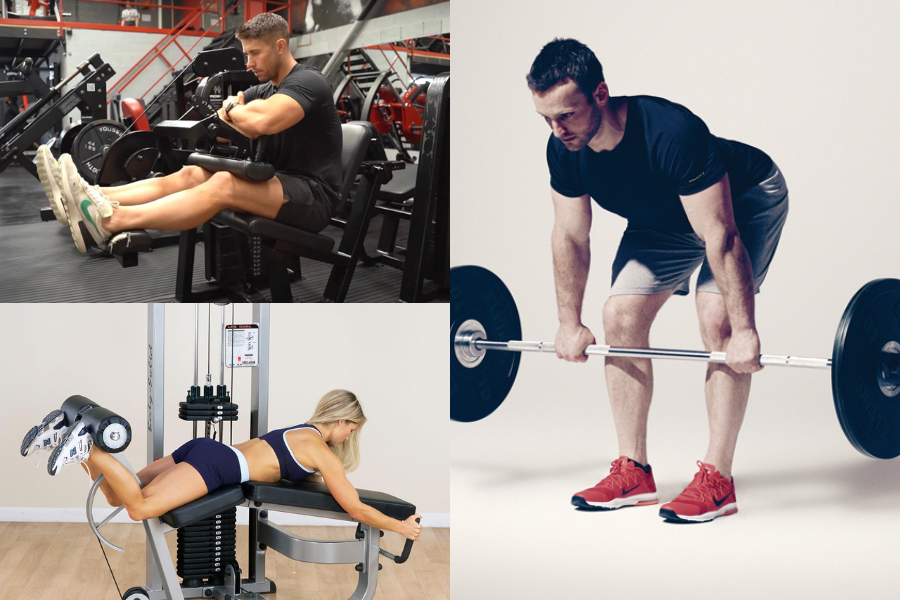
- Knee flexion movements like lying, seated, or standing leg curls
When you combine heavy hip hinges with higher rep curls, you target the hamstrings in different ranges and fiber types. This is the foundation of serious strength and muscle growth in the back of your legs.
Why advanced hamstring training matters
If you are lifting regularly, there is a good chance your hamstrings do not get the same attention as your chest or arms. That gap has real consequences. Tight, weak hamstrings often show up as lower back pain, recurring strains, or a deadlift that stalls just below the knee.
Eccentric-focused hamstring work is especially powerful here. A 2023 meta-analysis of 23 randomized controlled trials with 18,215 participants found that hamstring eccentric training cut lower extremity injuries by 28 percent and hamstring injuries by 46 percent, while also reducing knee injuries by 34 percent in athletes. That is a big payoff for a relatively small time investment.
For you, this means that the right advanced hamstring workout does not just improve how you look in shorts. It also lowers your risk of injury in the gym and in any sport or active hobby you enjoy.
Key principles for an advanced hamstring workout
Before you jump into exercises, it helps to have a simple framework. You can think of your plan in terms of frequency, exercise selection, reps, and rest.
Train hamstrings often enough, not all at once
Research and expert programming suggest that training hamstrings 2 to 3 times per week works best for strength and growth. You spread the total work across the week, so each session feels focused but not overwhelming.
You can do this by:
- Adding a hamstring focus to 2 lower-body days
- Or having 1 dedicated hamstring-and-glute session plus 1 leg day that includes hamstrings
Most lifters make better progress with lower total volume per session but more frequent exposure rather than trying to crush hamstrings once per week and then limping for days.
Use both hip hinge and leg curl variations
For complete development, aim for at least:
- One hip hinge exercise each week
- One leg curl variation each week
If you are very experienced or have a lagging posterior chain, you can run 2 hip hinge and 2 curl variations across the week, but you rarely need more than 2 or 3 different exercises in a single training cycle.
Match rep ranges to the exercise
Your hamstrings have to work hard to stabilize your spine on heavy hinges, so fatigue feels different from a simple curl. To keep things both safe and effective:
- Use mostly 5 to 10 reps for heavy hip hinge movements like Romanian deadlifts or stiff-legged deadlifts.
- Use 10 to 20 or even 20 to 30 reps for leg curl variations, where postural fatigue is lower and you can safely push close to failure.
This mix gives you plenty of heavy mechanical tension and the higher rep work that supports hypertrophy and connective tissue resilience.
Rest long enough to perform well
Rest times do not need to be identical across all hamstring exercises. Instead, use them to protect your performance:
- For heavy barbell hinges, rest up to about 3 minutes between sets so you can maintain technique and load.
- For seated or lying leg curls, rest can be as short as 30 to 60 seconds, since these do not tax your whole body as much.
A simple rule is to start your next set when you feel ready to give another productive effort, not when a stopwatch hits a specific number.
Best advanced hamstring exercises
You have many options, but a few lifts stand out for advanced lifters because they load the hamstrings heavily, in the right ranges, and with room for long-term progression.
Romanian deadlift (barbell or dumbbell)
The Romanian deadlift (RDL) is consistently ranked as one of the best advanced hamstring exercises because it hits the hamstrings in a lengthened position. You start from the top, hinge at the hips, keep a soft bend in the knees, and lower the weight under control until you feel a deep stretch in the back of your thighs.
You can use barbells, dumbbells, or kettlebells. A common prescription is 3 to 4 sets of 8 to 12 reps, focusing on slow, controlled eccentrics and a strong hip drive on the way up. This is also one of the key exercises highlighted in science-based hamstring hypertrophy guides, which stress its value for both strength and muscle growth.
Stiff-legged or conventional deadlift
The classic barbell deadlift is often described as one of the greatest tools for hamstring development because it lets you use a lot of weight while coordinating multiple joints. For a hamstring emphasis, a stiff-legged or closer-to-RDL style deadlift, where you push the hips back and keep the bar close, makes your posterior chain do more of the work.
You can program 3 sets of 6 to 8 reps here, leaving a couple of reps in reserve to protect your lower back. Think of this as your heavy, performance-oriented hinge.
Single-leg deadlift
When you stand on one leg and hinge, you force your hamstrings and glutes to stabilize your hip and your core to resist rotation. Single-leg deadlifts also recruit smaller stabilizers like the gluteus medius, which helps keep your pelvis level and your knees tracking well.
Because balance plays a big role, you might start with bodyweight or light dumbbells, then build toward 3 sets of 6 to 8 controlled reps per leg. This move is ideal if you notice one side is weaker or less stable than the other.
Bulgarian split squat
Bulgarian split squats, or rear-foot-elevated split squats, challenge your hamstrings, glutes, and quads one side at a time. When you hinge slightly at the hips and sit back into your front heel, you feel substantial hamstring involvement, especially in the stretched position.
For advanced lifters, 3 to 4 sets of 8 to 12 reps per leg with dumbbells work well. You can treat this as either your main single-leg strength movement or a tough accessory after heavy hinges.
Leg curl variations
Leg curls are where you can safely push intensity techniques like high reps, drops, or myoreps. Since you are not balancing a heavy barbell on your back or worrying about your spine, you can take these closer to failure with less risk.
Choose from:
- Seated leg curls
- Lying leg curls
- Standing or kneeling unilateral leg curls
Slow down each rep, especially on the way down, and work in the 10 to 20 or even 20 to 30 rep range. Research and coaching experience both suggest that controlling the full stretch and full contraction during curls is key for full hamstring activation.
Tip: Try finishing at least one curl set with lengthened partial reps at the bottom of the movement. This can give your hamstrings an extra growth stimulus without adding more total sets.
Eccentric-focused methods for strength and injury prevention
If you want both stronger hamstrings and fewer injuries, eccentrics deserve special attention. In eccentric training, you emphasize the lowering phase, where your muscles lengthen under tension.
A large review has shown that integrating eccentric hamstring training, such as Nordic curls and RDLs, can reduce hamstring injury risk by as much as 70 percent in some athletic settings while also improving performance. There is also emerging evidence in dance and performing arts. A 2024 study of female dance students found that a 6 week eccentric program using Nordic hamstring exercises plus single leg deadlifts significantly improved both hamstring strength and flexibility compared to static stretching and control groups, and it outperformed stretching alone for strength gains.
You can bring those benefits into your own training by:
- Lowering RDLs over a 3 to 4 second count before driving up
- Adding Nordic hamstring curls as a bodyweight accessory on a pad or lat pulldown machine
- Pausing briefly in the stretched position at the bottom of leg curls
The goal is not to turn every set into an ultra slow grind, but to include 1 or 2 sets per session where you clearly feel your hamstrings control the lengthening phase.
Sample 2 day advanced hamstring workout plan
Use this as a template and adjust loads to your current strength. Aim for 2 to 3 minutes of rest on big compound lifts and around 60 seconds on curls.
Day 1: Heavy hinge emphasis
- Romanian deadlift
- 4 sets of 6 to 8 reps
- Controlled 2 to 3 second lowering
- Bulgarian split squat
- 3 sets of 8 to 10 reps per leg
- Seated leg curl
- 3 sets of 12 to 15 reps
- Last set: add a short drop set by reducing weight and continuing to near failure
- Glute bridge or hip thrust
- 3 sets of 10 to 12 reps
- Focus on powerful hip extension
Day 2: Unilateral and high rep focus
- Single-leg deadlift
- 3 sets of 6 to 8 reps per leg
- Light to moderate weight, strict balance and control
- Conventional or stiff-legged deadlift
- 3 sets of 5 to 6 reps
- Heavier load, leave 1 to 3 reps in reserve
- Lying leg curl
- 4 sets of 10 to 20 reps
- Use slower eccentrics and a brief hold at peak contraction
- Back extension or reverse hyper if available
- 3 sets of 12 to 15 reps
- Think “hinge and squeeze” not just bending at the lower back
You can run this plan for 4 to 6 weeks. When sets feel comfortable, increase weight, reps, or both slightly so you keep progressing.
Progression and advanced techniques
To keep improving, your hamstrings need a gradually increasing challenge, not random punishment. You can build progression into your program by:
- Adding a small amount of weight every 1 to 2 weeks on hinges when reps are solid
- Increasing reps within your target range before bumping weight on curls
- Introducing down sets, where you reduce the load after heavy sets and focus on pristine form
- Occasionally using myoreps or drop sets on leg curls, while keeping heavy barbell work more conservative
For most advanced lifters, it helps to train hard but leave 0 to 4 reps in reserve on most sets. You do not need to fail every set to grow, and your hamstrings will thank you when you come back stronger rather than beat up.
Putting it all together
An effective advanced hamstring workout respects how your hamstrings function, how they respond to load, and how they protect your knees and lower back. When you train both hip hinges and leg curls, use smart rep ranges, and include some eccentric-focused work, you build strength, size, and resilience at the same time.
Pick one or two of the sessions above, add them to your weekly split, and track your lifts for the next month. You will likely notice not only stronger hamstrings, but also more stable squats, smoother deadlifts, and a lower chance of those nagging pulls that stop progress before it starts.
About the Author