A strong hamstring workout with dumbbells can do more for your lower body than you might expect. With just a few pairs of weights and some floor space, you can build strength, protect your knees and lower back, and boost your performance in everyday activities like walking, running, and climbing stairs.
Below, you will learn how your hamstrings work, the best dumbbell exercises to target them, and how to turn those moves into simple, effective workouts you can do at home or in the gym.
Why your hamstrings matter
Your hamstrings sit along the back of your upper legs and are made up of three muscles: the biceps femoris, semitendinosus, and semimembranosus. These muscles help you bend your knees and extend your hips, which makes them essential for walking, running, squatting, and jumping, as described in a 2021 article from Born Tough.
When your hamstrings are strong and flexible you are more likely to:
- Maintain better posture
- Reduce strain on your lower back and knees
- Accelerate and decelerate more safely in sports
- Recover smoothly from everyday movements like lifting or bending
Training your hamstrings with dumbbells is especially helpful because it lets you work each leg independently, which improves balance and corrects side-to-side strength differences. You also get more freedom of movement compared with machines, which can be easier on your joints.
How dumbbells train your hamstrings
You might think you need heavy machines to get an effective leg session, but dumbbells are more than enough to challenge your hamstrings.
According to Born Tough, properly performed dumbbell exercises can put maximum stress on your leg muscles and are effective for both toning and building muscle mass, even if the weights are lighter than typical machine stacks.
With a hamstring workout with dumbbells you can:
- Target the entire posterior chain, including hamstrings, glutes, and lower back
- Add unilateral work, for example, single-leg deadlifts, to fix imbalances
- Train in small spaces, using only a bench or even just the floor
- Adjust difficulty easily by changing reps, tempo, or range of motion
A careful, controlled motion is key. Hamstrings take a long time to recover, so rushing through reps or jerking the weight can lead to strain. Born Tough recommends starting with light weights, moving slowly, and progressing only when your form feels solid.
Form basics for safe dumbbell hamstring work
Most effective hamstring exercises with dumbbells involve some version of a hip hinge or a knee curl. Both patterns ask a lot from your lower back and knees, so good form is not optional.
When you train your hamstrings with dumbbells, keep these points in mind:
- Maintain a long, neutral spine, do not round or aggressively arch your back
- Keep a slight bend in your knees, never lock them out completely
- Move through the hips, not the lower back, when you hinge
- Use a slow, controlled tempo so the muscles, not momentum, do the work
- Stop immediately if you feel sharp or sudden pain rather than a steady muscle burn
That deep, steady burn you feel in your hamstrings during Romanian deadlifts or leg curls is a sign of effective muscle engagement. Sharp or pinching pain usually means your form is off, or the weight is too heavy.
Key dumbbell hamstring exercises
Below are some of the best hamstring exercises you can do with dumbbells, drawn from guidance by Born Tough and Gymshark.
1. Dumbbell Romanian deadlift (RDL)
The dumbbell Romanian deadlift is one of the most effective hamstring builders you can perform at home or in the gym. Gymshark notes that using dumbbells instead of a barbell can make the exercise easier for beginners and may reduce lower back strain because the load sits at your sides, not in front of you.
How to do it
- Stand tall with a dumbbell in each hand at your sides.
- Set your feet about hip width apart. Soften your knees slightly.
- Brace your core and keep your chest open.
- Push your hips back as if you are trying to close a car door with your glutes, letting the dumbbells travel down the front or sides of your legs.
- Keep your spine neutral and the weights close to your body.
- Lower until you feel a strong stretch in your hamstrings, usually around mid-shin.
- Drive through your heels and squeeze your glutes to return to standing.
Important cues
- Think of “hinge at the hips” instead of “bend forward”
- Keep your knees slightly bent the entire time, do not lock them
- Avoid rounding the back, which can shift stress to the spine
Research cited by Born Tough and Gymshark notes that Romanian deadlifts can achieve 75 to 100 percent activation in the hamstrings and 60 to 75 percent in the glutes when performed with proper form, which makes them a cornerstone of any hamstring workout with dumbbells.
A typical strength-focused prescription is 4 sets of 6 to 8 reps for heavier training, as suggested in the Gymshark guide.
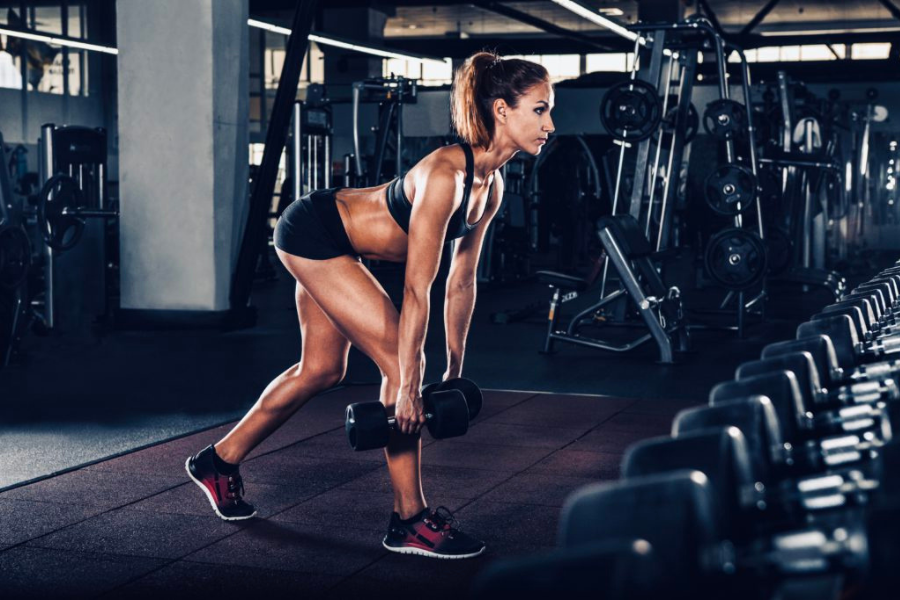
2. Single-leg dumbbell Romanian deadlift
The single-leg Romanian deadlift takes the standard RDL and shifts the focus to one leg at a time. Gymshark highlights this variation as one of the best for targeting the biceps femoris and improving balance and stability.
How to do it
- Hold one dumbbell in the hand opposite the working leg, or use two lighter dumbbells.
- Stand on your working leg with a soft bend in the knee.
- Keeping your hips square to the ground, hinge at the hip and let your torso tip forward.
- Allow your non-working leg to extend behind you as a counterbalance.
- Lower the dumbbell until you feel a stretch in your hamstring, then drive through the heel to stand tall.
This move challenges your hamstrings, glutes, and small stabilizing muscles in your ankles and hips. It also exposes and helps fix left-right strength differences that can contribute to injury if ignored.
3. Dumbbell deadlift
The conventional dumbbell deadlift uses more knee bend than the Romanian version and involves quads as well as hamstrings and glutes. Born Tough recommends 3 sets of 12 to 15 reps for a muscle building focus.
How to do it
- Stand with dumbbells in front of your thighs, feet about hip width apart.
- Push your hips back and bend your knees to lower the dumbbells toward the floor.
- Keep your chest lifted and your spine neutral.
- Once the dumbbells reach mid-shin or just above the ground, push through your feet to stand up and squeeze your glutes at the top.
Compared with barbell squats, dumbbell deadlifts may use lighter loads but still challenge your legs, core, lats, and traps. They are a practical alternative if you train at home or without access to a rack.
4. Lying dumbbell leg curl
The lying dumbbell leg curl is one of the few true isolation moves in a hamstring workout with dumbbells. It targets all three hamstring heads and also improves knee stability by strengthening the tendons and ligaments around the joint.
How to do it
- Lie face down on a bench or mat with your legs extended.
- Place a light dumbbell vertically between your feet and squeeze your feet together to hold it.
- Brace your core and keep your hips pressed into the surface.
- Slowly curl your heels toward your glutes in a controlled arc.
- Pause briefly at the top, then lower the dumbbell back down with control.
Focus on smooth movement and avoid swinging your legs. If holding the dumbbell feels shaky, use a lighter weight until your coordination improves.
5. Weighted glute bridge
Weighted glute bridges primarily train your glutes, but they also work your hamstrings and lower back. Born Tough suggests 3 sets of 10 reps as a solid starting point.
How to do it
- Lie on your back with knees bent and feet flat on the floor, hip width apart.
- Place a dumbbell across your hips and hold it securely with your hands.
- Brace your core and press through your heels to lift your hips until your body forms a straight line from shoulders to knees.
- Squeeze your glutes at the top, pause, then lower your hips back to the floor with control.
You can progress this move by elevating your shoulders on a bench for a hip thrust variation, or by performing it on one leg to increase the hamstring challenge.
6. Other useful dumbbell moves
Born Tough also recommends including the following in your lower-body routine to hit your hamstrings from different angles:
- Dumbbell elevated hip thrust
- Dumbbell good morning
- Dumbbell sumo squat
- Reverse dumbbell lunge
- Weighted swings
Bulgarian split squats, performed with dumbbells at your sides, are another valuable unilateral exercise for the posterior chain, according to Gymshark. They heavily involve both glutes and hamstrings while also improving balance and hip stability.
Sample hamstring workouts with dumbbells
You can build a complete hamstring workout with dumbbells using just a handful of the exercises above. Here are a few simple templates you can adapt to your equipment and fitness level.
Aim to perform these workouts one or two times per week, with at least one full day of rest between sessions so your hamstrings can recover.
Beginner routine
If you are new to strength training or returning after a break, start with lighter weights and higher control.
- Dumbbell Romanian deadlift, 3 sets of 10 to 12 reps
- Lying dumbbell leg curl, 3 sets of 12 reps
- Weighted glute bridge, 3 sets of 10 to 12 reps
Rest 60 to 90 seconds between sets. Focus on feeling your hamstrings and glutes work rather than chasing fatigue.
Intermediate routine
Once your form feels solid and you can control the weights, increase the challenge.
- Dumbbell Romanian deadlift, 4 sets of 8 to 10 reps
- Single-leg Romanian deadlift, 3 sets of 6 to 8 reps per side
- Dumbbell deadlift, 3 sets of 10 to 12 reps
- Weighted glute bridge or hip thrust, 3 sets of 8 to 10 reps
Rest 60 to 120 seconds between sets. You can gradually increase weight or slow down your lowering phase to add difficulty.
Advanced ideas
For a more advanced hamstring workout with dumbbells, you can:
- Use tempo RDLs, for example, three seconds down, one second up
- Combine leg curls with hip bridges into a hybrid set
- Add bands to your RDLs or bridges for extra tension
Stop a set when you feel your form starting to break down, even if you have reps left in your plan. Quality matters more than volume for both results and injury prevention.
Stretching and recovery for your hamstrings
Strength without flexibility can limit your performance. To keep your hamstrings healthy, pair your dumbbell training with mobility work.
Born Tough and Gymshark highlight several effective stretches and drills, including:
- Hamstring Scoop
- Hamstring Flossing
- Standing Hamstring Stretch with flat foot
These movements help maintain range of motion, reduce tightness after heavy sessions, and lower your risk of strains when you run, jump, or change direction quickly.
After a hamstring focused day, give your muscles time to recover. Light walking, gentle stretching, and adequate sleep can go a long way toward getting you ready for your next session.
Putting it all together
A focused hamstring workout with dumbbells does not require complicated equipment or long routines. By learning a few key exercises, such as Romanian deadlifts, single-leg variations, deadlifts, leg curls, and glute bridges, you can build stronger, more resilient legs wherever you train.
Start with a level that matches your current strength, move slowly and with control, and pay attention to how your body feels. Over time, your improved balance, power, and stability will show up not just in your workouts, but in every step, jump, and lift you perform during the day.
About the Author