A lot of lifters train hard and still feel like their calves never change. High rep calf workouts can be a simple way to finally see growth, as long as you use them with the right exercises, range of motion, and weekly structure.
Below, you will see how to build easy high rep calf routines, how often to train, and what to focus on in each rep so you get more than just a burning sensation. You will also see how to blend high reps with heavier work so your calves get a complete growth signal, not just a pump.
Why high rep calf workouts work
Your calves are working all day while you walk, climb stairs, or stand in place. That constant low level effort means they are very resistant to fatigue and quite used to light, repetitive work. High rep calf workouts give them a stimulus that is harder and more targeted than daily activity, without needing very heavy weights.
Research summarized by Gymshark notes that your calf muscles are largely slow twitch, which means they respond especially well to higher volume and lower load training compared with many other muscles. In a 2020 study reviewed in that article, Brad Schoenfeld and colleagues found that increases in calf muscle thickness were similar regardless of how heavy the weights were, as long as you pushed sets with real effort. This suggests that your intensity and effort level are more important than chasing max weights.
High rep training in the 20 to 30 rep range is very productive for most lifters and can be as effective as the more common 10 to 20 rep range when it comes to calf growth. When you pair that with a good range of motion and smart weekly planning, you give your calves a very strong reason to grow.
Key principles for calf growth
Before you start any specific routine, it helps to understand a few basic rules that apply to most effective high rep calf workouts.
The first principle is using a full range of motion. Many people bounce up and down with their knees locked and their ankles barely moving. That short, rushed motion reduces tension where you want it most. You want a deep stretch at the bottom and a hard squeeze at the top of every rep to fully load the calf.
The second principle is effort. Since lighter weights can build calf size as long as you work hard, you should pick loads that let you reach close to failure in the target rep range. If you comfortably stop at 20 reps when you could do 40, you are not giving the muscle enough challenge.
The third principle is variety. Your calves contain both fast and slow twitch fibers and they help with both sprinting and endurance tasks. They respond well when you mix heavy sets of 5 to 10 reps, moderate sets of 10 to 20, and lighter, high rep sets of 20 to 30. If you always use the same rep range, your body adapts and progress slows.
Finally, weekly frequency matters. Training calves once per week is usually not enough. Because they recover quickly, most people do better with 2 to 3 focused sessions each week, and more advanced lifters may go up to 4 to 6 smaller sessions at a manageable volume.
Best exercises for high rep training
You do not need a long list of fancy exercises to grow your calves. You mainly want two categories of movements, one with a straight knee and one with a bent knee.
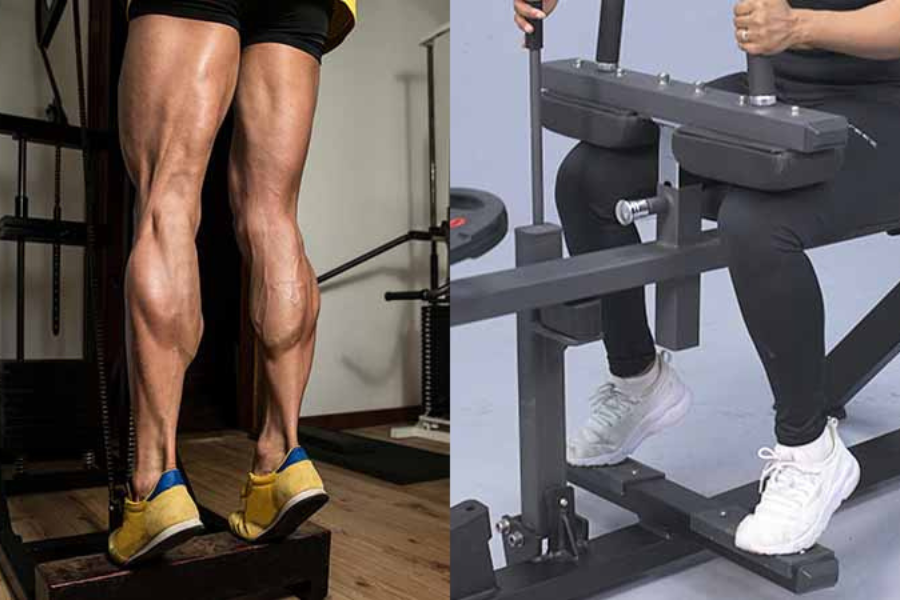
Straight knee exercises like standing calf raises target the gastrocnemius, the larger, more visible muscle that gives your calves a rounded shape. You can do these on a standing machine, a leg press (pressing through the balls of your feet), or even on a step holding dumbbells. The key is to keep your knees almost locked so the gastrocnemius does most of the work.
Bent knee exercises like seated calf raises shift more of the load to the soleus, the deeper calf muscle that is very important for posture and endurance. The soleus is primarily slow twitch, so it responds especially well to higher repetition work. Seated raises can be done on a machine, with a barbell or dumbbell across your thighs, or with a resistance band if you train at home.
If you want more complete lower leg development, you can also include tibialis anterior work, such as toe raises, to build the muscles along the front of your shin. This is especially useful if you run or jump often, since it can support injury prevention and better ankle control.
How to perform each rep correctly
High rep calf workouts only pay off if you make each repetition count. That starts with positioning, then continues with tempo and focus through the entire set.
Begin each rep from a controlled, stretched position. This means you lower your heels below the level of your toes, not just to the floor. If your gym setup does not allow this easily, you can stand on a small weight plate or block so your heels can drop further. A deeper stretch increases the range of motion and loads the calf more fully.
From that bottom position, drive through the balls of your feet until your heels rise as high as they comfortably can. A useful cue is to imagine trying to show the bottom of your shoe to someone behind you. Research points out that a common mistake is skipping this hard contraction at the top, which reduces the mind muscle connection and limits your range of motion. Squeezing for a brief pause at the top of each rep keeps tension where you want it.
Throughout the movement, avoid bouncing or relying on momentum. In high rep sets it is tempting to speed up as the burn builds, but that often shifts the work to your Achilles tendon instead of the muscle. Use a smooth, deliberate tempo, with a controlled descent and a strong, but not jerky, push upward.
Between sets, light stretching of the calves can help maintain mobility and may support a better pump. Some physiotherapy approaches use this combination of high rep loading and progressive stretching as part of calf rehab and endurance building, since it safely increases tissue tolerance over time.
Simple high rep calf routine for beginners
If you are new to focused calf training, start with a short routine you can add at the end of your regular workouts two or three days per week. This beginner plan uses basic movements and a moderate session length so you can build consistency without dragging out your gym time.
Here is a simple structure to follow:
- Standing calf raises
- 3 sets of 10 to 12 reps
- Full stretch at the bottom and hard flex at the top on every rep
- Choose a weight that makes the last 2 reps feel challenging but controlled
- Seated calf raises
- 3 sets of 10 to 12 reps
- Pause briefly at the top of each rep to feel the soleus working
- Again, pick a load that slows you down but does not break your form
Aim to train calves on nonconsecutive days, for example Monday, Wednesday, and Friday. This gives your muscles time to recover while still providing a frequent signal to grow. Over a few weeks, you can slowly increase the weight or add a rep or two to each set to keep making progress.
Progressing to focused high rep sessions
Once you are used to regular calf work and want more of a high rep focus, you can shift part of your weekly volume into the 20 to 30 rep range. Remember that research suggests this range can be as effective as moderate reps for calf hypertrophy when you train hard.
A simple way to structure your week is to split your sets like this:
- About half of your calf sets in the moderate 10 to 20 rep range
- The remaining half split between heavy 5 to 10 rep sets and light 20 to 30 rep sets
For example, if you do 12 total sets of calf training per week, your breakdown might be:
- 2 sets heavy (5 to 10 reps)
- 6 sets moderate (10 to 20 reps)
- 4 sets high rep (20 to 30 reps)
You can put the heavier work earlier in the week when you are fresh, then use the high rep sessions later in the week when fatigue is a bit higher. This sequencing reduces injury risk because you are not constantly loading your calves with heavy weights at the same time you are tired.
On your high rep days, keep the same form standards as before, but reduce the weight so you can reach 20 to 30 reps with good control. Expect a strong burning sensation in the last 5 to 10 reps. That feeling is normal, and as long as your technique stays solid, it is part of what signals your calves to adapt.
Weekly training structures that work
As your calves adapt, you can increase training frequency and volume within reason. Programs that use 3 to 6 calf sessions per week are feasible when you keep the total number of hard sets within your own recovery limits.
For most people, a practical weekly structure might look like one of these options:
- Two full body days with moderate calf work and one extra day focused on high rep calves
- Three lower body days where you add a short calf finisher at the end of each workout
- Four to five weekly sessions where you sprinkle in smaller calf blocks, rotating exercise types
When you raise frequency, rotating your main exercise each day helps manage wear and tear. You might use standing calf raises one session, leg press calf presses the next, and then a stair or step based calf movement after that. This variety changes the angle and loading slightly, which can help avoid overuse issues from repeating the exact same stress pattern.
Physiotherapy approaches to calf rehab often rely on increasing repetition ranges in bent and straight knee raises as a key progression strategy. They use methods like moving from 3 sets of 10 to 3 sets of 15, then maybe to 4 sets of 12, in order to build endurance and strength safely over time. You can borrow the same idea in your training: raise reps or sets gradually rather than jumping straight to very high volumes.
Avoiding common high rep mistakes
High rep calf workouts are simple, but some habits can quietly hold your progress back. Paying attention to a few details will help you get more out of every minute you spend on calf work.
The first mistake is not going through a full range of motion. When you only move in the top half of the rep, you miss the deep stretch at the bottom that is so important for loading the muscle. Using a small platform, step, or weight plate to elevate your toes can make it easier to sink your heels lower.
A second mistake is letting the weight be too heavy. If your heels barely rise an inch off the ground and your ankles are shaking from the first rep, you have gone too heavy for proper high rep training. Lighter weights that allow your heels to travel through a full range and still challenge you in the 20 to 30 rep zone are a better choice.
A third mistake is training only one position. If you always do standing calf raises with your knees straight and your feet in the same direction, your calves adapt quickly and growth slows. You will get better results if you pair standing and seated work and occasionally vary your foot angle so your toes point forward, inward, or outward. The Gymshark guide specifically suggests using different foot angles in high rep sets to target all parts of the gastrocnemius more effectively.
Finally, do not forget recovery. Your calves can handle frequent training, but they still need rest, good nutrition, and basic self care. Gentle stretching between sets and after your workout supports mobility and may enhance your muscle pump. Over time this combination of hard work and consistent recovery helps your lower legs stay strong and resilient, which is important for running, jumping, and daily movement.
Putting it all together
If your calves have been stuck for a while, you do not need a complicated plan to change that. You mainly need consistent training, attention to technique, and a mix of rep ranges with a clear place for high rep work.
Start by adding two or three short calf sessions each week using both standing and seated raises. Focus on a deep stretch and hard contraction in every rep, and gradually build up to sets of 20 to 30 reps that truly challenge you. Over time, blend in some heavier work early in the week and keep a couple of high rep sessions later in the week.
With this approach, your high rep calf workouts become more than just a burn. They become a simple, reliable way to add strength, shape, and endurance to a muscle group that supports almost everything you do on your feet.
About the Author