Why focus on a dumbbell tricep workout
If you want stronger, more defined arms, a consistent dumbbell tricep workout belongs at the center of your routine. Your triceps make up a surprising amount of your upper arm, and they play a big role in pushing, lifting, and stabilizing your shoulders and elbows.
The triceps sit on the back of your upper arm and have three heads, the long, lateral, and medial heads. Together, they straighten your elbow and support your shoulder during overhead lifts, working as the opposite, or antagonist, to your biceps. Since the triceps make up roughly two thirds of your arm mass, prioritizing them is one of the most efficient ways to build visible arm size and strength, and to boost pressing moves like push ups, bench presses, and overhead presses.
Dumbbells are especially useful for tricep training because they let you move through a wide range of motion, train each arm separately, and challenge your stability across multiple planes of movement.
In the guide below, you will learn:
- How to perform key dumbbell tricep exercises with safe, effective form
- A sample dumbbell tricep workout you can do at home
- Simple progressions to keep seeing results over time
You can follow the full routine or pick a few moves to add to your existing program.
Understand your triceps
Before you start lifting, it helps to know what you are targeting.
The three heads of the triceps
Your triceps brachii has three parts:
- Long head: Runs from your shoulder down the back of your arm and helps with both elbow extension and shoulder stability.
- Lateral head: The outer part of the tricep that often gives the arm a more “cut” look.
- Medial head: Sits deeper underneath and assists with elbow extension, especially during lighter tasks and at the end of a press.
Together, they extend and straighten the elbow and help stabilize your shoulder when you lift overhead.
Why tricep training matters
Consistent dumbbell tricep work can help you:
- Increase arm size and definition
- Improve strength in pressing movements like push ups and bench presses
- Support shoulder health and reduce the risk of pain in the shoulder, hand, and forearm
- Build functional strength for everyday push and lift tasks
Since your triceps take on such a large share of arm size, focusing on them gives you more visible return for your time.
How to structure your dumbbell tricep workout
You can organize a dumbbell tricep workout in several ways, but a simple approach works well.
Basic guidelines
- Train triceps 2 to 3 times per week
- Place your tricep work after compound pushes like push ups or bench presses so you are not pre-fatigued
- Aim for 3 to 4 exercises per workout
- Perform 2 to 4 sets of 8 to 12 reps for muscle gain, or 12 to 15 reps with lighter weights for more endurance and toning
- Rest 60 to 90 seconds between sets
Peloton coaches recommend including triceps kickbacks and related moves two or three times weekly, either as part of an upper body day or paired in supersets with biceps curls for balanced arm training.
Sample dumbbell tricep workout
You can do this entire routine with one or two pairs of dumbbells:
- Close grip dumbbell bench or floor press
- Lying dumbbell triceps extension
- Dumbbell triceps kickback
- Overhead single arm tricep extension
If you are newer to strength training, start with 2 sets of each exercise. If you are more experienced, use 3 to 4 sets.
Key tricep exercises with dumbbells
Below are some of the most effective dumbbell tricep exercises highlighted by coaches and fitness publications like Men’s Health UK. Each includes form tips so you get the most from every rep.
Close grip dumbbell bench or floor press
This move is a strong dumbbell alternative to the barbell close grip bench press for building tricep strength and muscle, with less stress on the shoulders due to the elbow positioning.
How to do it
- Lie on a flat bench or on the floor, knees bent, feet flat.
- Hold a dumbbell in each hand at chest level with your palms facing each other.
- Tuck your elbows close to your torso. Do not let them flare wide.
- Press the dumbbells straight up until your elbows are almost locked out.
- Lower under control until your upper arms are just above your torso, then press again.
Tips for better form
- Keep your elbows close to your sides throughout the movement to maximize tricep activation.
- Do not bounce the weights off your chest or rush the lowering phase.
- If your shoulders feel strained, switch to the floor variation, which limits range of motion and can feel more joint friendly.
Lying dumbbell triceps extension
This exercise focuses on the long head of the triceps by placing your arms overhead and giving the muscle a deep stretch.
How to do it
- Lie on a bench or on the floor, holding a dumbbell in each hand above your chest, arms straight.
- Angle the dumbbells slightly backward so they are not directly above your shoulder joints.
- Keep your upper arms still and bend your elbows to lower the dumbbells toward your forehead or just behind your head.
- Pause when you feel a stretch in your triceps.
- Press the dumbbells back up by straightening your elbows, keeping that slight backward angle so tension stays on the triceps.
Tips for better form
- Move only at the elbow, not the shoulder. Your upper arms should stay mostly fixed.
- Do not let the dumbbells drift directly above your chest at the top, that can reduce tension and turn this into more of a chest exercise.
- Start light until you feel confident controlling the arc.
Dumbbell triceps kickback
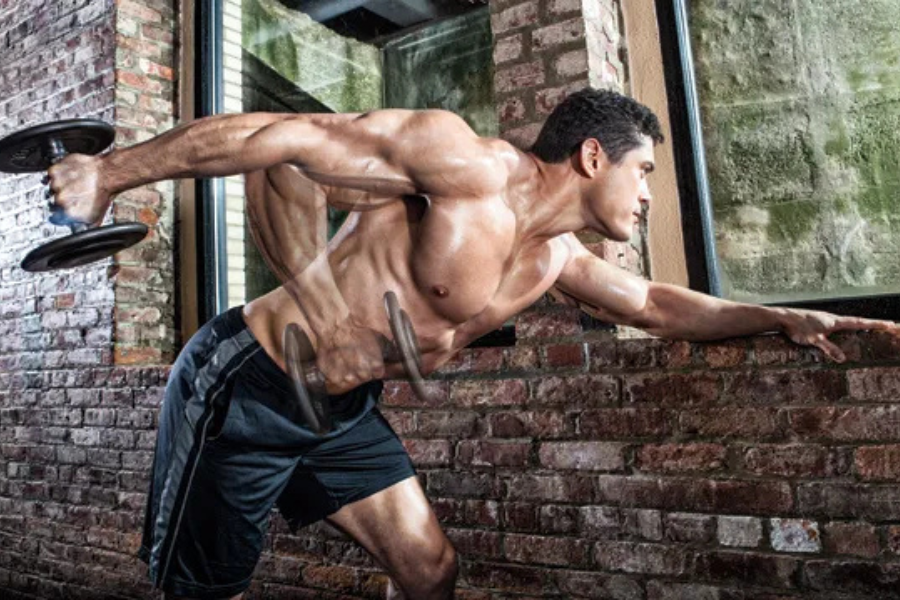
The triceps kickback is an isolation move that mainly targets the long head while also engaging the lateral and medial heads. It is especially effective for achieving full contraction and maximum shortening of the triceps, thanks to the arm position behind the body.
How to set up
You can perform tricep kickbacks with one arm supported on a bench or in a standing position.
- Hold a light dumbbell in one hand.
- Hinge forward at your hips with a straight back. Keep your chest lifted and your core braced.
- Bend your working elbow to about 90 degrees so your upper arm is in line with your torso.
- Tuck your elbow close to your side and keep your chin gently tucked to maintain neck alignment.
Leaning on a bench with your non-working hand can help you maintain a neutral spine and reduce lower back strain.
How to do the kickback
- From the hinged position, exhale and extend your arm straight back by straightening your elbow.
- At the top of the movement, your arm should be straight and slightly behind your torso, where the triceps are fully contracted.
- Pause briefly and squeeze the back of your arm.
- Inhale and slowly return to the starting position with control, stopping at about 90 degrees of elbow bend.
You can perform this exercise with one arm at a time for more focus and core stabilization, or with both arms simultaneously to save time.
Form and safety notes
- Use a lighter weight than you expect so you can keep your upper arm in line with your body. Heavy weights often cause the shoulder to drop and reduce tricep engagement.
- Avoid swinging the weight. If you need momentum, lower the load.
- Keep your elbow glued to your side instead of letting it drift away from your torso.
Peloton experts recommend including dumbbell triceps kickbacks two or three times per week as part of an upper body routine to improve arm definition, functional strength, and joint stability around the elbows and shoulders.
Overhead single arm dumbbell tricep extension
This move challenges the long head of the triceps and builds shoulder stability.
How to do it
- Sit or stand tall with feet about hip width apart.
- Hold one dumbbell overhead in one hand, arm straight but not locked.
- Keep your upper arm close to your head and your biceps near your ear.
- Bend your elbow and slowly lower the dumbbell behind your head.
- Pause, then straighten your elbow to bring the weight back overhead.
Tips for better form
- Keep your ribs down and core engaged so you do not over arch your lower back.
- If your shoulder mobility is limited, try a lighter weight and shorten the range of motion slightly.
- Switch arms after completing all reps on the first side, or alternate sides set by set.
Alternate arm row into kickback
This combination move can be part of a time efficient dumbbell tricep workout at home, especially when you want to hit your back and triceps in one sequence.
How to do it
- Stand with feet hip width apart and hinge forward at the hips with a flat back.
- Hold a dumbbell in each hand with your arms hanging straight down.
- Row one dumbbell up toward your ribs, keeping your elbow close to your body.
- From that row position, extend your elbow into a kickback.
- Reverse the motion to return to the row, then lower the dumbbell to the start.
- Repeat on the other side.
Why it works
- The row phase engages your back and helps you find a stable upper arm position.
- The kickback phase isolates your triceps in a controlled, functional pattern.
Tricep push up on a dumbbell
This bodyweight and dumbbell hybrid move puts a strong emphasis on your triceps while requiring minimal equipment.
How to do it
- Place a single dumbbell on the floor and grip it with both hands so your palms face inward.
- Set up in a push up position with shoulders stacked over your wrists and your body in a straight line.
- Tuck your elbows close to your ribcage as you bend them to lower your chest toward the dumbbell.
- Press back up by straightening your elbows.
Keeping your elbows tucked helps maximize tricep activation and avoids excessive upper arm flaring, which is a key recommendation from tricep guides such as the Men’s Health UK dumbbell workout series.
Tricep dips with a dumbbell
Adding a dumbbell to traditional dips increases the challenge and helps build more strength.
How to do it
- Sit on the edge of a sturdy chair or bench with your hands at your sides, fingers pointing forward.
- Slide your hips off the edge and support your weight with your hands.
- Place a dumbbell on your lap if you want extra resistance, anchoring it with your thighs.
- Bend your elbows and lower your body until your upper arms are about parallel to the floor.
- Press through your palms to straighten your arms and return to the top.
If you are newer to dips, try the move without extra weight first and focus on a shorter range of motion.
How to progress your tricep training
To keep your dumbbell tricep workout effective over time, you will want to gradually increase the challenge. You can do this without complicated programming.
1. Increase weight gradually
Once you can perform 2 to 3 sets of 12 reps with solid form and without grinding through the last few reps, move up to slightly heavier dumbbells.
For exercises like kickbacks, it is often better to increase reps before increasing weight, since maintaining strict form with heavy loads is difficult.
2. Adjust sets and reps
You can rotate between different rep ranges over the weeks:
- Muscle and definition focus: 3 sets of 10 to 12 reps
- Endurance and toning: 2 to 3 sets of 12 to 15 reps
- Strength emphasis: 4 sets of 6 to 8 reps with heavier weights and slightly longer rest
3. Use variations for comfort and core challenge
Peloton instructors and Men’s Health UK coaches highlight several useful variations:
- Single arm kickbacks to improve muscle activation and core stability
- Incline bench kickbacks to ease lower back strain while keeping a strong contraction
- Resistance bands in addition to dumbbells to keep tension on the triceps throughout the entire range of motion
Changing your angle or support can make an exercise feel better on your joints and help you stay consistent.
4. Place triceps smartly in your split
To avoid overworking the same joints, you can:
- Train triceps after big push moves on an upper body day
- Pair triceps with biceps in a dedicated “arms” session
- Space heavy pressing days at least a day apart so your elbows and shoulders recover
Repeatedly doing only one tricep move, such as the dumbbell triceps kickback, will lead to limited growth over time. You will see better results by including several different patterns, presses, extensions, and kickbacks in your weekly routine.
Support tricep gains with recovery and nutrition
Your muscles grow and strengthen between workouts, not during them. Support your tricep training with a few basics:
- Rest days: Allow at least one day between intense tricep sessions.
- Sleep: Aim for consistent, adequate sleep so your body can repair muscle tissue.
- Nutrition: For muscle gain, combine your dumbbell tricep workout with a balanced diet rich in protein sources like meat and dairy, plus plenty of vegetables and fruits. This helps supply the building blocks your muscles need to grow.
If you like guided routines and structure, the Start TODAY app offers on demand fitness videos, tricep focused sessions, and healthy meal plans led by certified trainers like Stephanie Mansour. You can follow along with detailed demonstrations and plug tricep workouts into a broader plan that supports your overall wellness.
Putting it all together
A focused dumbbell tricep workout does more than tone the back of your arms. It boosts your pressing strength, supports shoulder and elbow stability, and makes everyday pushing and lifting feel easier.
To get started, you can:
- Pick 3 to 4 exercises from this guide, such as close grip presses, lying tricep extensions, kickbacks, and overhead extensions.
- Perform 2 to 3 sets of 8 to 12 reps, two or three times per week.
- Focus on strict form first, then slowly increase your weights or reps as you get stronger.
Choose one or two of these moves for your next workout and pay attention to how your arms feel afterward. With consistency, you will notice more strength and definition, and you will have a simple routine you can do almost anywhere you have a pair of dumbbells.
About the Author