Understand your triceps first
If you want a stronger upper body and more defined arms, a calisthenics tricep workout is one of the most efficient ways to get there. Calisthenics tricep exercises use your body weight as resistance, so you can train almost anywhere without equipment.
Before you start doing dips and pushups, it helps to know what you are actually working.
Your triceps brachii has three heads:
- Long head, runs from your shoulder blade down the back of your arm and helps with shoulder stability
- Lateral head, the outer part of your upper arm, often the most visible “horseshoe” shape
- Medial head, sits underneath, supporting elbow extension and overall strength
Together, these three heads make up a large portion of your upper arm muscle mass, so if you are chasing bigger arms, training triceps is non‑negotiable. Varying arm angles in your calisthenics tricep workout helps you hit all three heads for balanced development.
Know why calisthenics works for triceps
Bodyweight training is not just for beginners. When you structure it correctly, it can build impressive size, strength, and endurance in your triceps.
Key benefits of calisthenics tricep training
-
No equipment required
You can do pushups, dips using a sturdy chair, and bodyweight extensions at home, outdoors, or while traveling. -
Joint friendly when done well
Exercises like diamond pushups and close‑grip pushups improve elbow joint stability by strengthening the muscles that control your elbow and shoulder position. -
Functional strength
Pressing movements, especially pushups, have been shown to activate the triceps strongly and carry over to everyday pushing tasks and sports. -
Scalable difficulty
Progressive overload is central to any effective calisthenics tricep workout. You can make movements harder by adjusting leverage, tempo, or volume instead of adding weights.
Warm up your upper body
Cold triceps are more likely to complain. Take 5 to 10 minutes to prepare before you start pushing hard.
Simple warm up sequence
- Arm circles, 20 to 30 seconds forward and backward
- Shoulder rolls, 10 to 15 each direction
- Wall pushups, 2 sets of 10 to 15 comfortable reps
- Elbow extensions
- Stand tall, bend and straighten your elbows slowly for 15 to 20 reps
- Light plank hold, 20 to 30 seconds to wake up your core and triceps
Move smoothly, avoid bouncing, and stop if you feel sharp pain.
Learn the core tricep calisthenics exercises
Below you will find the key movements that show up in many effective calisthenics tricep workouts. You do not need to use all of them at once. Instead, think of this as your toolbox.
Diamond pushups
Diamond pushups are a classic tricep builder that rely entirely on your body weight.
How to do them
- Start in a high plank with hands under your chest.
- Bring your thumbs and index fingers together to form a diamond shape.
- Brace your core and keep your body in a straight line.
- Bend your elbows, keeping them close to your body, and lower your chest toward your hands.
- Press back up until your arms are straight, without locking your elbows aggressively.
Why they work
The narrow hand position increases tension on the triceps, especially the lateral head, and pressing movements like this are very effective for strength and definition in your arms.
Make them easier
- Drop your knees to the floor.
- Elevate your hands on a bench or sturdy chair.
Make them harder
- Slow the lowering phase to 3 or 4 seconds.
- Add a pause at the bottom.
Close‑grip pushups
These are similar to diamond pushups but with a slightly wider hand position that some wrists and shoulders prefer.
How to do them
- Start in a high plank with hands under your shoulders or slightly closer.
- Turn your elbows back along your sides as you lower your chest.
- Keep your torso straight, no sagging hips.
- Press up, focusing on driving through the palms.
Close‑grip pushups emphasize the medial and lateral heads, which helps with full tricep development.
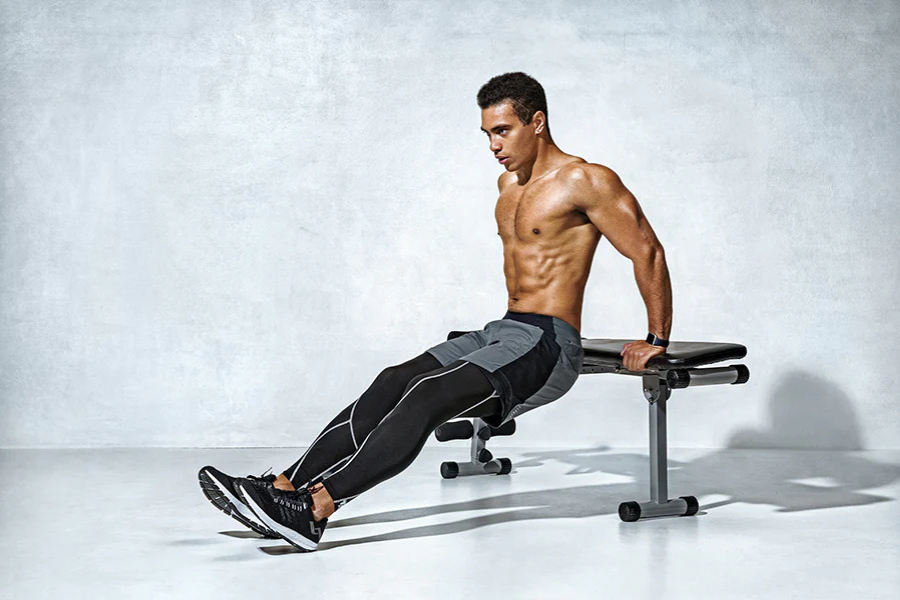
Bench or chair dips
You can train dips even if you do not have parallel bars. A stable bench or chair is enough to light up your triceps.
How to do them
- Sit on the edge of a bench or sturdy chair, hands next to your hips.
- Walk your feet forward and slide your hips off the edge, arms straight.
- Bend your elbows and lower your body until your upper arms are roughly parallel to the floor.
- Press through your hands to return to the starting position.
Tricep dips use a large range of motion and lift a good portion of your body weight, which helps increase muscle size and strength over time.
Form tips
- Keep your shoulders away from your ears.
- Do not let your shoulders roll forward as you dip.
- Move within a comfortable range. If your shoulders feel pinchy, reduce the depth.
Progressions
- Bend your knees and keep your feet closer to make the move easier.
- Straighten your legs and elevate your feet to make it harder.
Straight bar dips
If you have access to a straight bar, this variation shifts more load to your triceps and chest and is considered a building block for advanced skills like the muscle up.
How to do them
- Grip the bar with your hands slightly wider than shoulder width.
- Support yourself with straight arms and your torso slightly leaning forward.
- Lower yourself by bending your elbows until your shoulders are just below your elbows.
- Press back up to straight arms.
Keep your elbows close to your body to maximize tricep involvement.
Bodyweight tricep extensions
You can do these using a sturdy table edge, rail, or bar set at about waist or chest height.
How to do them
- Place your hands on the bar with arms straight and body in a plank position.
- Walk your feet back so your body is at an angle.
- Bend your elbows and allow your forehead or nose to move toward your hands.
- Push back to the starting position by straightening your arms.
Changing the angle of your body lets you easily scale the difficulty from beginner friendly to advanced.
Pike pushups
Although pike pushups are often thought of as a shoulder exercise, they also train your triceps hard, especially as you increase the difficulty.
How to do them
- Start in a downward dog position with hips raised and hands shoulder‑width apart.
- Bend your elbows and lower the top of your head toward the floor between your hands.
- Press back up, focusing on strong lockout through your triceps.
You will feel these in your shoulders and triceps. Keep the movement controlled to protect your neck and wrists.
Plank to pushup
Isometric holds are useful for tricep endurance and stability. This dynamic plank variation combines both isometric and concentric work.
How to do them
- Begin in a forearm plank.
- One arm at a time, press up onto your hands into a high plank.
- Reverse the movement to return to your forearms.
- Alternate the leading arm each rep.
This move keeps continuous tension on the triceps as you support your body weight while moving between positions.
Build a beginner calisthenics tricep workout
If you are new to calisthenics or coming back after a break, start with manageable volume and focus on form.
You can pick 4 to 5 exercises and do 3 sets of 12 to 15 reps each, as commonly recommended in bodyweight tricep routines. Adjust reps down if you cannot maintain good technique.
Sample beginner routine
Perform this 2 to 3 times per week with at least one rest day between sessions.
- Incline close‑grip pushups on a bench or table
- 3 sets of 10 to 15 reps
- Bench or chair dips
- 3 sets of 8 to 12 reps
- Bodyweight tricep extensions on a high bar or sturdy surface
- 3 sets of 8 to 12 reps
- Plank to pushup
- 3 sets of 8 to 10 transitions, alternating the lead arm
Stop each set when you feel your form breaking down instead of forcing more sloppy reps. Quality beats quantity.
Progress to an intermediate routine
Once you can complete the beginner routine comfortably, you can move to more demanding exercises or add volume.
Sample intermediate calisthenics tricep workout
Aim for 2 upper body days per week that emphasize triceps, with at least one rest or lower body day in between.
- Diamond pushups
- 3 to 4 sets of 10 to 15 reps
- Bench or straight bar dips
- 3 to 4 sets of 10 to 15 reps
- Pike pushups
- 3 sets of 8 to 12 reps
- Plank to pushup
- 3 sets of 10 to 15 transitions
In many structured calisthenics programs, dips appear multiple times per week with rep ranges of 8 to 15 to build both strength and endurance. You can follow a similar pattern if your joints feel good.
Train like an advanced practitioner
If basic dips, pushups, and pike pushups feel easy, you can increase intensity to keep your triceps progressing.
Advanced exercise ideas
- Plyometric narrow‑grip pushups
Push up explosively so your hands briefly leave the floor. - Archer pushups
Shift most of your weight to one side to challenge each arm individually. - Handstand pushups
A demanding press that heavily involves shoulders and triceps. - Ring or bar dips with added tempo
Slow negatives and pauses build serious control.
A more advanced month of training might have you doing dips 4 times per week with 4 sets of 10 to 15 reps, along with high‑tension moves like archer pushups for 3 sets of 6 to 10 reps per side. Adjust this idea to suit your schedule, recovery, and goals.
Apply progressive overload to your triceps
Your body builds muscle when it has a reason to adapt. Progressive overload means making your calisthenics tricep workout a bit more challenging over time. You can do that without ever touching a dumbbell.
Try progressing one variable at a time:
- Reps
Add 1 to 2 reps per set once an exercise feels comfortable. - Sets
Move from 3 sets to 4 sets for key movements like dips and pushups. - Leverage
Elevate your feet in pushups, straighten your legs in dips, or lower the height of your tricep extension bar. - Tempo
Slow down the lowering phase to 3 to 5 seconds or add a 1 second pause at the bottom. - Exercise selection
Shift from incline variations to flat floor or decline versions, or move from bench dips to straight bar dips.
The goal is to progress steadily, not to overhaul your routine every week.
Protect your elbows and shoulders
Tricep training involves repeated elbow extension and shoulder loading, so paying attention to form and recovery will help you stay consistent.
Technique tips
- Keep elbows close
During dips, pushups, and extensions, avoid letting your elbows flare wide. This keeps tension on the triceps and reduces stress on the shoulders. - Use full but comfortable range of motion
Lower under control until you feel a strong but comfortable stretch, then press back up. Do not bounce or drop suddenly. - Engage your core
A solid plank position supports healthy shoulder and elbow alignment during pushups and extensions.
Recovery habits
- Rest at least 48 hours before training triceps hard again, especially if you are sore.
- Light movement, gentle stretching, and easy isometric holds can help the day after an intense session.
- If you feel persistent sharp pain in your elbows or shoulders, scale back intensity and volume and consider speaking with a health professional.
Combine calisthenics with other training styles
You do not have to choose between calisthenics and weights. Many people find that combining them produces excellent tricep growth and performance.
For example, you might:
- Use barbell or dumbbell presses on one day.
- Focus on dips, diamond pushups, and bodyweight extensions on another.
The key is to give your triceps enough rest between heavy sessions so you can recover and keep making progress.
Put it all together
A calisthenics tricep workout can be as simple as a few well chosen bodyweight exercises or as advanced as a full program with straight bar dips, plyometric pushups, and handstand presses. The essentials stay the same:
- Understand the three heads of your triceps and train them from different angles.
- Use bodyweight movements like diamond pushups, close‑grip pushups, and dips as the foundation of your routine.
- Apply progressive overload by adjusting reps, sets, leverage, and tempo over time.
- Protect your joints with a proper warm up, solid form, and smart recovery.
If you are not sure where to start, pick one beginner routine from this guide and commit to it for the next four weeks. Track your reps, notice how your strength and control improve, and then build from there.
About the Author