Why core strength matters
If you want stronger abs, better posture, and easier everyday movement, focusing on the best ab exercises is one of the most efficient ways to get there. Your core is more than just a six pack. It includes muscles in your abdomen, lower back, hips, and even your pelvic floor. When these muscles work together, you feel more stable walking, lifting, and working out, and you are less likely to strain your back.
Core training is not only about crunches. Research highlighted by the American Council on Exercise shows that moves like bicycle crunches can effectively target your obliques and deep core muscles without equipment, making them ideal for home workouts. At the same time, beginners can benefit from slower, more controlled moves that reduce the risk of sloppy form.
In this guide, you will find 10 of the best ab exercises for building core strength, plus tips on how to use them in a simple, beginner friendly routine.
How ab muscles actually work
To choose the right ab exercises, it helps to know what you are training. Your abdominal area has four main muscle groups that work together to move and stabilize your torso:
- Rectus abdominis, the front muscle people think of as a six pack
- Internal and external obliques along the sides of your waist
- Transverse abdominis, a deep corset like muscle that wraps around your midsection
Your core also includes:
- Lower back muscles such as spinal erectors
- Glutes
- Muscles around the pelvis and hips
You cannot truly separate upper and lower abs. Sensations that feel like “lower abs” are often your hip flexors working along with the rectus abdominis. What you can do is train your core from different angles and with different types of movements like flexion, rotation, and anti rotation, and build a balanced, strong midsection.
How to structure your ab workouts
Before you jump into individual moves, it helps to have a simple plan. Based on the research you can build a beginner friendly routine like this:
- Pick 5 core exercises
- Work for 30 to 45 seconds per move
- Rest 15 seconds between exercises
- Start with 1 round which is about 7 to 10 minutes
- Gradually build to 3 or 4 rounds as you get stronger
If you prefer reps instead of timed sets, another common structure is:
- 3 exercises per session
- 10 to 15 reps per exercise
- 3 sets total
- Done 2 to 3 times per week
You do not need to train abs every day. Your core muscles benefit from rest just like your arms or legs. Give yourself at least 24 hours between full ab sessions so your muscles can recover and get stronger.
The 10 best ab exercises for core strength
Below you will find 10 effective exercises that work your abs and surrounding core muscles. You can mix and match them to create a routine that fits your fitness level.
1. Dead bug
The dead bug is a beginner friendly move that teaches you how to brace your core without stressing your lower back. It is part of a well regarded five move routine designed by NASM certified trainer Maricris Lapaix and is ideal if you are new to ab training.
How to do it
- Lie on your back with your arms straight up toward the ceiling.
- Lift your legs so your hips and knees are bent at 90 degrees, knees over hips.
- Gently press your lower back toward the floor and brace your core as if you are preparing for a light punch.
- Slowly lower your right arm behind you while extending your left leg toward the floor. Move only as far as you can without your lower back lifting.
- Return to the starting position and switch sides.
Why it works
- Trains your deep core muscles to stabilize your spine
- Encourages control and good breathing
- Great for people who feel strain in traditional crunches
2. Glute bridge
The glute bridge, sometimes called the back bridge, strengthens your glutes and many core muscles at the same time. It is simple but very effective for building a solid base for other exercises.
How to do it
- Lie on your back with knees bent and feet flat on the floor, hip width apart.
- Place your arms at your sides, palms down.
- Press through your heels, squeeze your glutes, and lift your hips until your body forms a straight line from shoulders to knees.
- Pause for 1 to 2 seconds at the top, keeping your ribs down and core engaged.
- Lower your hips with control.
Why it works
- Strengthens glutes, lower back, and deep abs
- Helps improve posture and reduces strain in your lower back
- Sets the stage for heavier lifting and athletic movements
3. Bird dog
The bird dog, also called the quadruped, trains your core to resist rotation while supporting your spine. Research cited in 2019 suggests that it can help improve lower back function and reduce pain, making it a smart option if you sit most of the day or have a history of back discomfort.
How to do it
- Start on hands and knees with wrists under shoulders and knees under hips.
- Brace your core and keep your back flat, like a tabletop.
- Extend your right arm forward and left leg back until they are in line with your body.
- Hold briefly, focusing on keeping your hips level.
- Return to the starting position and switch sides.
Why it works
- Targets the rectus abdominis and obliques
- Strengthens the lower back and improves balance
- Trains you to move your arms and legs while keeping your torso still
4. Bear plank with knee taps
This variation of a plank adds gentle movement and teaches you to maintain tension in your abs as you move. It also fits well into quick, 10 to 15 minute routines.
How to do it
- Start on hands and knees with wrists under shoulders and knees under hips.
- Brace your core, then hover your knees 1 to 2 inches off the floor.
- Keeping your hips steady, lightly tap your knees to the floor and lift them again.
- Continue tapping for the set time or reps.
Modification for wrist pain
If your wrists are uncomfortable, make fists and support yourself on your knuckles instead of flat palms.
Why it works
- Loads your core in a “bear” position that feels accessible yet challenging
- Trains bracing and stability
- Adds a small movement to keep the exercise engaging
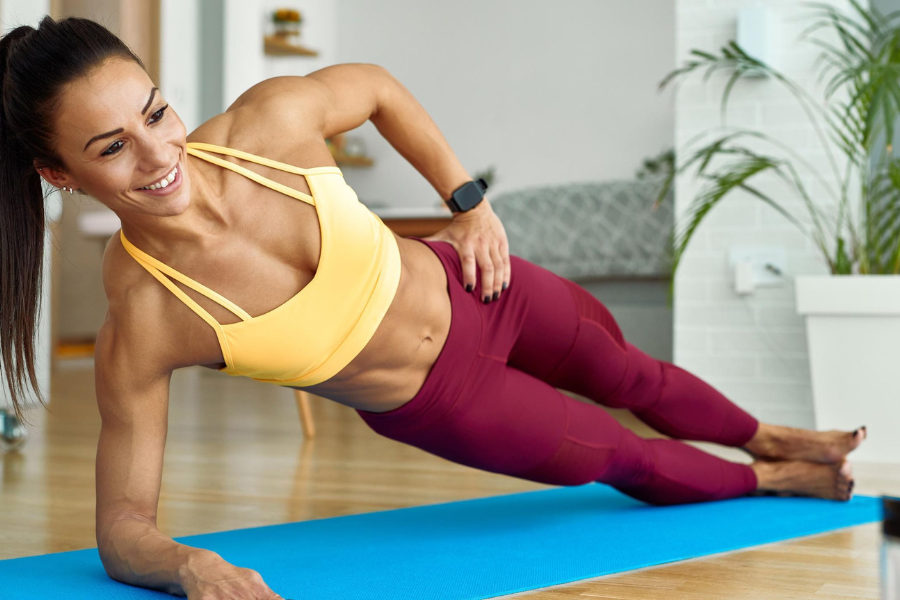
5. Modified side plank
Side planks are powerful for building oblique and deep core strength. The modified version is more approachable and lets you focus on good form. According to guides from Gymshark and other fitness sources, side planks help your core learn to resist side bending which supports posture and can help protect your spine.
How to do it
- Lie on your side with knees bent at about 90 degrees.
- Prop yourself up on your forearm, elbow directly under your shoulder.
- Stack your knees and hips, then lift your hips so your body forms a straight line from head to knees.
- Hold for 30 to 45 seconds, keeping your hips lifted.
- Switch sides and repeat.
Why it works
- Targets obliques, transverse abdominis, and glutes
- Trains your core to resist lateral flexion
- Good stepping stone to a full side plank
6. Plank
A classic plank is one of the best ab exercises for building endurance in your entire core. It also teaches you how to brace, which is one of the main jobs of your abdominal muscles. Guides often recommend working up to 4 sets of 30 to 60 second holds.
How to do it
- Start on your forearms with elbows under shoulders and legs extended behind you.
- Press your forearms into the floor, squeeze your glutes, and brace your core.
- Keep your body in a straight line from head to heels. Avoid sagging hips or lifted butt.
- Hold for the set time while breathing steadily.
Why it works
- Engages your entire front and side core
- Builds endurance that carries over to everyday tasks
- No equipment needed, easy to scale by adjusting time
7. Bicycle crunch
According to research from the American Council on Exercise, bicycle crunches rank as one of the most effective ab exercises for activating the obliques and transverse abdominis. They also use a twisting motion that many traditional crunches miss.
How to do it
- Lie on your back with your hands lightly behind your head and legs lifted, knees bent.
- Bring your right knee toward your chest while rotating your torso so your left shoulder moves toward that knee.
- Extend your left leg out at the same time.
- Switch sides in a smooth pedaling motion, not too fast.
Why it works
- Strongly activates obliques and deep core muscles
- Adds a rotational component for more complete core training
- Great for home workouts with no equipment
8. Leg raise
Leg raises focus on the rectus abdominis and hip flexors and are often used to build control in the “lower abs” area. Gymshark’s core training guide suggests starting on the floor and progressing to harder versions over time.
How to do it
- Lie on your back with legs straight and arms by your sides or under your hips for support.
- Brace your core and press your lower back gently into the floor.
- Slowly lift your legs together until they are vertical or as high as you can go without losing contact with the floor through your lower back.
- Lower your legs with a slow, controlled 3 count.
Why it works
- Improves control in your hip flexors and rectus abdominis
- Helps with performance in squats, running, and jumping
- Easy to make harder by adding an incline bench or eventually hanging versions
9. Abdominal crunch
The basic crunch is still a useful tool when you perform it with control and correct form. Guides focused on core strength recommend sets of 12 to 15 repetitions with attention on the deep transverse abdominis.
How to do it
- Lie on your back with knees bent and feet flat on the floor.
- Cross your arms over your chest or lightly support your head with your hands without pulling your neck.
- Engage your core and lift your shoulder blades off the floor in a smooth curl, not a jerk.
- Pause at the top, then slowly lower back down.
Why it works
- Targets the rectus abdominis and deep core when done correctly
- Simple move that is easy to include at the end of a workout
- Helps build endurance and basic strength in the front of your core
10. Hollow hold
The hollow hold comes from gymnastics and is extremely efficient for building total core strength and improving posture. Some routines recommend 3 to 4 rounds of 45 to 60 seconds.
How to do it
- Lie on your back with arms overhead and legs straight.
- Brace your core and press your lower back into the floor.
- Lift your head, shoulders, arms, and legs a few inches off the ground so your body forms a gentle curve like a shallow bowl.
- Hold this position while breathing steadily, without letting your lower back pop up.
Why it works
- Engages nearly every muscle in your core
- Trains you to maintain tension, which helps with lifting and athletic moves
- Very little movement, which reduces impact on your spine while still being challenging
How to build a simple core workout
You do not need an elaborate program to benefit from these exercises. Here are two easy templates you can use.
Beginner friendly routine (7 to 15 minutes)
Try this 1 to 2 times per week at first:
- Dead bug, 30 seconds
- Glute bridge, 30 to 45 seconds
- Bird dog, 30 seconds
- Bear plank with knee taps, 30 seconds
- Modified side plank, 30 seconds each side
Rest 15 seconds between moves. Start with 1 round and build up to 3 rounds as it feels easier.
Intermediate routine (strength and definition)
Once you are comfortable, you can use a mix of flexion and rotational moves:
- Plank, 30 to 60 seconds
- Bicycle crunch, 12 to 20 reps per side
- Leg raise, 10 to 15 reps
- Hollow hold, 30 to 45 seconds
Complete 3 sets, resting 45 to 60 seconds between sets.
How often you should train abs
You might feel tempted to work your abs every day, especially if your goal is visible definition. However, your core muscles need recovery just like any other muscle group.
- Aim for 2 to 3 focused ab sessions per week
- Leave at least 24 hours between hard core workouts
- You can still do gentle stretching or light yoga on rest days
Overtraining can increase stress hormones, which is linked to belly fat accumulation. Starting gradually actually helps you get better results and reduces your risk of injury or burnout.
Why core strength alone is not enough for visible abs
Strong abs are important for health and performance, but they do not guarantee a visible six pack. Multiple fitness guides note that visible abs depend heavily on overall body fat levels, not just which ab exercises you do.
Common ranges often mentioned include:
- Roughly 6 to 13 percent body fat for many men
- Roughly 14 to 20 percent body fat for many women
At higher body fat levels your abdominal muscles can be strong but remain hidden under a layer of fat. You also cannot “spot reduce” belly fat with crunches or any other isolated abdominal exercise. Sources like WebMD explain that your body uses fat from all over for energy. To reduce belly fat, you need a mix of:
- A sustainable, healthy diet that supports fat loss
- Regular strength training for your whole body
- Cardio or other activities you enjoy, such as walking, cycling, or swimming
- Adequate sleep and stress management
High intensity interval training, HIIT, can be a time efficient way to support fat loss because it alternates intense bursts of effort with rest, but it is not required if you do not enjoy it.
Putting it all together
If you are just getting started, pick three of the best ab exercises from this list that feel approachable. Focus on controlled movement, steady breathing, and good form. Add one or two short sessions to your weekly routine and give yourself a few weeks to notice the difference.
You do not have to aim for perfection. Consistent, well performed core work will help you stand taller, move more easily, and feel stronger in everything you do.
About the Author