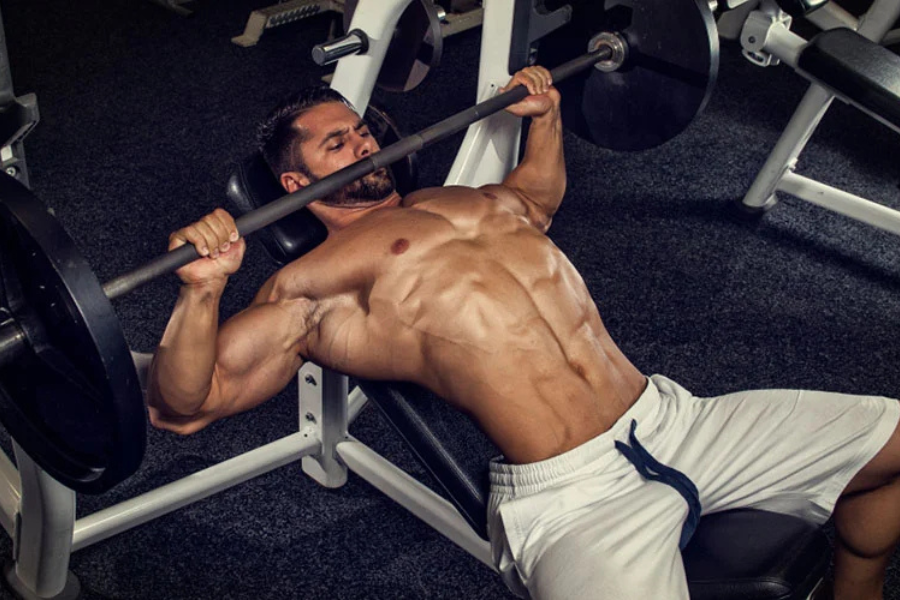
Understand your barbell chest workout
If you want a stronger, fuller chest, a focused barbell chest workout is one of the best tools you can use. The bench press and its variations let you load heavy weight, build size and strength, and test your progress in a very clear way.
At the same time, relying only on the barbell can create muscle imbalances, overuse injuries, and the classic “all lower chest, no upper chest” look. With a few smart tweaks, you can keep all the benefits of barbell work while avoiding the common traps that stall your progress.
In this guide, you will learn how to set up, press, and program your barbell chest training so you build a strong, balanced upper body safely.
Avoid common barbell chest mistakes
Before you add more weight to the bar, it helps to fix the habits that quietly limit your results.
Overdoing the flat bench press
The flat barbell bench press is a classic and effective chest exercise that hits your chest, triceps, and shoulders and lets you load heavy weight as of October 2021. It is also one of the three main powerlifting competition lifts.
The problem is not the exercise itself. It is doing too much of it and too little of everything else.
If you only perform heavy flat bench sets, you can:
- Overdevelop the lower pecs relative to the upper chest
- Create a “droopy” lower pec look instead of a balanced chest
- Increase strain on shoulders, elbows, and wrists
- Raise your risk of pec strains or tears
You get better long term results by treating flat bench as one tool among several, not your entire chest routine.
Chasing numbers instead of muscle
Because the bench press is seen as the ultimate “how strong are you” test, it is easy to fall into ego lifting. This happens when you load more weight than you can handle with good form.
Ego lifting often leads to:
- Short, half reps that limit muscle growth
- Bouncing the bar off your chest
- Shoulders and triceps doing most of the work instead of your pecs
- Higher risk of strain or injury
Progressing your bench is important, but you build your chest fastest when you prioritize control and full range of motion over what is written on the plates.
Neglecting the upper chest
If you rarely use an incline bench, your upper chest can lag behind even if you bench heavy. The research you saw notes that the incline bench press shifts more emphasis to the upper chest and shoulders and can improve overhead pressing strength (October 29, 2021, Steel Supplements).
Ignoring this part of your chest can make your torso look bottom heavy and less athletic. Adding purposeful incline work helps balance out your physique.
Nail your barbell bench press form
Better technique instantly makes your barbell chest workout more effective. You will feel your pecs doing the work rather than your shoulders taking over.
Set up on the bench correctly
Use this basic checklist for each rep, whether you are flat, incline, or decline pressing:
- Position your body
- Lie on the bench with your eyes roughly in line with the bar.
- Plant your feet firmly on the floor for stability.
- Create a slight natural arch in your lower back, not an extreme bend.
- Lock in your upper back
- Pull your shoulder blades together and slightly down into the bench.
- Keep them retracted throughout the set.
- This stable base keeps your shoulders safe and lets your chest drive the lift.
Protracting your scapula, or letting your shoulders round forward, pushes the work into your shoulders and arms instead of your pecs and can reduce your gains.
- Choose a comfortable grip
- Start with a grip slightly wider than shoulder-width.
- A wider grip tends to flare your elbows and move the bar higher on your chest.
- A narrower grip tucks your elbows more and moves the touch point lower.
The “best” grip is the one that lets you feel your chest working without shoulder discomfort.
Execute each rep with control
A strong rep has three simple phases:
- Unrack and settle
- Grip the bar tightly.
- Press it out of the rack to straight arms over your mid-chest.
- Let the weight settle for a moment before you descend.
- Lower with purpose
- Tuck your elbows slightly, about 45 degrees from your torso.
- Lower the bar in line with your mid-chest or sternum.
- Use a controlled tempo, no bounce off your chest.
- Press and finish
- Drive your feet into the floor as you press the bar up.
- Push the bar back up in a small arc toward your chin.
- Finish with elbows locked out and chest still lifted, not collapsed.
This arc helps keep the bar over your shoulder joint where you are strongest and safest.
Warm up to protect your chest and shoulders
Going straight to heavy working sets without warming up raises your risk of strains, sprains, or tears and limits your range of motion.
Before your main sets, add:
- 5 to 10 minutes of general warm up, like light cardio
- 1 to 2 sets of light push-ups or band pull-aparts
- 2 to 4 progressively heavier warm up sets on the bench press before your work weight
You should feel warm and mobile, not fatigued, when your real sets start.
Use the main barbell chest variations
Rotating a few barbell presses keeps your joints happier and your chest development more balanced. Studies show that flat, incline, and decline bench press variations with barbells or dumbbells all promote muscle growth and strength as long as you work hard within a 3 to 20 rep range and use a large range of motion.
Flat barbell bench press
- Primary focus: Overall chest size and pressing strength
- Muscles worked: Pectoralis major, triceps, front deltoids, some core
- Best for: Building a strong base and testing your one rep max if you compete or like tracking strength
Use the flat bench as your main heavy movement in most chest workouts.
Incline barbell bench press
According to an October 2021 guide from Steel Supplements, the incline bench press performed around a 45 degree angle:
- Emphasizes your upper chest and front shoulders
- Has better carryover to overhead pressing strength
- Helps round out your upper body appearance
You can alternate weeks between flat and incline as your first exercise or keep incline as your secondary lift in the same workout.
Decline barbell bench press
The decline bench press, also described in the Steel Supplements guide, has a few unique benefits:
- Places slightly more tension on the lower pec fibers
- Reduces strain on the shoulder joints due to the bench angle
- Often feels smoother for lifters with shoulder discomfort on flat bench
You do not need a lot of decline work, but including it periodically can give your shoulders a break and still challenge your chest.
Compare your options quickly
| Variation | Main focus | Shoulder stress | Best use case |
|---|---|---|---|
| Flat bench | Overall chest & size | Moderate | Primary strength and size builder |
| Incline bench | Upper chest & delts | Moderate | Balancing upper chest, overhead carry |
| Decline bench | Lower chest | Lower | Extra volume and joint friendly work |
You do not have to use all three in the same phase, but switching between them over time keeps your progress moving.
Balance barbells with smarter assistance work
Even though your barbell chest workout is the focus, supporting exercises can make those barbell sets much more productive.
Add dumbbell presses for stability
The dumbbell bench press also targets the chest, triceps, and deltoids, but it demands more from your stabilizer muscles because each arm works independently.
You can use dumbbells to:
- Increase your range of motion at the bottom of the rep
- Even out strength differences between sides
- Practice the bench movement pattern with lighter loads and more control
Using both barbell and dumbbell variations can help you understand the bench path better and reduce plateaus.
Use push-ups to build your base
If you are newer to lifting or your bench numbers are stuck, push-ups are still useful:
- They build chest and triceps strength with little equipment
- You can adjust difficulty with incline or decline variations
- They make a great warm up exercise before heavier pressing
Beginners who struggle to control the bar can benefit from including push-ups on most training days.
For sensitive shoulders, consider specialty bars
If straight bar benching bothers your shoulders, some lifters find relief using alternatives such as hex bars, football bars, or Swiss bars. These variations were suggested as shoulder friendly options in a Muscle & Strength discussion.
They change your grip angle and can reduce joint strain while still training the pressing movement pattern.
Program your barbell chest workout
Once your form is solid, your results come down to how you structure sets, reps, and weekly training.
Choose the right rep ranges
Scientific evidence indicates that bench press work that brings you near muscular failure within 3 to 20 reps, and uses a large range of motion, reliably promotes both muscle growth and strength.
You can think of rep ranges like this:
- 3 to 6 reps: Strength focused, heavier weight, more rest
- 6 to 12 reps: Muscle growth focused, moderate to heavy weight
- 12 to 20 reps: Endurance and extra volume, lighter weight
Some guidelines from Muscle & Strength suggest 6 to 8 heavy reps at full effort for strength development. You can combine ranges across a single workout, for example heavy sets first, then lighter sets for volume.
Use progressive overload
A practical progression method from an October 2021 Steel Supplements guide looks like this:
- Start with about 80 percent of your one rep max, for 4 sets of 4 reps.
- Each week, add 1 rep per set with the same weight.
- When you can perform 4 sets of 8 reps, increase the weight and reset to 4 sets of 4.
- Repeat this cycle.
This simple structure gives you a clear target every session and helps you build both size and strength over time.
Plan your weekly chest volume
Your total number of challenging sets per week matters more than any single workout.
Based on the October 2021 article:
- Beginners: About 12 weekly sets for chest
- Novice lifters: Around 16 weekly sets
- Experienced lifters: Up to 20 weekly sets
Aim for at least 48 to 72 hours of recovery between hard chest sessions. For example, you might bench on Monday and Thursday or Tuesday and Friday.
Sample barbell chest workout plans
Use these as starting points and adjust based on how your body responds.
Beginner barbell chest day
Focus on learning form and building a base.
- Flat barbell bench press
- 4 sets of 6 to 8 reps
- Start light enough to keep every rep smooth and controlled.
- Incline dumbbell press
- 3 sets of 8 to 10 reps
- Push-ups
- 3 sets close to failure, 1 to 2 reps left in the tank
- Light accessory: band pull-aparts or rows
- 3 sets of 12 to 15 reps for shoulder health and balance
Intermediate strength and size session
You have some experience and want to balance strength work with hypertrophy.
- Flat barbell bench press
- Work up to 3 to 4 sets of 4 to 6 heavy reps
- Incline barbell bench press
- 3 sets of 6 to 8 reps
- Decline barbell or dumbbell press
- 3 sets of 8 to 10 reps
- Optional: push-ups or machine press finisher
- 2 sets of 12 to 15 reps
Advanced rotation for long term progress
If you lift for years, varying focus blocks can keep joints healthy and gains coming.
-
Block 1 (4 to 6 weeks):
-
Day 1: Heavy flat bench + moderate incline dumbbells
-
Day 2: Heavy incline bench + moderate decline or machine work
-
Block 2 (4 to 6 weeks):
-
Day 1: Heavy incline bench + lighter flat bench for volume
-
Day 2: Heavy dumbbell work + specialty bar for joint friendly pressing
Within each block, move from heavier, lower rep sets to slightly higher rep ranges before cycling back to heavier loads.
Stay safe and track your progress
The best barbell chest workout is one you can follow consistently without pain.
To keep your chest training sustainable:
- Keep your shoulder blades pulled together on the bench to protect your shoulders.
- Avoid ego lifting, especially if your form breaks down.
- Use warm ups and lighter sessions after very heavy days.
- Rotate flat, incline, and decline work over months instead of living on just one angle.
- Add dumbbell presses and push-ups to support your barbell lifts.
Pay attention to how your chest actually feels during the workout. When your technique, exercise selection, and programming line up, you will notice more tension in your pecs, smoother reps, and steady gains in both strength and size.
About the Author