Understand what creates bicep definition
If you want bicep workouts for definition rather than just size, you need to think about shape, balance, and how often you train. Defined biceps come from:
- Hitting both the long head and short head of the biceps
- Training the supporting muscles like the brachialis and brachioradialis
- Using a mix of rep ranges that emphasize tension and control
- Training often enough, but not so much that you cannot recover
The long head helps create that noticeable peak. The short head adds width from the front. Research and guides from brands like Gymshark and RP Strength highlight that you get the best results when you intentionally train both heads and use a full range of motion for each exercise, going all the way down for a stretch and near full contraction at the top.
Key principles for defined biceps
Before you jump into specific bicep workouts for definition, it helps to understand a few core principles.
Train both heads of the biceps
Your biceps have two main heads:
- Long head, creates the peak
- Short head, adds thickness and width
You can shift emphasis between them by changing grip and arm position:
- Narrow or neutral grips, and movements where your elbows sit slightly behind your body, tend to hit the long head more
- Wider or supinated (palms up) grips, and positions where your elbows come slightly forward, tend to hit the short head more
Guides updated in February 2024 from Gymshark stress that working both heads is essential for well rounded bicep definition, not just bigger arms.
Use the right training frequency and volume
For most people aiming for more defined arms:
- Train biceps 2 to 3 times per week for solid hypertrophy and definition benefits, which has been shown to lead to better week to week gains compared to once a week
- Do 2 to 4 exercises per workout
- Perform 3 to 4 sets per exercise
- Stay mostly in the 8 to 12 rep range, with some heavier and lighter sets mixed in
Some hypertrophy focused recommendations from RP Strength suggest you can even train biceps 3 to 6 times a week if you manage fatigue, but you still want to avoid going past roughly 10 hard sets for biceps in a single workout so you do not overtrain.
Work all the biceps functions
The biceps do more than bend your elbow. They are involved in three main actions:
- Elbow flexion, bending your arm
- Supination, turning your palm up
- Shoulder flexion, raising your arm in front of you
You get better definition when your program includes curls that challenge all three of these functions, not just basic up and down movements. That is why some workouts combine different curl angles and grips within one session.
Use a mix of rep ranges
To emphasize both size and definition:
- Include heavy sets of about 5 to 10 reps
- Spend most of your time in moderate sets of 10 to 20 reps
- Add occasional high rep sets of 20 to 30 or more for a deep burn and pump
RP Strength recommends putting about half of your weekly volume in that moderate 10 to 20 range, since it balances muscle growth, fatigue, and control.
Best bicep exercises for definition
Below are some of the most effective moves you can plug into your bicep workouts for definition. They target different parts of the biceps and surrounding muscles so your arms look balanced from every angle.
Concentration curls
Concentration curls are often rated as one of the best bicep exercises for isolation and definition because they:
- Lock your upper arm in place
- Maximize mind muscle connection
- Focus heavily on the short head
How to do them
- Sit on a bench and spread your knees.
- Hold a dumbbell in one hand, then rest that elbow inside your thigh.
- Let the dumbbell hang toward the floor, palm facing up.
- Curl the weight toward your shoulder without swinging.
- Squeeze at the top, then lower slowly until your arm is fully extended.
Aim for 3 sets of 8 to 12 reps, done later in your workout once heavier compound moves are finished.
Hammer curls
Hammer curls use a neutral grip with palms facing each other. They mainly hit:
- The long head of the biceps
- The brachialis underneath the biceps
- The brachioradialis in your forearm
Training these muscles together helps your arms look thicker and stronger overall.
How to do them
- Stand tall with a dumbbell in each hand, arms at your sides, palms facing each other.
- Keep your elbows close to your ribs.
- Curl both dumbbells up, or alternate one arm at a time.
- Pause briefly at the top, then lower under control.
Use 3 to 4 sets of 8 to 12 reps, focusing on a smooth, non swinging motion.
EZ bar curls
EZ bar curls are great if straight bar curls bother your wrists. The angled grip lets you train hard while still emphasizing the biceps.
- A narrow grip tends to emphasize the long head
- A wider grip shifts more focus to the short head
Because you can usually go heavier with an EZ bar, these curls work well for your strength focused sets.
How to do them
- Stand with feet hip width apart, holding the EZ bar at your chosen grip width.
- Let the bar hang at arm’s length, chest up, shoulders down.
- Curl the bar toward your shoulders without swinging your hips.
- Squeeze at the top, then lower all the way down for a full stretch.
Try 3 to 4 sets of 6 to 10 reps if you want to prioritize strength and size.
High cable bicep curls
High cable curls mimic a front double biceps pose. They:
- Place your shoulders in an externally rotated position
- Emphasize the short head
- Keep constant tension on the biceps throughout the rep
How to do them
- Set the pulleys on a cable station to about head height.
- Attach single handles and grab them with palms facing up.
- Step into the middle and raise your arms to the sides in a “T” shape.
- Curl the handles in toward your ears, keeping your upper arms in place.
- Squeeze hard at peak contraction, then return slowly to the start.
Use 3 sets of 8 to 12 reps to really finish your workout with a solid pump.
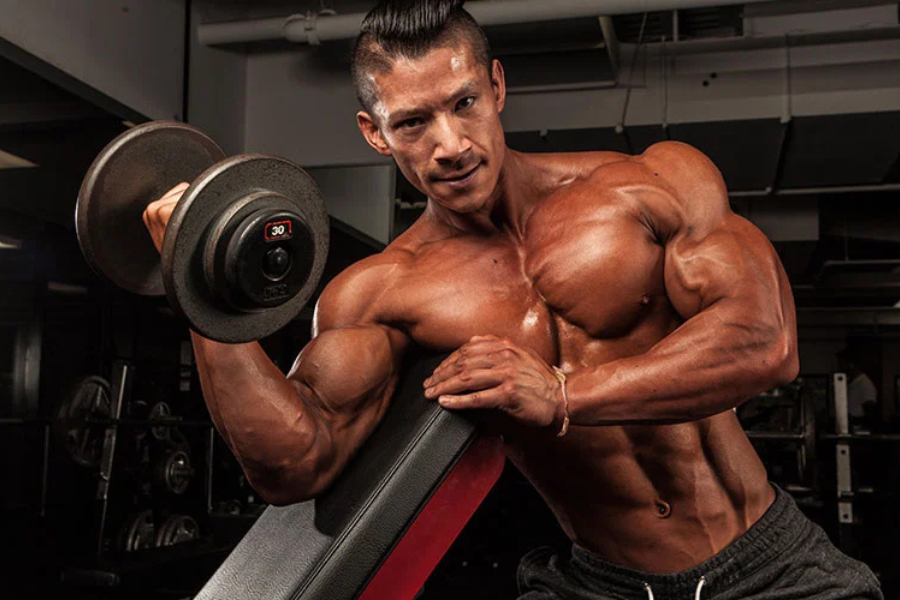
Preacher curls
Preacher curls force your biceps to work from a stretched position and remove momentum. They are especially useful for building that high, rounded bicep look.
How to do them
- Sit at a preacher bench with your upper arms resting fully on the pad.
- Grip an EZ bar or dumbbells with palms facing up.
- Start with your arms almost straight but not locked.
- Curl the weight up, focusing on squeezing your biceps.
- Lower until you feel a good stretch, then repeat.
Perform 3 sets of 8 to 12 reps with a weight you can control at the bottom.
Chin ups
Chin ups are a bodyweight compound exercise that challenge your biceps along with your back and shoulders. Because you are pulling your entire body, they can be a powerful strength and definition builder.
How to do them
- Grab a bar with an underhand grip, hands about shoulder width apart.
- Start from a dead hang with arms straight.
- Pull your chest toward the bar, focusing on driving your elbows down and in.
- Pause when your chin is over the bar, then lower slowly back to a full hang.
If unassisted chin ups are too hard right now, you can loop a resistance band over the bar and under one knee or foot for help. Aim for 3 sets to near technical failure, which might be 3 to 8 reps depending on your strength.
Sample bicep workout for definition (gym)
Use this as a template on days when you have access to a full gym. This routine is built around the exercises highlighted in the 2024 guides you saw in the research, and it is designed to hit both heads of the biceps with different angles and grips.
Workout structure
Do this workout 2 times per week, with at least one rest day between sessions. If you already train back once a week, you can place this bicep workout right after your back workout to maximize the pump.
Warm up, 5 to 10 minutes
- Light cardio to raise your heart rate
- 1 to 2 very light sets of curls to warm the elbows and wrists
Main workout
- EZ bar curls
- 4 sets of 6 to 10 reps
- Focus: heavier power sets for strength and size, using a grip that matches your weak point (narrow for long head, wide for short head)
- Hammer curls
- 3 sets of 8 to 12 reps
- Focus: long head, brachialis, and forearm engagement for thicker arms
- Preacher curls
- 3 sets of 8 to 12 reps
- Focus: strict form and deep stretch, no swinging
- Concentration curls
- 3 sets of 10 to 15 reps per arm
- Focus: slow negatives and strong squeeze for detail and shape
If you like intensity techniques, you can finish your final set of each exercise with a drop set, where you lower the weight once or twice mid set to extend the set without losing form.
Try to keep total working sets around 10 or fewer for biceps in this session so that you avoid overtraining.
Advanced finisher: “21s” for bicep detail
The “21s” method is often used to cap off an arm session because it attacks the biceps across the full range of motion. It is simple and brutal, and it fits nicely into bicep workouts for definition.
You perform 21 total reps without rest:
- 7 bottom half reps
- Start from arms straight.
- Curl only halfway up.
- 7 top half reps
- Start from halfway up.
- Curl to the top and back only to halfway.
- 7 full reps
- Go from full extension to full contraction each time.
You can do 21s with:
- A barbell
- An EZ bar
- Dumbbells
Choose a light to moderate weight, since the set is long and the burn is intense. One or two sets of 21s at the very end of your workout is usually plenty.
At home bicep workouts for definition
You do not need a full gym to build more defined biceps. With a few dumbbells, resistance bands, or even household items, you can still target the long and short heads of the biceps and the supporting muscles.
With dumbbells or bands
Here is a simple at home routine if you have a pair of dumbbells or a band. Perform this 2 to 3 times per week.
- Standing dumbbell curls or band curls
- 3 sets of 10 to 15 reps
- Focus on full range of motion and control
- Hammer curls
- 3 sets of 8 to 12 reps
- You can do these with dumbbells or a rope attachment on a door anchored band
- Cross body curls
- 3 sets of 10 to 12 reps per arm
- Curl the weight across your body toward the opposite shoulder to hit the biceps and brachialis from a slightly different angle
- High band curls
- 2 to 3 sets of 12 to 20 reps
- Anchor the band above head height, then mimic a high cable curl to emphasize the short head and constant tension
Rest 30 to 90 seconds between sets depending on how conditioned you are and how much time you have.
With household items or bodyweight
If you do not have equipment yet, you can still challenge your biceps using simple variations and bodyweight moves. For example:
-
Backpack curls
-
Fill a backpack with books.
-
Grip the top handle with both hands and curl it up while seated or standing.
-
Shoulder tap biceps curls
-
In a tabletop or plank position, bend your elbows slightly and control the movement as you tap opposite shoulders.
-
This works your arms and core together.
-
Assisted chin up progressions
-
Use a sturdy bar or monkey bars.
-
Start with band assisted chin ups or slow negatives, where you focus on lowering slowly from the top position.
These moves are not as targeted as cable curls in a gym, but combined with consistency and smart progression they still help you develop visible muscle tone.
Programming your week for arm shape
Once you know which movements to use, you can arrange them into a weekly schedule that supports muscle definition and recovery.
Example weekly layout
Here is a simple way to work biceps often enough without overdoing it:
-
Day 1, Back + Biceps
-
Main back work
-
2 to 3 biceps exercises, 3 sets each
-
Day 3 or 4, Push or Legs
-
Optional light bicep “touch up”
-
1 or 2 bicep exercises with moderate reps, 2 to 3 sets each
-
Day 6, Arms focus (optional)
-
3 to 4 bicep exercises, 3 sets each
-
Finish with a technique like 21s or high rep burn sets
This structure keeps your total biceps volume in a healthy range while spreading the work across the week. Research suggests that training a muscle several times per week, instead of just once, tends to produce better hypertrophy when volume is matched, as long as you recover properly.
Progress and recovery tips
To keep progressing toward better arm shape:
- Increase weight or reps gradually whenever you hit the top of your target rep range with good form.
- Use full range of motion, from a controlled stretch to a strong but not joint straining squeeze.
- Rest 30 seconds to 2 minutes between sets depending on how heavy you are going.
- Check your technique regularly, especially on isolation moves like preacher and concentration curls, so that your biceps do the work instead of your shoulders or lower back.
- Respect rest days, since definition depends on muscle recovery as much as training effort.
Putting it all together
To build biceps that look defined from every angle, you want:
- A combination of heavy and moderate weight curls
- Exercises that hit both the long and short heads
- Supporting work for the brachialis and forearms
- 2 to 3 focused bicep sessions per week with about 3 to 4 exercises each
Start by picking 3 or 4 exercises from this guide that you can perform safely with the equipment you have, then commit to doing them consistently for at least 6 to 8 weeks. As you get stronger, slowly add reps, sets, or weight.
With steady training and good recovery habits, those bicep workouts for definition will begin to show in the mirror as fuller peaks, clearer lines, and stronger arms overall.
About the Author