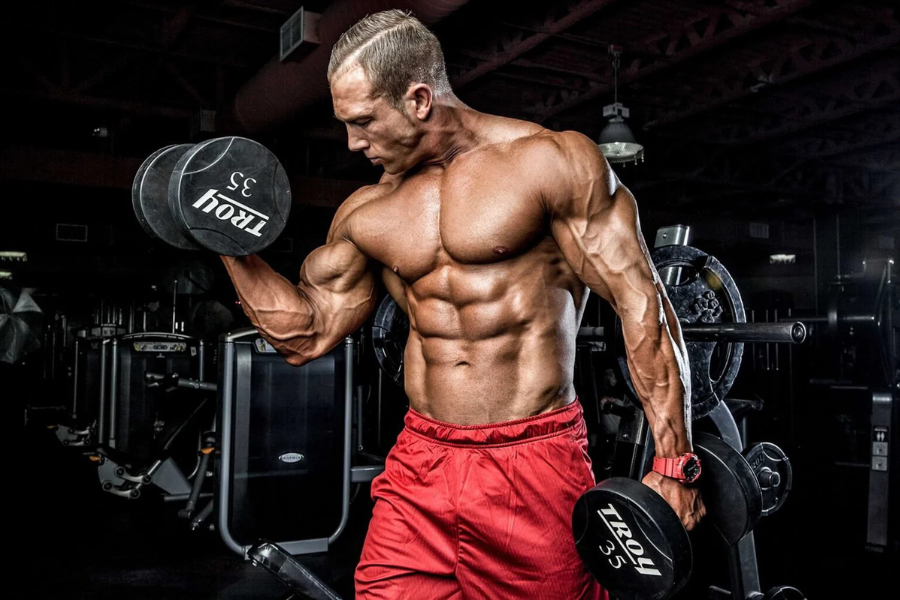
Why bicep workouts change after 40
Bicep workouts for men over 40 look a bit different from the routines you might have followed in your twenties. You can still build bigger, stronger arms, but your joints, recovery, and schedule all deserve more respect now.
Your biceps are not just “show” muscles. The biceps brachii has two heads, long and short, that help you bend your elbow and rotate your forearm. Everyday tasks like carrying groceries, lifting kids, or loading a suitcase all rely on this small but important muscle group, along with the brachialis and brachioradialis.
Once you are over 40, a smart arm plan focuses on:
- Quality form instead of ego lifting
- Enough weekly volume without daily training
- Exercise choices that are kind to your elbows and shoulders
- A mix of biceps and triceps work, since triceps make up about two‑thirds of your upper arm
You do not need marathon gym sessions or heavy barbells to see progress. Light to moderate dumbbells and bands, used consistently, are more than enough to grow your arms safely.
Understand your bicep muscles
Before you load up curls, it helps to know what you are actually training.
The key players in your upper arm
- Biceps brachii long head
Sits on the outside of your upper arm and creates the familiar “peak.” It works hard any time you bend at the elbow with your palm up or slightly turned out. - Biceps brachii short head
Runs closer to the inside of your arm. It kicks in with underhand and closer‑grip curls and helps give your biceps width from the front. - Brachialis
A powerful muscle that lives underneath the biceps. It drives elbow flexion and, when it grows, it literally pushes the biceps up so your arms look thicker. - Brachioradialis
Runs along the top of your forearm and helps with curls done in a neutral or hammer grip.
Your workouts should touch all of these through small grip and angle changes. That is how you build complete arm strength and not just a partial pump.
Training guidelines for men over 40
You can still train hard. You just want to train smart. Use these simple rules to structure your bicep workouts for men over 40.
Volume and frequency that actually work
Research on hypertrophy for adults points to moderate volume and consistent frequency as the sweet spot for muscle growth.
- Aim for 2 to 4 bicep exercises per workout
- Use 8 to 12 reps for 3 to 4 sets for most moves
- Train biceps 2 to 3 times per week, not every day
This type of plan gives your arms enough work to grow while still leaving room for recovery, which is when the actual muscle building happens.
Why rest days matter more now
As you get older, your recovery slows down slightly. Training your biceps hard every single day can lead to:
- Persistent elbow or shoulder soreness
- Plateaued strength and size
- General fatigue that bleeds into other workouts
It is better to have two very solid bicep sessions a week than five mediocre, painful ones.
Stay away from constant failure sets
Going to failure on every curl looks intense, but for men over 40 it can raise stress hormones and beat up your joints for very little extra benefit.
Instead:
- Stop each set with 1 to 2 reps in the tank
- Focus on smooth, controlled reps instead of grinding, ugly last lifts
- Save all‑out efforts for an occasional finisher, not every set
You will recover faster and your elbows will thank you.
Warm up before every arm session
Good bicep workouts for men over 40 start before you pick up a weight. A short warm up protects your muscles and joints and usually improves your performance in the main sets.
A simple 5 to 10 minute warm up
Try this sequence:
- Light cardio, 3 to 5 minutes
Brisk walking, easy cycling, or marching in place to raise your heart rate. - Dynamic upper body moves, 3 to 5 minutes
- Arm circles in both directions
- Gentle band pull‑aparts
- Shoulder rolls and scapular wall slides
- Specific warm up sets, 1 to 2 per exercise
Before your first curl or press, do 1 to 2 light sets of 10 to 15 reps with a very easy weight. This primes the movement pattern without fatigue.
Treat the warm up as part of your workout, not something to rush through.
Exercise form: quality over quantity
After 40, you will get more from perfect curls with modest weights than from sloppy swings with heavy ones.
Why strict form matters
Cheating your reps by heaving your torso or bouncing the weight:
- Reduces the tension on the biceps
- Shifts work into your lower back and shoulders
- Increases your chance of tweaks and strains
Men over 40 benefit from “strict” variations like:
- Standing curls with your back against a wall
- Seated or kneeling curls that remove leg drive
These force your arms, not your hips, to do the lifting.
Grip, tempo, and time under tension
You can also make a light weight feel heavy by playing with cadence.
- Use a controlled 2 to 3 second lowering phase on each rep
- Occasionally try fast reps for 15 to 20 seconds, followed by slower reps for 8 to 10 seconds, to increase time under tension
- Squeeze the top of each curl for a brief pause instead of rushing straight back down
This keeps your joints happy while still challenging your muscles.
The best bicep exercises for men over 40
You do not need a huge exercise list. A handful of focused movements is enough, especially if you change grips to hit different heads of the muscle.
Foundational curl variations
These moves should make up the core of your bicep work.
Standing dumbbell curl
A classic for a reason. You can use dumbbells as light as 15 pounds and still see results when you control the motion.
- Stand tall, chest up, core lightly braced
- Let the dumbbells hang at your sides with palms facing forward
- Curl both weights up without swinging your back
- Lower under control until your arms are fully straight
Use 3 sets of 10 to 12 reps. Focus on feeling the biceps do the work the whole way.
Standing barbell curl
If your elbows and wrists feel good with a bar, the standing barbell curl is an efficient strength builder.
- Take an underhand, shoulder‑width grip on the bar
- Keep your elbows close to your sides as you curl
- Do not let your torso rock back to “help” the lift
Stick with 3 sets of 8 to 12 reps and only increase weight when you can keep every rep smooth.
Strict dumbbell or cable curl
To cut out momentum, try strict curls.
- Stand or sit with your back supported against a wall or bench
- Start each rep from a dead stop, no bouncing
- Use a full range of motion, from full elbow extension to a solid squeeze at the top
Moderate loads feel much harder with this style, which is ideal for joint‑friendly training.
Targeted work for the short head, long head, and brachialis
Small changes in position and grip can shift emphasis within your arm.
Concentration curl (short head focus)
This is the “elbow on inner thigh” curl you might already know.
- Sit on a bench and spread your knees slightly
- Rest the back of one arm against your inner thigh
- Curl the dumbbell up toward your shoulder, then lower slowly
This setup minimizes cheating and really homes in on the short head. Aim for 3 sets of 10 to 12 reps per arm.
Preacher curl (short head and control)
Using a preacher bench or a slanted surface supports your upper arm and helps isolate the biceps.
- Pin your upper arms firmly to the pad
- Lower the weight until your elbows are almost straight
- Curl up until your forearms are vertical and the biceps are fully contracted
Because the bottom position is demanding, use controlled weights and 8 to 12 reps.
Hammer curl (brachialis and forearm strength)
Hammer curls are especially useful for men over 40, since they hit the brachialis and brachioradialis, which add thickness to your arms and support your elbows.
- Stand with feet shoulder‑width apart, slight knee bend
- Hold dumbbells with a neutral grip, palms facing in
- Curl the weights while keeping your palms facing each other
- Lower slowly and keep your elbows close to your ribs
Use 3 sets of 6 to 8 or 8 to 10 reps, depending on how challenging the weight feels with clean form.
At‑home dumbbell options
If you work out at home or just prefer simple equipment, you can still get a complete arm session with minimal gear. Trainer Bobby Maximus highlights several dumbbell moves that work well for men over 40.
Kneeling single‑arm bicep curl
Kneeling takes your legs and lower back out of the equation, so your biceps and forearms do nearly all the work.
- Kneel on both knees, torso tall
- Hold one dumbbell with your palm facing forward
- Curl without leaning or twisting, then lower under control
- Switch arms after each set
Squeezing the handle hard also boosts forearm activation.
Single‑arm hammer curl
This combines the neutral grip of a hammer curl with the focus of a one‑arm exercise.
- Stand with feet shoulder‑width apart and knees slightly bent
- Hold a dumbbell at your side with a neutral grip
- Curl the weight up, pause, then lower
- Repeat for all reps, then switch sides
Single‑arm variations are helpful if one side is noticeably weaker or less coordinated.
Drag curl
Drag curls are a simple but very intense option.
- Hold dumbbells at your sides, palms facing forward
- Instead of curling straight up, “drag” the weights up along your thighs, keeping your elbows pulled behind you
- At the top, around waist height, hold for up to 10 seconds, then lower
Even a one‑minute set of drag curls can light up your arms without requiring heavy weights.
Do not forget your triceps
If you only train biceps, your arms will never hit their full size potential. Triceps make up roughly two‑thirds of your upper arm, so they deserve equal attention.
Key tricep exercises for men over 40
You can keep things simple but effective with two main moves.
Skullcrusher
Despite the dramatic name, this is a controlled lying triceps extension.
- Lie on a bench, holding dumbbells or an EZ bar over your chest
- Bend at the elbows to lower the weights toward your forehead
- Keep your upper arms mostly vertical
- Extend your elbows to press the weight back up
Use a weight that lets you move smoothly for 8 to 12 reps, paying attention to any elbow discomfort.
Diamond pushup
This bodyweight exercise is tough but joint‑friendly when you progress gradually.
- Start in a plank position
- Place your hands close together so your thumbs and index fingers form a diamond
- Lower your chest toward your hands, keeping elbows close to your sides
- Press back up to the plank
You can do these from your knees or with your hands on a bench if full version is too challenging at first.
When you combine consistent triceps work with regular bicep training, your arms will look and perform much better overall.
Sample weekly plan for strong biceps after 40
Here is a simple way to organize bicep workouts for men over 40 within a balanced routine. Adjust exercises based on the equipment you have.
Weekly structure
- Day 1: Push (chest, shoulders, triceps)
- Day 2: Legs
- Day 3: Pull (back, biceps)
- Day 4: Full body or active recovery
You will train your biceps directly twice per week while also hitting them indirectly with pulling exercises.
Example “Pull Day” for biceps focus
After your main back work, you could do:
Standing dumbbell curl
- 3 sets of 10 to 12 reps
Preacher curl or concentration curl
- 3 sets of 8 to 12 reps
Hammer curl
- 3 sets of 6 to 8 reps
Rest about 60 seconds between sets for most moves. If you are pairing exercises in a sequence, such as a triceps “triple threat,” you can stretch that to 90 seconds between full rounds.
Example at‑home arm session
If you have only dumbbells and bands, try:
Kneeling single‑arm bicep curl
- 3 sets of 30 seconds per arm
- First 15 to 20 seconds at a quicker but controlled pace, then finish the time with slower, more deliberate reps
Single‑arm hammer curl
- 3 sets of 8 to 10 reps per arm
Band curl
- 3 sets of 12 to 15 slow reps
Diamond pushups
- 3 sets to a point where you could still do 1 to 2 more clean reps
This approach of mixing rep counts and timed sets raises time under tension without needing big weights.
How to progress safely over time
Gains after 40 are absolutely possible. You just need a consistent, measured plan.
Use progressive overload without punishing your joints
You can progress in several ways:
- Add a small amount of weight to one or two exercises
- Add 1 or 2 reps to each set at the same weight
- Slow down the lowering phase slightly to increase challenge
- Reduce rest periods by 10 to 15 seconds when that feels manageable
You do not have to change everything at once. Pick one variable, track it, and nudge it forward from week to week.
Combine strength training with cardio
Adults over 40 do best when they combine regular strength work with aerobic exercise. Steady walking, cycling, or swimming pairs nicely with your lifting routine and supports heart health and recovery.
Even if your progress feels slower than it did in your twenties, you can absolutely build muscle and strength with a plan that respects where your body is now.
When to dial back or adjust
Listen to your elbows, shoulders, and lower back. They often give you early warnings.
You may need to modify your bicep workouts if you notice:
- Sharp or persistent joint pain that lingers for days
- Numbness or tingling down your arm
- Swelling or discomfort that gets worse with each session
If that happens, scale down volume, switch to more joint‑friendly tools like dumbbells and bands instead of heavy barbells, and consider seeing a qualified professional for an assessment.
Putting it all together
Bicep workouts for men over 40 do not have to be complicated or risky. Focus on:
- Training biceps 2 to 3 times per week with 8 to 12 reps for 3 to 4 sets
- Using strict form on curls, with variations like standing dumbbell curls, preacher curls, and hammer curls
- Including at‑home friendly moves like kneeling curls, drag curls, and band work
- Balancing bicep training with triceps exercises such as skullcrushers and diamond pushups
- Warming up thoroughly and staying 1 to 2 reps shy of failure
Pick one or two exercises from this guide for your next workout, keep the weight light enough to move well, and build from there. With consistent effort and smart progression, your arms can be stronger and more defined in your forties and beyond than they were a decade ago.
About the Author