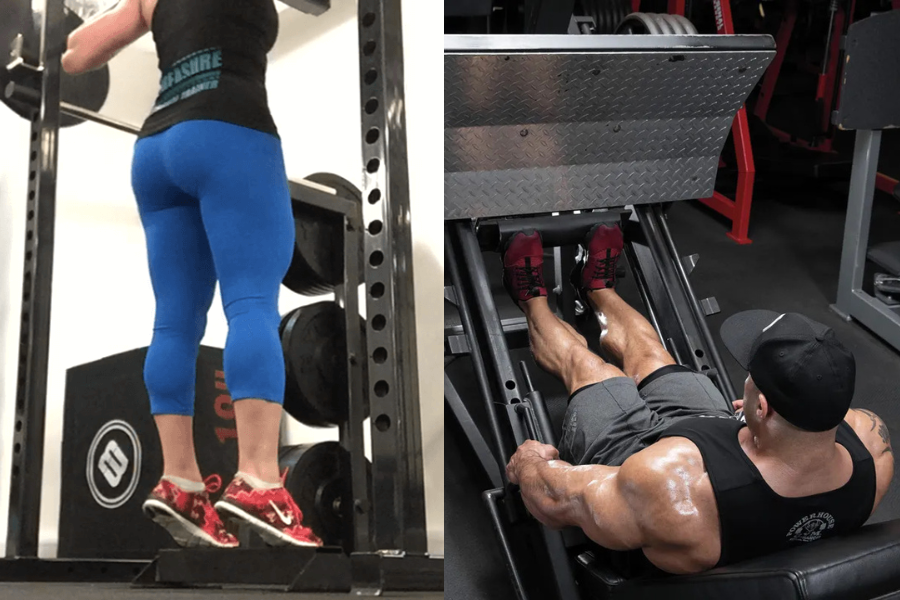
Bodyweight calf exercises are one of the simplest ways to build lower-leg strength, protect your joints, and move with more power in daily life. You do not need a gym or equipment, just your body weight, a bit of floor space, and some consistency.
Below, you will learn how your calves work, which bodyweight calf exercises are worth your time, and how to turn them into an effective, joint-friendly routine you can actually stick with.
Understand why your calves matter
Your calves do much more than help you stand on your tiptoes. The two main muscles, the gastrocnemius and the soleus, run down the backs of your lower legs and form the shape you think of as your calves, as explained by the University of Colorado School of Medicine. The gastrocnemius kicks in when you lift your heels, while the soleus stabilizes your ankle and supports you when you stand or walk.
Strong calves help you:
- Walk and run with better propulsion
- Jump and change direction more powerfully
- Maintain good posture and balance
- Reduce the risk of knee issues and Achilles strains
Because you already use your calves all day through walking and standing, they adapt quickly to low-intensity work. To make real strength and muscle gains, you need targeted, higher-intensity bodyweight calf exercises.
Start with classic standing calf raises
If you only do one bodyweight calf exercise, make it the standing calf raise. It is simple, requires no equipment, and trains your calves through a larger range of motion than walking.
To perform a basic standing calf raise, stand tall with your feet hip-width apart and your weight evenly spread from heel to toe. Press through the balls of your feet to lift your heels as high as possible, pause briefly at the top, then lower your heels with control.
You can do these on flat ground or on an elevated surface like a stair or curb to increase the stretch. You can also point your toes slightly outward or inward to shift the emphasis to different parts of the calf without needing any equipment.
Variations to keep raises effective
Your calves get used to repetitive movement quickly. To keep progress coming, rotate through different versions:
- Toes forward for overall calf development
- Toes turned slightly out to emphasize the inner calf
- Toes turned slightly in to hit the outer calf
Work through a full, comfortable range of motion, but avoid bouncing at the bottom. Think of each rep as a smooth lift and controlled lower.
Try dynamic bodyweight calf raises
Dynamic Bodyweight Calf Raises add more movement and can improve lower body stability and endurance. You still raise your heels off the ground while keeping your toes planted, but you can move through different tempos or angles that challenge your muscles in new ways.
For example, you might raise up quickly, pause at the top, then lower very slowly. Or you could shift your weight slightly from side to side at the top of the raise to test your balance. These small changes encourage more engagement from the gastrocnemius and soleus, as well as supporting muscles like the peroneus longus and brevis and the tibialis posterior.
Because your trunk has to stabilize you as you move, your core also gets involved, including the rectus abdominis, obliques, and transversus abdominis. This turns a simple calf exercise into a full lower-leg and core stability drill.
Progressions for every level
You can increase the difficulty of dynamic calf raises without any equipment:
- Add a slow three-second lower on each rep
- Pause for two to three seconds at the bottom stretch
- Do partial reps in the bottom half of the movement, where your calves can produce more force
Research on calf training suggests that only using the full range of motion can sometimes limit strength gains due to active insufficiency. Focusing on the bottom half of the movement, where the calves are stretched, can help you produce more force and build more strength over time.
Add single-leg and angle changes
Once regular calf raises feel easy, shifting to one leg at a time is a simple way to progress. Balancing on one foot while you raise and lower your heel increases the load on each calf without needing weights. You will likely feel your ankle and foot working harder as well.
You can also play with angle changes to hit your calves from multiple directions. Outward and inward calf raises are small adjustments, but they help recruit different fibers in the muscles.
Try standing with your toes pointed slightly out, lift your heels, pause, then lower with control. Next set, point your toes slightly in and repeat. The pattern remains the same, but the training effect changes just enough to keep your muscles challenged.
If balance is an issue at first, lightly hold a wall, countertop, or the back of a chair. Over time, aim to use less support and let your lower legs and feet do more of the stabilizing.
Use your whole workout to train calves
You do not have to isolate your calves in a single block of exercises. You can turn parts of your full-body workouts into calf training opportunities without adding much time.
Small tweaks to common leg exercises can dramatically increase calf activation. During lunges, you can lift your front heel at the top of each rep. During bodyweight squats, you can finish each squat by rolling up onto your toes. These simple changes force your calves to contribute more to the movement.
Walking or running on an incline also increases calf demand. If you walk on a treadmill, bump up the incline for some of your session. Outdoors, look for hills or stairs. Over time, this added challenge builds strength and endurance without feeling like a separate workout.
Include jumping and plyometric moves
Explosive, high-impact movements like jump squats, jumping jacks, butt kickers, and fast feet engage your calves in a different way than slow, controlled raises. They require your calves to produce force quickly, which is essential for sprinting, jumping, and changing direction.
Plyometric moves are particularly useful if you are an athlete or a regular runner who wants better performance and resilience. Because these exercises are intense, keep your landings soft, stay within a comfortable volume, and increase gradually to protect your joints.
Jump rope is another simple option. It strengthens your calves while providing cardiovascular benefits. You can start by jumping with both feet for one minute, then rest, and progress toward three minutes as your conditioning improves. If you do not have a rope available, you can simulate the motion and still get most of the training effect.
Do not forget the front and sides of your lower legs
For well-balanced lower legs, you need more than just calf raises. The front of your lower leg, especially the tibialis anterior, helps pull your toes up, supports your ankle, and works against the calves to keep the joint stable.
If you only train the back of your lower leg, you can end up with imbalances that increase your risk of shin discomfort and ankle issues. Targeted movements like tibialis raises, where you lift your toes toward your shins while your heels stay down, help fill that gap. Seated calf raises or exercises that keep the knee bent can also emphasize the soleus, which often does not get as much direct attention.
Varying your exercises matters because your calves adapt very quickly to the same movement, such as standing calf raises. Mixing in moves that hit the soleus and tibialis anterior helps you build strength and resilience across the whole lower leg.
Mix your reps and sets for better results
Your calves contain both slow-twitch and fast-twitch muscle fibers. This means they respond well to a mix of high and low reps, not just a single standard range.
You might structure your week like this:
- One session focused on slower, heavier-feeling work, such as single-leg calf raises in the bottom half of the movement for 6 to 12 reps per set
- Another session focused on higher rep endurance, like two-legged raises on a stair for 15 to 25 reps per set
- A short session with jumping or fast-feet drills for explosive power
Walking alone, even if you take 3,000 to 10,000 steps per day, is usually not enough to stimulate calf growth. Those steps are low-intensity and short-range. Longer sets and more demanding movements are what signal your muscles to adapt and grow.
Stretch and recover your calves properly
Regular stretching helps your calves stay mobile and reduces the chance of strains, especially if you have started adding more calf work to your routine. The American Academy of Orthopaedic Surgeons recommends stretching your calves twice a week. You can hold each stretch position for about 30 seconds and repeat it three times.
For the gastrocnemius, keep your back leg straight with your heel on the ground and lean forward until you feel a stretch in the upper calf. For the soleus, bend the back knee slightly while keeping the heel down and lean in again. You will feel the stretch lower and deeper.
Between sets of calf exercises, a brief stretch can also improve your range of motion and enhance the muscle pump. This can help with recovery and may support muscle growth.
Think of your calf work as a full cycle: activate, challenge, then restore. The stretching and recovery are what let you come back stronger.
Safety tips before you get going
While bodyweight calf exercises are generally safe, it pays to use common sense. If you have a history of Achilles problems, ankle injuries, or persistent lower-leg pain, it is important to talk with a medical professional before you start a new routine.
Begin with a short warmup, such as a few minutes of brisk walking and some gentle ankle circles. Move through each exercise with control instead of bouncing or rushing. If something feels sharp or wrong, stop and reassess your form or choose an easier variation.
As your calves adapt and feel stronger, you can increase the total number of sets, add more challenging variations, or introduce plyometric work. Muscle fatigue and a mild burn are normal during a set. Lingering pain that worsens over time is a sign to ease back and, if needed, seek professional advice.
Put it all together into a simple routine
To make this practical, here is a sample bodyweight calf routine you can do three times per week:
- Standing calf raises on flat ground, 2 sets of 15 to 20 reps
- Dynamic calf raises with a slow lower, 2 sets of 10 to 12 reps
- Single-leg calf raises, 2 sets of 8 to 10 reps per side
- Jumping jacks or low-intensity jump rope, 1 to 2 minutes
Finish with calf stretches for both the gastrocnemius and soleus, holding each for 30 seconds and repeating three times.
You can start with just the first two exercises if you are new, then gradually add the others as your calves feel ready. The key is consistency. A few focused minutes, repeated week after week, will do more for your lower-leg strength than a single hard session.
Choose one exercise from this list today, such as standing calf raises on a step, and try two easy sets. Notice how your lower legs feel more awake and supportive afterward. With a handful of smart bodyweight calf exercises, you can build strength that carries into every step you take.
About the Author