Why elbow friendly tricep exercises matter
If your tricep workouts keep ending with sore elbows instead of stronger arms, it is time to focus on elbow friendly tricep exercises. These movements build size and strength while reducing strain on your elbow joints and tendons, so you can keep training consistently instead of taking forced breaks.
According to coaches at VAHVA Fitness, strengthening the medial head of your triceps can greatly reduce elbow pain by improving structural balance and taking pressure off irritated tendons and joints. When you choose smarter tricep exercises, you give your elbows the support they need instead of grinding them down over time.
In this guide, you will learn why your elbows hurt in the first place, which movements to prioritize, and how to adjust your form so every rep builds strength rather than pain.
Understand what causes elbow pain
Before you swap exercises, it helps to know what is actually going on around your elbows.
Common reasons your elbows hurt
Elbow discomfort during tricep exercises often comes from a mix of factors, not a single bad move.
- Stiff, overworked muscles and tendons
- Repeating the same high stress exercises without variation
- Too much weight and not enough control
- Poor technique that twists or overextends the joint
Wellness coach Nurudeen Tijani explains on TitaniumPhysique that elbow pain during tricep exercises is usually not caused by the exercise itself. Instead, stiff or overworked tissues reduce your elbow’s ability to tolerate repeated pressing and extension movements. Over time, your tendons simply cannot keep up.
Why the medial head of the triceps matters
Your triceps have three heads: long, lateral, and medial. The medial head plays a key role in stabilizing the elbow, especially at full lockout.
Coaches at VAHVA Fitness note that if you avoid locking out your elbows on every rep, most of the work shifts to the lateral and long heads. Over time, this imbalance can contribute to elbow pain because the medial head is undertrained and not strong enough to support the joint.
When you train the medial head properly, you:
- Improve structural balance in your triceps
- Reduce strain on the elbow joint and tendons
- Make pressing movements feel more stable and controlled
The key detail: you need to fully lock out your elbow during tricep exercises, especially with lighter weights and clean form, to get that medial head working.
Train with joint friendly technique
The same exercise can be helpful or harmful depending on how you perform it. Small technique changes can turn your current routine into a more elbow friendly tricep workout.
Use lighter weights and higher reps
For most elbow friendly tricep exercises, you will get more benefit from control than from sheer load. Research sources recommend:
- Light to moderate weights
- Sets of about 10 to 20 reps
- Slow tempo and smooth, controlled movement
This style lets you focus on how the triceps feel, keeps tension on the muscles instead of the joints, and helps you build strength in the medial head without aggravating sensitive tendons.
Prioritize full, controlled lockout
To effectively target the medial head, you need to straighten your arm completely on each rep.
- Extend until your elbow is fully straight, not just “almost there”
- Pause briefly at lockout to feel the triceps contract
- Avoid snapping into lockout so you do not jar the joint
Consistent, deliberate lockout teaches your medial head to do its job and support the elbow through the full range.
Keep your range of motion joint safe
Some elbow friendly tricep exercises require you to limit the range of motion slightly to avoid overstretching the tendon.
For example, when you do tricep kickbacks, it is recommended that you:
- Extend your arm only until it is parallel with your body
- Avoid swinging the weight past your torso or aggressively bending the elbow during the lowering phase
By staying in a strong, controlled range, you reduce uneven stress on your elbow tendons.
Choose elbow friendly mass builders
You can still build impressive triceps while keeping your elbows happy. The following compound presses are excellent options when you want size and strength without the usual joint complaints.
Close grip barbell bench press
The close grip bench press is one of the best elbow friendly tricep exercises for building mass.
Why it works:
- Pulling your hands inward shifts more of the load to the triceps
- It helps you refine your overall bench press form
- It is especially useful if you have shoulder issues, because the grip reduces stress on the shoulders
Technique tips:
- Keep your hands slightly narrower than shoulder width, not touching
- Maintain a straight bar path lined up with your lower chest
- Lower the bar under control and press up while keeping your elbows close to your torso
A controlled, straight bar path reduces triceps tendon strain and helps protect your elbows.
Crush grip bench press
The crush grip bench press uses a pair of dumbbells that you press together to create extra tension through the triceps and upper body.
Key benefits:
- Emphasizes tricep activation while maintaining good shoulder position
- Creates tension across the entire upper torso
- Increases time under tension because you must squeeze the dumbbells together as you press and lower
How to perform it:
- Lie on a flat bench with a dumbbell in each hand.
- Hold the dumbbells together over your chest with palms facing each other.
- Squeeze the dumbbells into each other as you lower them to your chest.
- Press them back up while maintaining that inward squeeze.
Focus on smooth, controlled reps. The constant squeeze helps build the triceps without needing huge weights.
Crush grip incline bench press
This variation takes the crush grip to an incline bench, which increases involvement of both the triceps and front delts.
Why to use it:
- Higher bench angle increases the challenge on the front of your shoulders and upper chest
- You must keep your chest high and upper back tight, which supports shoulder health
- Still keeps the emphasis on triceps through the crush grip
Basic setup:
- Set the bench to a moderate incline
- Keep your chest lifted and shoulder blades pulled together
- Perform the same crush grip pattern as on the flat bench, with light to moderate weights
The combination of a strong upper back position and controlled crush grip makes this a joint conscious way to push your triceps harder.
Use smart isolation movements
Isolation work for triceps has a reputation for causing elbow pain, especially with exercises like heavy skull crushers. With lighter weights and better choices, you can still isolate your triceps without irritating the joint.
Side lying triceps extensions
Side lying triceps extensions are recommended as an elbow friendly option because you can finely control the elbow angle and keep consistent tension on the medial head.
How to do them:
- Lie on your side with a light dumbbell in your top hand.
- Bend your working elbow so the dumbbell starts near your shoulder.
- Keeping your upper arm stable, straighten your elbow until your arm is extended.
- Fully lock out with control, then slowly bend back to the start.
Why they help:
- The side lying position reduces cheating from your torso
- You can focus completely on elbow extension and lockout
- The light load and slow tempo make it kind to your joints
Aim for 10 to 20 reps per set, and stop each set while your form still feels smooth.
Cable side triceps extensions
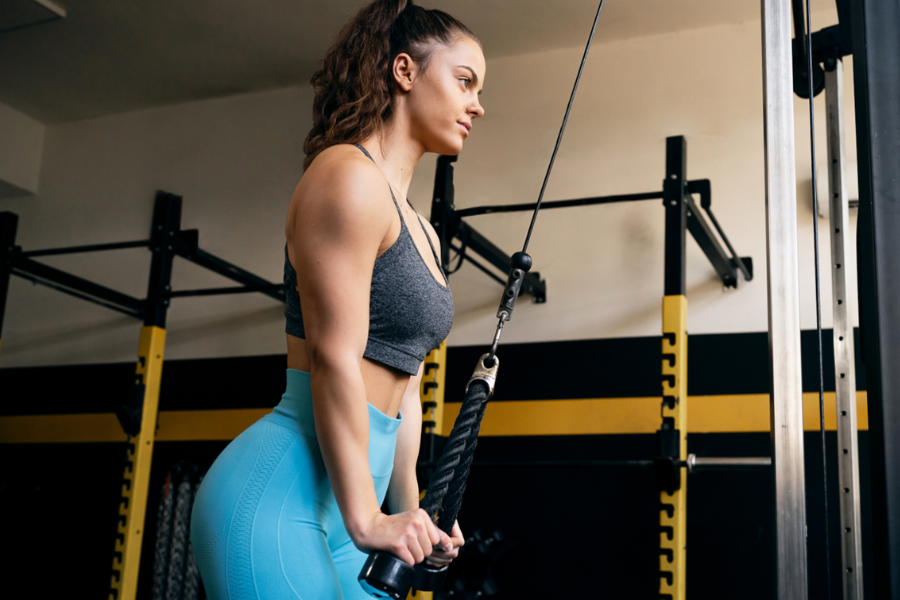
Cable machines are great for elbow friendly tricep exercises because they provide continuous tension without sudden jolts.
For cable side extensions:
- Stand sideways to the cable stack
- Grip the handle with the arm farther from the machine
- Keep your upper arm close to your body
- Extend your elbow until fully straight, then return under control
Benefits:
- Fine control of the angle and range of motion
- Constant resistance that does not drop off at the top
- Comfortable, scalable load for high rep sets
Stick with lighter weights so you can focus on squeeze and lockout rather than fighting the stack.
Safer approach to skull crushers
Skull crushers are often blamed for elbow pain, but the problem is usually too much weight and poor control rather than the exercise itself.
If you want to keep them in your routine:
- Use light weights and avoid ego lifting
- Keep your upper arms steady and only move your forearms
- Lower the weight with slow, controlled motion
- Focus on a pain free range, even if you shorten it slightly
By dialing back the load and increasing control, you can enjoy the muscle building benefits of skull crushers with less risk to your elbows.
Protect your elbows during dips and kickbacks
Dips and kickbacks are popular tricep moves that can either help or hurt your elbows. The difference comes down to setup and range of motion.
Make your dips more elbow friendly
Dips can overload the shoulders and elbows if you drop too deep or let your elbows flare out.
Form adjustments:
- Keep your elbows close to your torso as you descend
- Avoid bending your elbows much beyond 90 degrees
- Stop just before your shoulders feel overstretched
- Press back up with control, without bouncing at the bottom
These changes help prevent overstretching and irritation of the triceps tendons, which is a common contributor to elbow pain.
Using chains for dips
If you are more advanced, using chains can make dips more joint friendly by changing how the weight loads your body.
How chains help:
- They reduce weight at the bottom, where your shoulders and elbows are most vulnerable
- They add more weight as you press up, when your joints are in a stronger position
- This accommodating resistance lets you train hard without maxing out stress at the deepest point
This approach is especially useful if you have shoulder limitations but still want a challenging tricep exercise.
Safer triceps kickbacks
Kickbacks look simple, but small mistakes can overload your elbows.
Safer guidelines:
- Set your upper arm so it is in line with your torso
- Extend your elbow until your arm is parallel with your body, not past it
- Keep the motion controlled, no swinging
- Avoid overextending the elbow during the lowering phase
Limiting your range to a strong, parallel line with your torso helps reduce uneven tendon stress and keeps the movement focused on the triceps.
Build an elbow friendly tricep routine
Putting everything together, you can design a weekly routine that builds strength while respecting your joints.
Sample workout structure
Try starting with a structure like this, adjusting sets and reps to your fitness level:
- Close grip bench press
- 3 sets of 8 to 12 reps
- Focus on bar path and elbow position
- Crush grip bench press or incline crush grip bench press
- 3 sets of 10 to 15 reps
- Emphasize constant squeeze and smooth tempo
- Side lying triceps extensions or cable side triceps extensions
- 3 sets of 12 to 20 reps
- Light weights, full lockout, slow control
- Dips or triceps kickbacks
- 2 to 3 sets in a comfortable rep range
- Prioritize form and pain free range of motion
Between sets, check in with your elbows. You should feel muscular fatigue in your triceps, not sharp or lingering pain in the joint.
Progress without irritating your joints
To keep progressing while staying elbow friendly:
- Add reps before you add weight
- Increase tempo control, for example 2 seconds up, 3 seconds down
- Rotate exercises every few weeks to avoid overuse
- Take extra rest days if your elbows feel tender
If a movement consistently causes joint pain, set it aside for now and focus on alternatives that feel better.
Key takeaways
- Elbow friendly tricep exercises focus on controlling load, locking out the elbow, and strengthening the medial head to support the joint.
- Most elbow pain comes from overworked, stiff tissues and poor technique, not from one single “bad” exercise.
- Close grip bench press, crush grip presses, side lying and cable extensions, and carefully performed dips and kickbacks can all build triceps with less joint stress.
- Lighter weights, higher reps, slow tempo, and thoughtful range of motion protect your elbows while still driving progress.
Start by adjusting one or two exercises in your current routine. Pay attention to how your elbows feel over the next few weeks. With consistent, joint conscious training, your triceps can grow without your elbows paying the price.
About the Author