A strong hamstring workout for men does more than build the back of your legs. When you train these muscles with intention, you boost speed, protect your knees and lower back, and improve everyday movements like bending, lifting, and climbing stairs. Hamstring-focused training is one of the quickest ways to feel more powerful and athletic in your daily life.
Below, you will find a clear guide to how your hamstrings work, the best strength exercises, speed and power drills, and simple stretches to keep everything flexible and pain free.
Understand your hamstring muscles
Your hamstrings are a group of three muscles that run along the back of each thigh: the biceps femoris, semitendinosus, and semimembranosus. Together, they flex your knees and extend your hips. That means they help you bend your knee, straighten your hip, and stabilize your legs when you walk, run, jump, sit, and stand.
When these muscles are strong, they help support your back any time you hinge forward, such as washing dishes or picking up a child from the floor. Weak or tight hamstrings can increase your risk of strains, joint injuries, poor posture, and lower back pain.
A good hamstring workout for men should:
- Train all three muscles through hip extension and knee flexion
- Include both heavy compound lifts and focused isolation work
- Balance strength, speed, and flexibility
Once you understand this, it is easier to see why a couple of light leg curls at the end of leg day are not enough.
Why men often undertrain hamstrings
If your current leg routine centers on squats, leg press, and leg extensions, your quadriceps are getting most of the attention. Many standard leg workouts neglect the posterior chain because front-of-leg exercises are more familiar and often feel easier to load heavily.
Over time, this can create quad dominance and underdeveloped hamstrings, which may:
- Limit your acceleration and jumping ability
- Make cutting, landing, and changing direction less stable
- Raise the risk of hamstring and knee injuries
Athletes across many sports, and even recreational lifters, commonly have below-average hamstring development and strength. Building a more intentional hamstring workout is one of the simplest ways to correct that imbalance.
Key principles for effective hamstring training
Before you jump into specific exercises, keep a few training principles in mind so your effort actually translates into results.
Prioritize form and muscle engagement
To strengthen your hamstrings safely, focus on solid technique. Engage your core and glutes, move with control, and avoid rushing. Even if your range of motion is limited at first, it is better to work through a smaller, high quality movement than to swing heavy weights with poor control.
You will know you are on the right track when you feel the back of your thigh doing most of the work, not just your lower back or calves.
Use enough volume and intensity
Many men only perform a few half-hearted sets of leg curls after heavy quad work. That rarely gives your hamstrings enough stimulus to grow. A more effective approach is at least 10 to 12 challenging sets per week that specifically target the back of your legs, using a mix of compound and isolation exercises.
You can also occasionally add intensity techniques such as rest-pause or drop sets on curls to push past your comfort zone once your form is solid.
Emphasize full range of motion
Rushing through partial reps reduces the stretch and contraction that drive progress. Slowing down your tempo and using a full range of motion helps you hit the hamstrings from origin to insertion. Single-leg versions of certain moves can make it easier to control depth and ensure each side pulls its own weight.
Best strength exercises for hamstrings
These moves form the foundation of a strong hamstring workout for men. Start with the big compound lifts, then add targeted isolation work.
Barbell deadlift
Conventional deadlifts load your entire posterior chain, with heavy emphasis on hip extension. They train your hamstrings, glutes, back, and core in a single movement, which is ideal for building strength and overall power. Fitness guides frequently highlight barbell deadlifts as one of the best hamstring builders when performed for 3 sets of 6 to 8 reps with good form.
Focus on:
- Keeping the bar close to your shins
- Bracing your core before you pull
- Driving through your heels and pushing the floor away
Stop if you feel the movement turning into a lower back lift instead of a hip hinge.
Romanian deadlift (RDL)
Romanian deadlifts are often considered a pinnacle hamstring exercise because they emphasize the hip hinge with only a slight bend in the knees. This places more direct tension on the hamstrings and glutes, especially in the stretched position, and is highly effective at 3 sets of 6 to 8 reps.
Key cues:
- Soften your knees but do not squat
- Push your hips back, letting the bar slide down your thighs
- Lower until you feel a strong stretch in the hamstrings, then return by driving your hips forward
You can progress to single-leg RDLs to improve balance and fix side-to-side strength differences.
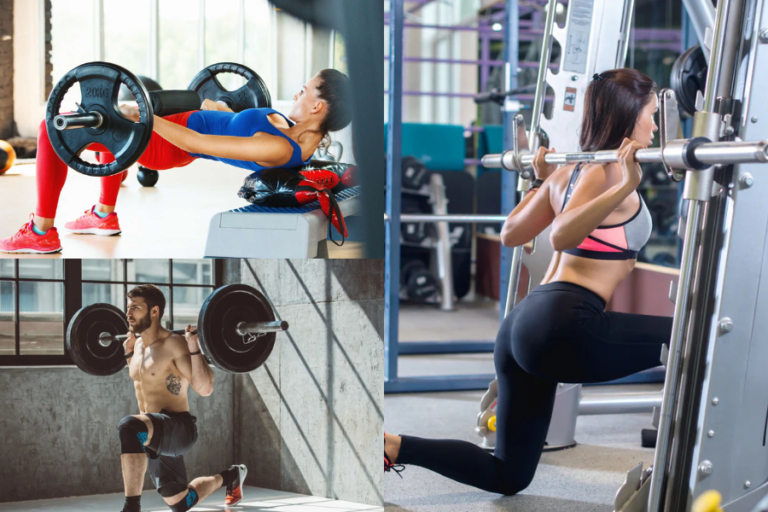
Hip thrusts
Hip thrusts are often known for glute development, but they also recruit the hamstrings, especially when your feet are placed slightly farther out than 90 degrees and you drive through your heels. Using a bench and barbell allows you to load this movement heavily for strength and size.
Aim for 3 to 4 sets of 8 to 12 reps and pause briefly at the top to feel your hamstrings and glutes fully engaged.
Targeted isolation hamstring moves
After your main compound lifts, add isolation exercises to train the hamstrings through knee flexion and to hit specific regions along the muscle group.
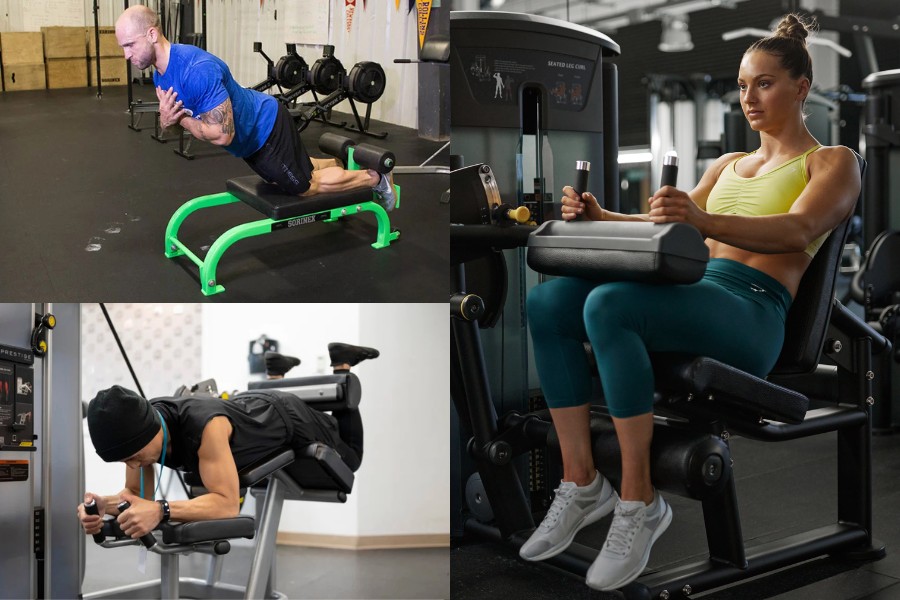
Leg curls: lying, seated, and single-leg
Leg curls directly target the hamstring section closer to the knee. Lying and seated variations each emphasize slightly different parts of the muscle group, so rotating between them can help you build fuller development.
Helpful practices:
- Perform 3 to 4 sets of 10 to 15 reps
- Control both the lifting and lowering phases
- Try single-leg curls to ensure each side is working equally
Using one leg at a time also encourages a more complete range of motion, which leads to a better stretch and contraction.
Nordic hamstring curls
Nordic curls are a challenging bodyweight movement that focuses on knee flexion under high tension. You anchor your feet and slowly lower your body forward from a tall kneeling position, catching yourself with your hands as needed. This creates intense work through the hamstrings and has been shown to be effective for both strength and injury prevention.
Because these are demanding, start with 2 to 3 sets of as many controlled reps as you can manage, and use your hands to assist as you lower and push back up.
Bridges and ball leg curls
Bodyweight bridges and glute-ham bridge variations are good options if you are newer to strength training or do not have access to machines. Bridges with your heels on a stability ball plus an added leg curl combine hip extension and knee flexion in one move.
You can also use simple donkey kicks to activate and strengthen the glute-ham connection while learning to keep your lower back stable.
Speed and power drills for athletic hamstrings
Once you have a base of strength, you can layer in ballistic and power-focused movements to help your hamstrings react quickly and explosively.
Kettlebell swings
Kettlebell swings are a powerful hip hinge exercise that trains your hamstrings, glutes, and back in an explosive pattern. They also elevate your heart rate, which can support conditioning and fat loss.
For hamstring development:
- Use a hip hinge, not a squat
- Snap your hips forward to drive the kettlebell to chest height
- Let the kettlebell swing back between your legs under control
A common recommendation is 3 sets of 12 to 15 swings, resting as needed to keep each set crisp.
Sprint and acceleration drills
Short sprints, resisted sprints, and hill sprints all demand powerful hip extension from your hamstrings. If you are new to sprinting, start with low volume and longer rest to reduce injury risk. Your strength work in the gym will support better mechanics and more forceful strides over time.
Sample hamstring-focused workout for men
You can use the template below once or twice per week as your main hamstring workout. Adjust weights so the last 1 or 2 reps of each set are challenging but do not break your form.
Always warm up with 5 to 10 minutes of light cardio plus dynamic leg swings and hip hinges before heavy lifting.
- Barbell deadlift or Romanian deadlift
- 3 to 4 sets of 6 to 8 reps
- Hip thrust
- 3 sets of 8 to 10 reps
- Lying or seated leg curl
- 3 to 4 sets of 10 to 15 reps
- Single-leg RDL or single-leg curl
- 2 to 3 sets of 8 to 12 reps per leg
- Kettlebell swings
- 3 sets of 12 to 15 reps
If you are already doing a separate heavy squat or quad day, you can place this workout later in the week to give your legs time to recover.
Flexibility and mobility for healthy hamstrings
Strength alone is not enough. To maintain healthy hamstrings and reduce injury risk, you need consistent flexibility work as well.
Experts recommend stretching your hamstrings two to three times per week using standing and seated variations, and holding each stretch for 15 to 30 seconds, without pain. Physical therapists also suggest mobility drills such as the hamstring scoop, hamstring flossing, and lying hamstring stretches with a towel to combat tightness and improve movement quality.
You might include:
- A standing hamstring stretch with your heel on a low surface
- A seated forward bend with a straight spine
- A towel-assisted lying stretch, gently pulling your leg toward you
Take your time and focus on a mild stretch, not an aggressive pull.
Putting it all together
A thoughtful hamstring workout for men combines heavy hip hinges, focused curls, and explosive movements with regular stretching. You do not need a complicated program to see results, but you do need to give the back of your legs as much attention as the front.
Start by adding one or two of the exercises above into your next leg day, and pay attention to how your hamstrings feel during daily tasks and sports. Over a few consistent weeks, you are likely to notice stronger lifts, more stable knees, and a clear boost in power every time you sprint, jump, or simply climb the stairs.
About the Author