A strong hamstring workout for women does more than sculpt the back of your legs. It supports your hips and knees, protects your lower back, and makes daily movements like walking, climbing stairs, and standing up feel easier. When you train your hamstrings with intention, you build lower-body balance instead of just focusing on quads and glutes.
Below, you will find practical guidance, clear exercise breakdowns, and a simple routine you can plug into your week whether you lift at home or in the gym.
Understand why your hamstrings matter
Your hamstrings are a group of three muscles that run from your hips to your knees along the back of your thighs. They help you bend your knees and extend your hips, which you rely on any time you walk, run, jump, sit, or stand, as physical therapist Jared Hoffmann explains for Banner Health.
When these muscles are strong, they help stabilize your knees and hips and support your lower back during moves like hinging forward or picking something up from the floor. That reduces your risk of poor posture and lower back discomfort over time, according to Hoffmann on Banner Health.
If you mostly train squats, lunges, and leg presses, you may be more quad-dominant. This imbalance can leave your hamstrings underdeveloped and tight, which is common in women who sit a lot or do a lot of running or heavy lifting without enough posterior chain work.
Key principles for hamstring training
Before you jump into exercises, it helps to understand a few simple training principles. These keep your hamstring workouts effective and safe.
Train often enough, not all at once
Experts recommend working your hamstrings about one to two times per week as part of your lower-body or full-body workouts. The updated Gymshark training guide suggests that targeting your hamstrings at least twice weekly can maximize strength and size gains.
You do not need marathon sessions. Instead, think in terms of quality sets and consistent effort.
Use progressive overload
Your hamstrings respond best to gradual progression. Progressive overload means you steadily increase one or more of the following over time:
- Volume: more reps or sets
- Intensity: slightly heavier weights
- Density: shorter rest periods or a more controlled tempo
- Frequency: an extra hamstring-focused day every week or two
Research-based guidance from Gymshark and physiotherapists emphasizes that building strength requires moving past “comfortable” weights and reps and gently but consistently challenging your muscles over time.
Prioritize form and full range
For a hamstring workout for women to be effective, form matters more than load. Trainers and physical therapists recommend:
- Engaging your core and glutes
- Moving in a controlled way, instead of rushing reps
- Using a range of motion you can control without pain
If your flexibility or mobility is limited right now, work within your current range. You can deepen that gradually. When in doubt, consult a trainer or physical therapist to check your technique, especially for heavier hip hinge moves like deadlifts.
Best compound hamstring exercises
Compound movements recruit multiple muscle groups at once. These are the backbone of a strong hamstring routine because they train strength, power, and coordination together.
Romanian deadlift
Romanian deadlifts (RDLs) are one of the most effective hamstring builders for women. You can use a barbell, dumbbells, or even a kettlebell.
How to do it:
- Stand with your feet hip-width apart, holding weights in front of your thighs.
- Soften your knees slightly.
- Hinge at your hips, pushing them back as you lower the weights along your legs.
- Stop when you feel a strong stretch in your hamstrings while your back stays flat.
- Drive your hips forward to return to standing.
Surrey Physio recommends three sets of 10 to 12 repetitions with a barbell starting around knee height to effectively activate your hamstrings. Gymshark also highlights Romanian deadlifts and their single-leg variation as top exercises for muscle size and strength.
Conventional or sumo deadlift
Conventional and sumo deadlifts train your entire posterior chain, including your hamstrings, glutes, and lower back. These are ideal if you have access to a barbell or heavier dumbbells.
- Conventional: feet about hip-width apart, hands outside your legs
- Sumo: feet wider, toes slightly turned out, hands inside your legs
Gymshark lists both styles as excellent options for building hamstring size and strength when performed with good form and progressive loading.
Kettlebell swing
If you want strength and power together, kettlebell swings are a strong choice.
- Stand with your feet slightly wider than hip-width, kettlebell on the floor in front of you.
- Hinge at the hips and grab the handle with both hands.
- Hike the bell back between your legs, then snap your hips forward to swing it to chest height.
- Let the bell swing back down and repeat, keeping your spine neutral.
Swings are essentially an explosive hip hinge. The Gymshark guide notes that kettlebell swings are among the best exercises for activating the biceps femoris, one of the main hamstring muscles.
Bulgarian split squat
While Bulgarian split squats are often thought of as quad exercises, the rear-leg elevated position places significant tension on your hamstrings and glutes, especially if you lean your torso slightly forward while keeping a neutral spine.
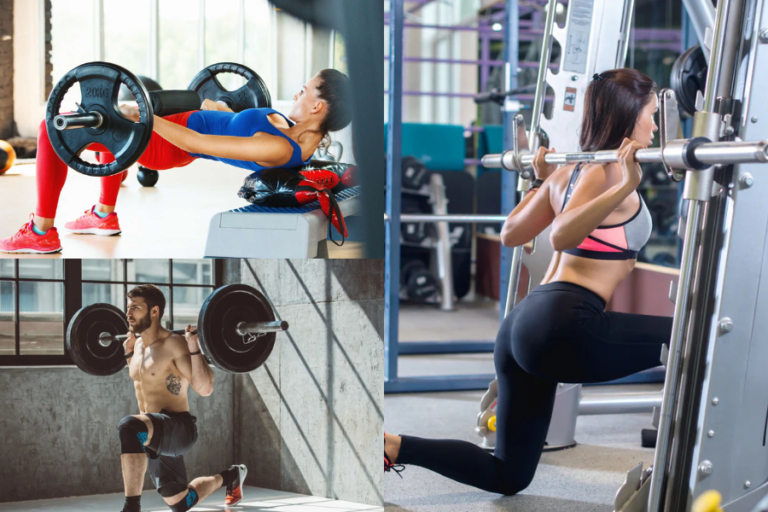
You can perform them with bodyweight to start, then hold dumbbells as you get stronger. Gymshark includes Bulgarian split squats in their list of effective hamstring builders because of their unilateral (single-leg) hamstring and glute demand.
Best isolation and accessory moves
Isolation exercises let you focus directly on your hamstrings. These are helpful later in your workout when your larger compound lifts are done.
Hamstring curls (machine or band)
Hamstring curls directly target your knee flexion strength. You can use:
- Prone or seated leg curl machines at the gym
- Resistance bands tied to a fixed object around your ankle at home
Surrey Physio recommends three sets of 10 to 14 reps when using banded hamstring curls, with the caution to stop if you feel cramping. Gymshark suggests including both seated and lying leg curls in a balanced routine, especially if you are aiming for 12 or more total sets for adequate hamstring volume.
Slow your tempo, fully straighten and then bend the knee, and avoid bouncing the weight.
Glute bridge and hip thrust
Glute bridges and hip thrusts target your hamstrings and glutes while sparing your lower back.
Basic bridge:
- Lie on your back with your knees bent and feet flat, hip-width apart.
- Brace your core and squeeze your glutes.
- Press through your heels to lift your hips until your body forms a straight line from shoulders to knees.
- Pause at the top, then lower slowly.
You can add a resistance band around your thighs, hold a dumbbell or barbell on your hips, or progress to single-leg bridges to increase difficulty. Surrey Physio highlights single-leg bridges as a way to work your hamstrings, core, and glutes together and to help support good posture.
Fitball leg curl
If you have an exercise ball, fitball leg curls add instability, which challenges your hamstrings and core.
- Lie on your back with your heels on top of the ball, legs extended.
- Lift your hips into a bridge.
- Bend your knees and pull the ball toward your glutes.
- Slowly extend your legs back to the starting position, keeping hips lifted.
This move combines a bridge and curl in one, making it a highly efficient accessory exercise.
Sample hamstring workout structures
You can build an effective hamstring workout for women with a mix of 3 to 5 exercises. Adjust sets, reps, and rest based on your experience level and how heavy you are lifting.
Here is a simple comparison of two approaches:
| Goal | Structure | Example exercises |
|---|---|---|
| Strength & muscle | 3 to 4 sets of 6 to 10 reps, longer rests | Romanian deadlift, conventional or sumo deadlift, seated leg curl, single-leg bridge |
| General toning & endurance | 2 to 3 sets of 10 to 15 reps, shorter rests | Kettlebell swing, Bulgarian split squat, banded hamstring curl, glute bridge |
You can also use a circuit-style approach if you enjoy a slightly faster pace. For example, trainers Kristina Earnest and Roxie Jones recommend choosing 3 to 4 exercises like weighted good mornings, banded glute bridges, dumbbell donkey kicks, and kettlebell swings. Perform 10 to 12 reps of each and repeat for three rounds, which takes about 15 to 20 minutes.
Whichever format you choose, listen to your body. If your form starts to break down, pause, rest, or reduce weight.
At-home vs gym hamstring options
You do not need a fully stocked gym to build strong hamstrings. You can swap equipment based on what you have access to.
At-home options
According to strength training guidance from Gymshark, some of the best at-home hamstring moves include:
- Good mornings with a bar, broomstick, or dumbbells
- Bodyweight or weighted glute bridges
- Kettlebell or dumbbell swings
- Straight leg or Romanian deadlifts with dumbbells
- Single-leg Romanian deadlifts
- Fitball leg curls
- Bulgarian split squats
These allow you to train your hamstrings effectively using modest equipment or even just bodyweight in some cases.
Gym-based options
If you train at a gym, you can access heavier loading and more machines. Useful exercises include:
- Barbell deadlifts and Romanian deadlifts
- Seated and lying leg curl machines
- Cable hip extensions
- Barbell glute bridges or hip thrusts
- Sumo deadlifts
Gymshark notes that these machine and barbell movements are ideal when you want to push intensity with more weight while still controlling your form.
Warm up, stretch, and recover
Strong hamstrings are not just about lifting. How you warm up, cool down, and stretch also affects your performance and injury risk.
Warm up before you lift
Experts recommend light aerobic activity followed by dynamic stretches to raise your muscle temperature and prepare your joints. A warmup might include:
- 3 to 5 minutes of brisk walking, cycling, or light jogging
- Leg swings front to back and side to side
- Walking lunges
- Bodyweight good mornings or air squats
This combination prepares your hamstrings for hip hinges, deadlifts, and curls.
Stretch regularly for flexibility
Tight hamstrings are common if you sit a lot or repeat the same workouts. Physical therapists Theresa Shoemaker and Taylor Pfeifer explain that prolonged sitting, quad dominance, and intense running or lifting can all lead to hamstring tightness, especially in women. Regular stretching:
- Increases your range of motion
- Supports better technique in squats, lunges, and hip hinges
- Helps reduce your risk of strains and soreness
Experts advise dynamic stretches before workouts and static stretches afterward, or on non-training days, for about 10 minutes total. Helpful static stretches include:
- Classic hamstring stretch while standing or seated
- Seated forward fold with a long spine, not rounding the back
- Supine wall hamstring stretch
- Hamstring stretch with a gentle twist or pyramid stretch
Hold each stretch for 15 to 30 seconds, or up to 60 seconds, without pain. Trainers also suggest using yoga blocks or a strap if you cannot comfortably reach your feet to maintain good alignment and reduce stress on your nervous system.
Foam rolling your hamstrings and occasional hot Epsom salt baths can ease tension, though baths should not replace stretching since soaking with your legs bent keeps the muscles in a shortened position.
Putting it all together
If you are just getting started, you might begin with:
- Day 1: Romanian deadlifts, glute bridges, banded leg curls
- Day 2 (later in the week): Kettlebell swings, Bulgarian split squats, single-leg bridges
Over time, you can increase weights, add a set, or include an extra exercise as you feel stronger. Remember that your goal is balanced lower-body strength, not just sore legs after every session.
By treating your hamstring workout as a key part of your routine instead of an afterthought, you support your knees, hips, and spine, improve your athletic performance, and move with more confidence in everyday life.
About the Author