A focused hamstring workout with barbell lifts builds power, size, and stronger hips that protect your lower back. Instead of adding more machines or random leg exercises, you can get excellent results from a handful of barbell movements done with good form and smart progression.
Below, you will learn exactly how to train your hamstrings with a barbell, which exercises to prioritize, and how to put them into a simple, effective workout.
Understand what your hamstrings do
Before you load the bar, it helps to know what you are actually training.
Your hamstrings are a group of three muscles on the back of your thigh: the biceps femoris, semitendinosus, and semimembranosus. They help bend your knee, extend your hip, and rotate your leg at the hip. That means they play a major role when you sprint, jump, climb stairs, or stand up with a heavy barbell.
Barbell movements mostly train the hip hinge function of the hamstrings. This is the motion where you push your hips back while keeping your spine neutral. Studies show that Romanian deadlifts and single-leg deadlifts create high activation in hamstring muscles like the biceps femoris and semitendinosus, making them top choices for strength and hypertrophy.
To fully develop your hamstrings you still need some knee flexion work, such as leg curls or Nordic curls. However, barbell exercises are your foundation for building power, mass, and resilience.
Key technique cues for barbell hamstring work
Good technique makes your hamstring workout with barbell lifts safer and more effective. Most of the main barbell movements share a few key cues.
Stay mindful of these in every set:
- Keep a neutral spine. Avoid rounding or hyperextending your back. Think about keeping your ribs stacked over your pelvis while you move at the hips.
- Engage your lats. Lightly pull the bar toward you as if bending it. This tension keeps your upper back stable.
- Hinge at the hips, not the knees. Push your hips back and let your torso lean forward while your shins stay relatively vertical.
- Control the negative. Lower the bar over 2 to 3 seconds. Research on Romanian deadlifts recommends this slower eccentric to maximize hamstring tension and protect your back during the stretch.
- Stop before losing position. When you feel a strong hamstring stretch or your lower back wants to round, that is your depth for now. Over time, your range of motion will improve.
If you are new to hip hinges, it can help to practice with a PVC pipe along your back or do wall-assisted single-leg RDLs before you progress to heavier barbell variations. This lets you learn the pattern with little risk while still feeling the hamstring stretch and engagement.
Romanian deadlift for targeted hamstring growth
The Romanian deadlift (RDL) is usually the best place to start if your goal is a hamstring workout with barbell strength and size. Unlike a conventional deadlift, the RDL starts from a standing position and emphasizes the lowering phase rather than lifting from the floor.
How to do the barbell RDL
- Stand tall with your feet about hip width apart and the bar in your hands at hip level.
- Grip the bar about shoulder width apart, using a double overhand or hook grip.
- Slightly bend your knees and lock that angle in. You are not squatting.
- Take a breath, brace your core, and push your hips back.
- Keep the bar close to your legs, lightly dragging it down your thighs and then your shins as you hinge.
- Lower over 2 to 3 seconds until your hamstrings feel tight or just before your lower back would round.
- Drive your hips forward to return to standing, squeezing your glutes at the top.
This movement pattern keeps tension on your hamstrings and glutes while your back muscles and core work to stabilize. Because you are controlling the eccentric and using a deep stretch, the RDL creates strong muscle building stimulus in the posterior chain.
For muscle growth, aim for 3 to 4 sets of 8 to 10 reps. Use a load that feels challenging by the last 2 reps while still allowing you to move slowly and keep the bar close.
Helpful RDL variations
Once you are confident with the basic barbell RDL, you can increase hamstring activation by:
- Looping a resistance band behind your knees or mid calf to pull you forward slightly, which makes you work harder to hinge back.
- Focusing on a very vertical shin angle with only a soft knee bend, which increases the stretch across the hamstrings.
These tweaks are best added once you can perform standard RDLs with solid form.
Stiff-leg deadlift for extra stretch and size
The stiff-leg deadlift looks similar to the RDL but is more intense on the hamstrings due to even less knee bend and a longer range of motion. This places more stretch and tension on the hamstrings, which is especially useful if your goal is maximum mass or flexibility.
In a stiff-leg deadlift you start from the floor or from blocks with your legs almost straight. You still keep a neutral spine and hinge at the hips, but your knees are only slightly unlocked. This increases the challenge for your hamstrings and spinal erectors, so you will usually use lighter weights than with conventional deadlifts.
Use stiff-leg deadlifts for 3 sets of 6 to 8 controlled reps after your main heavy lift for the day. Focus on slow lowerings and a deliberate squeeze through the back of your legs to stand up.
Conventional deadlift for total posterior strength
Conventional barbell deadlifts are a classic compound lift that train your hamstrings, glutes, adductors, quadriceps, and back. The bar is typically set about 225 millimeters off the ground when loaded with standard 45 pound plates, but you can start with lighter plates or blocks to find a comfortable height.
Deadlifts allow you to handle heavier loads and higher overall volume than most other hamstring exercises, which makes them great for building strength and size. When you keep the bar close, brace your core, and push your hips back before lifting, your hamstrings get a strong training effect alongside your glutes and erectors.
Since deadlifts are demanding, place them early in your hamstring workout with barbell training. A common structure is 3 to 5 sets of 3 to 6 reps with heavier weight, then transition to more hamstring focused lifts like RDLs or stiff-leg deadlifts.
Good mornings for controlled time under tension
Good mornings are another barbell hinge where the bar rests across your upper back, similar to a squat position. From there you hinge at the hips, letting your torso lean forward while your hips travel back, then you stand back up.
With moderate weights, good mornings provide a deep hamstring and glute stretch and plenty of time under tension in the lengthened position. They also challenge your core and improve posterior chain strength, which can reduce your risk of hamstring injury.
Because the bar is on your back and the leverage is demanding, start light. Treat them as a technique and tension exercise rather than a max strength test. Try 2 to 3 sets of 8 to 12 reps, focusing on smooth movement and a consistent depth that you can control.
Hip thrusts and squats as helpful companions
While your main hamstring workout with barbell lifts will revolve around hip hinges, you can support hamstring development by including barbell hip thrusts and squats in your lower body training.
Barbell hip thrusts are a loaded glute bridge variation. They place significant demand on the hamstrings and glutes but with less stress on your lower back than traditional deadlifts or back squats. A 2021 study in PLOS One reported strong hamstring activation from hip thrusts along with reduced spinal load compared with some other lifts, which makes them a smart addition if you have back concerns.
Barbell squats work the hamstrings as part of the larger lower body chain along with your quads and glutes. Going below parallel increases hamstring involvement. Squats are not a hamstring isolation exercise, but as part of a well rounded leg program they contribute to stronger and more muscular posterior thighs.
Add curls for complete hamstring development
Most barbell hamstring exercises focus on hip extension. To fully train the hamstrings you also need to work knee flexion. This means adding some version of:
- Seated or lying leg curls
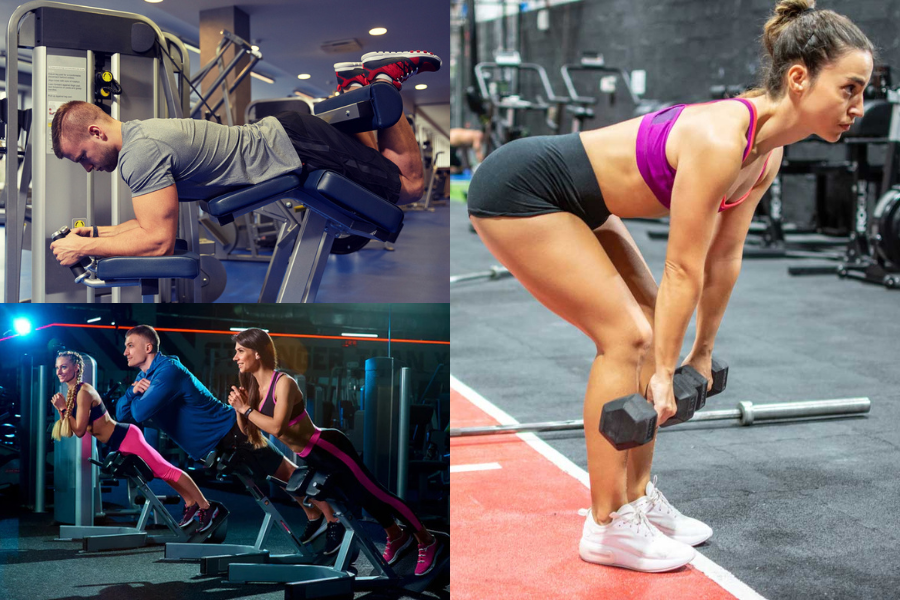
- Nordic hamstring curls
- Glute ham raises
These moves train the hamstrings in their role of bending the knee. Nordic curls and glute ham raises in particular have been linked with lower rates of hamstring strains in athletes by strengthening the muscles where they are most vulnerable.
Aim for at least 2 to 3 sets of 10 to 15 reps of a curl variation at the end of your session. Slow down the lowering phase and allow your hamstrings to lengthen fully on each rep to get the most benefit.
Sample barbell hamstring workouts
You can structure your hamstring workout with barbell exercises in different ways depending on your experience level and goals. Here are three simple templates you can adapt.
Use loads that let you maintain good form for all planned reps. When you can beat the top of a rep range for all sets, increase the weight slightly in the next workout.
Beginner strength and muscle
- Romanian deadlift: 3 sets of 8 to 10 reps
- Good morning: 2 sets of 8 to 12 reps
- Seated or lying leg curl: 3 sets of 10 to 15 reps
This plan lets you learn the hinge pattern and build basic strength without heavy pulls from the floor.
Strength focused posterior chain
- Conventional deadlift: 4 sets of 3 to 5 reps
- Stiff-leg deadlift: 3 sets of 6 to 8 reps
- Glute ham raise or Nordic curl: 3 sets of 6 to 10 reps
You start with heavy compound work, then move to more hamstring dominant lifts and finally deep knee flexion for full development.
Athletic performance and balance
- Barbell RDL: 3 sets of 6 to 8 reps
- Single-leg RDL (dumbbell or barbell as you prefer): 3 sets of 8 to 10 reps per leg
- Nordic curl: 2 to 3 sets of as many controlled reps as you can do
This option targets unilateral stability and hamstring strength in positions similar to running and cutting.
Progress your barbell hamstring training
To keep gaining power and size you need gradual progression. A few simple rules will help you move forward without sacrificing your joints:
- Add weight slowly. Increase loads only when your form is consistent across all sets.
- Track performance. Make a note of your weights and reps so you can see progress in RDLs, deadlifts, and other key lifts over time.
- Prioritize quality reps. Do not rush. Slow eccentrics and full ranges of motion are worth more than sloppy extra weight.
- Use intensity techniques sparingly. Advanced methods like drop sets or rest pause can be effective for hamstring growth, especially on leg curls and RDLs, but add them after you have a solid base of strength and technique.
Finally, remember that your hamstrings often get less attention than quads and upper body work. Building them up with a consistent hamstring workout with barbell exercises not only improves size and shape, it also supports healthy knees, protects your lower back, and enhances your overall athleticism.
About the Author