A strong set of quads does more than fill out your shorts. Effective quad workouts help you lift heavier, protect your knees, move better in everyday life, and perform better in sports. With a little planning, you can train your quadriceps in a way that builds strength, size, and stability without wrecking your joints.
Below, you will learn how your quads actually work, which exercises hit them hardest, how often to train them, and how to avoid the most common quad training mistakes.
Understand your quad muscles
Your quadriceps are a group of four muscles on the front of your thigh. Together, they straighten your knee and help flex your hip, which makes them essential for walking, running, squatting, jumping, and climbing stairs.
The four quad muscles are:
- Rectus femoris
- Vastus lateralis
- Vastus medialis
- Vastus intermedius
Each plays a slightly different role in knee extension and hip flexion, so your quad workouts are most effective when you train all four, not just the most visible outer sweep. Guides from Gymshark explain that a well rounded quad program supports both thigh shape and knee stability.
When these muscles are strong, they help stabilize your kneecap, reduce stress on the joint, and improve your ability to accelerate, decelerate, and change direction. Healthline also notes that strong quadriceps are key for reducing knee stress and improving kneecap stability.
Why quad strength matters
If you care about performance, longevity, or just moving without pain, your quads deserve focused attention.
Everyday movement and aging
Your quads help you:
- Stand up from a chair
- Walk and climb stairs
- Catch yourself if you trip
- Lower yourself to the ground and get back up
Research summarized in a 2024 Gymshark fitness guide connects regular quadriceps strength work with better walking and stair climbing ability later in life, as well as supporting bone density and lowering the risk of osteoporosis and mortality in older adults.
Keeping your quads strong from a younger age can make it much easier to stay active as you grow older, instead of dreading stairs or long walks.
Sports and lifting performance
Quad strength shows up in almost every athletic movement. Strong quads help you:
- Jump higher and land more safely
- Kick harder in sports like soccer
- Push off for sprints and fast direction changes
- Drive out of the bottom of squats, lunges, and sled pushes
The 2024 Gymshark guide highlights that stronger quadriceps improve performance in compound lifts and protect the knee joint by strengthening both muscles and tendons.
Key principles for effective quad workouts
Before you add more exercises, it helps to dial in how often and how hard you train.
How often to train your quads
For strength and muscle growth, a good target is:
- Quad workouts 2 times per week
- At least 2 quad focused exercises each session
- At least 10 total sets for quads per week
Gymshark recommends this frequency and set count for optimal hypertrophy, along with training mostly in the 8 to 12 rep range for 3 to 4 sets per exercise. This gives your muscles enough stimulus, while still leaving at least 48 hours between hard quad sessions for recovery.
Choosing the right rep ranges
If your main goal is muscle growth and strength, most of your quad training can live here:
- 6 to 8 reps for heavier, strength focused sets
- 8 to 12 reps for most hypertrophy work
- 12 to 15+ reps for finishers and higher burn sets
Higher reps with controlled form and deep range often challenge your quads more than trying to pile on weight with half reps.
How foot position and heels affect your quads
Foot position changes which muscles do most of the work in leg exercises. For quads, you want more knee bend and a “knees forward” position instead of sitting way back into your hips.
Here are two key tweaks that dramatically increase quad activation:
-
Heels elevated: Putting your heels on a plate or slant board increases knee flexion and helps you keep a more upright torso. That shifts load from your hips and glutes toward your quads and can also help if your ankle mobility is limited. Gymshark highlights heel elevated goblet squats and front squats for exactly this reason.
-
Knees tracking over toes: Letting your knees travel in line with or slightly over your toes, instead of forcing them to stay far behind, increases quad involvement. On machines like the leg press or hack squat, placing your feet lower on the platform increases knee bend so your quads do more work and your glutes do a bit less.
You may have heard that narrow stances hit the inner quad and wide stances hit the outer quad. Research and coaching experience suggest it is more about depth and knee angle than stance width. Proper foot placement and full range of motion matter more than chasing tiny stance tweaks.
Best compound quad exercises
Compound movements should form the backbone of your quad workouts because they train multiple muscles and joints at once. Below are some of the most effective options and how to perform them so your quads actually do the work.
Front squats
Front squats place the bar in front of your body, which naturally keeps your torso more upright and pushes more load onto your quads.
How to focus on your quads:
- Place your feet about shoulder width apart
- Keep your elbows high so the bar stays on your shoulders
- Sit straight down instead of far back
- Let your knees travel over your toes while your heels stay down
- Squat to at least parallel, then drive up by pushing the floor away
Because of that upright position and deeper knee flexion, front squats create more quad demand than traditional low bar back squats, as highlighted in the Gymshark 2024 guidance.
Heel elevated goblet squats
Goblet squats are beginner friendly and back friendly, but they burn your quads if you perform them correctly.
To do them:
- Hold a dumbbell or kettlebell at your chest
- Place your heels on a small plate or slant board
- Keep your chest tall, core braced
- Squat down until your thighs are below parallel if possible
- Drive through the middle of your foot to stand
Healthline recommends goblet squats as a great choice for beginners because holding the weight in front encourages proper form and allows you to squat lower without stressing your back. Gymshark also points out that elevating the heels increases knee flexion and shifts emphasis from hips to quads.
Hack squats and machine squats
Hack squats and similar machine variations let you push heavy weights with support for your back.
To make them quad focused:
- Place your feet lower on the platform
- Keep your feet about hip to shoulder width
- Squat down with control until your knees are deeply bent
- Push through your midfoot, not just your heels
Gymshark notes that lower foot placement on hack squat and leg press machines increases knee flexion and emphasizes your quadriceps.
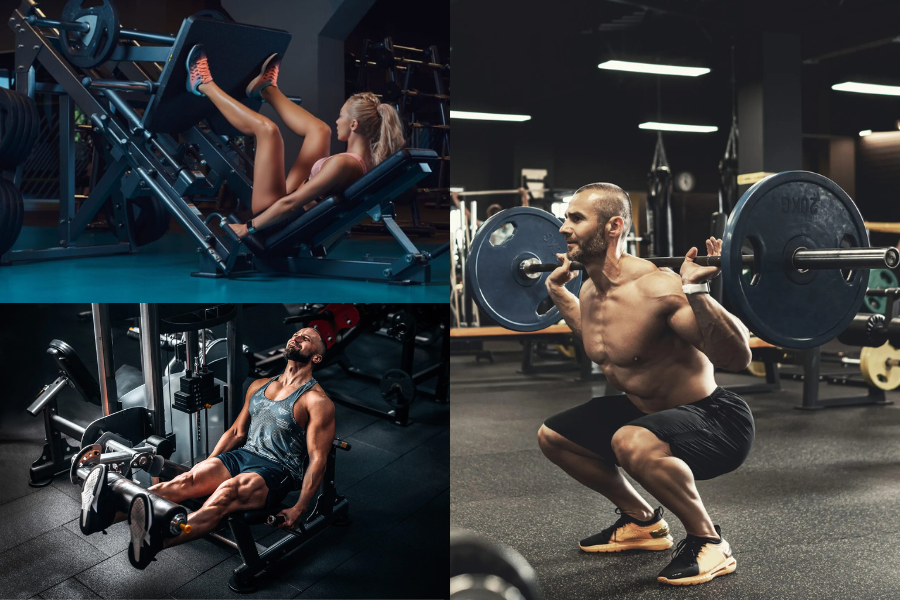
Leg press with low foot placement
The leg press is another excellent tool for loading your quads safely.
For quad emphasis:
- Sit with your lower back glued to the pad
- Place your feet lower on the platform with knees tracking in line with your toes
- Bring the sled down until your knees bend deeply but without pain
- Press up without locking your knees at the top
Because the machine supports your back, you can usually handle more weight here than on free weight squats, which is useful for muscle growth if you keep full range of motion. Gymshark highlights this low foot position for effective quad loading.
Unilateral and bodyweight quad exercises
Single leg work improves balance, fixes strength imbalances, and can be done almost anywhere. Many of these moves need little or no equipment but still challenge your quads.
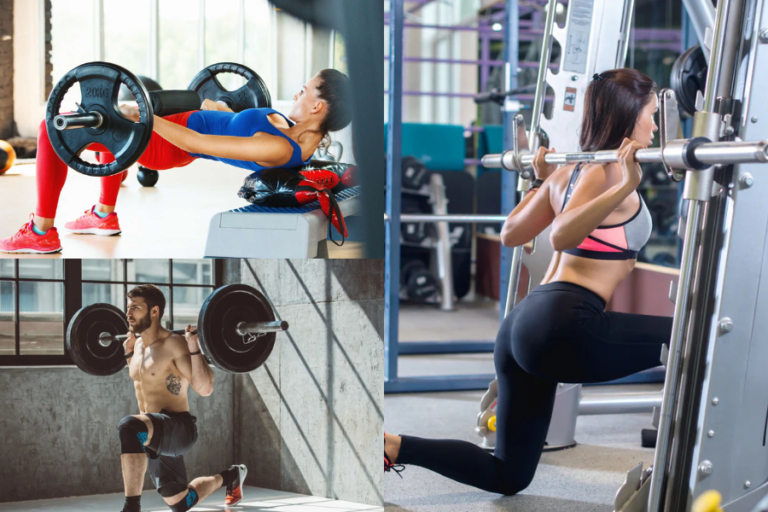
Split squats and Bulgarian split squats
Split squats are essentially static lunges. Bulgarian split squats take that further by elevating your back foot to increase the range of motion and stretch.
Form tips:
- Step one foot forward into a long stance
- Keep your torso upright and front knee tracking over your toes
- Drop your back knee toward the floor without slamming it down
- Drive through the whole front foot to stand
For Bulgarian split squats, place your back foot on a bench or sturdy chair behind you. Healthline suggests 2 sets of 10 reps per side with 30 seconds of rest as a beginner friendly starting point.
Walking lunges
Walking lunges challenge your quads, glutes, and balance at the same time.
To perform them:
- Step forward and lower until your back knee is close to the floor
- Keep your front knee over your toes, not collapsing inward
- Push through the front leg to step into the next lunge
You can start with bodyweight, then add dumbbells once you are comfortable.
Wall sits and single leg raises
If you want simple but effective at home quad exercises, these are reliable options.
-
Wall sit: Slide your back down a wall until your knees are roughly at 90 degrees, like you are sitting in an invisible chair. Hold as long as you can. Healthline recommends 2 sets of 30 seconds, or as long as possible, with 30 seconds rest.
-
Single leg raise: Lie on your back, one leg straight and the other bent. Tighten your quad on the straight leg and raise it until it matches the height of the opposite knee, then lower slowly. This especially targets the rectus femoris, which crosses the hip joint and supports hip flexion and core stability.
These moves are excellent if you are new to training, coming back from time off, or looking for low impact ways to strengthen your quads.
Isolation moves and stretching for healthy quads
You do not need many isolation exercises, but a few well chosen ones can help you fully fatigue your quads and support knee health.
Leg extensions as a finisher
Leg extensions let you isolate knee extension and really focus on squeezing your quads.
You can:
- Use them after heavy compounds as a high rep finisher
- Aim for 12 to 20 reps with controlled tempo and a brief pause at the top
- Avoid using so much weight that you jerk or swing through the movement
These are especially useful if your goal is hypertrophy and you want to ensure all quad heads are fully worked after squats and lunges.
Stretching and foam rolling
Tight quads can pull on your pelvis and kneecap, which may contribute to lower back pain and knee discomfort. Regular quad stretching can help keep things moving well.
A few options:
- Standing quad stretch, pulling your heel toward your glutes
- Lying quad stretch with a strap or towel
- Foam rolling the front and side of your thighs
Healthline suggests foam rolling the quads for 2 sets of 20 seconds each, with 30 seconds of rest between sets, to reduce muscle spasms and improve flexibility. Regular stretching can improve posture and balance by reducing quad tightness that tugs on your lower back.
Sample quad focused workouts
You can tailor your training to your level. Here are two simple examples that you can adjust by changing weights and reps.
Always warm up for 5 to 10 minutes with light cardio such as brisk walking and some dynamic leg swings or bodyweight squats before you start, as recommended by Healthline.
Beginner quad day (at home or in a basic gym)
- Goblet squat, 2 to 3 sets of 10 reps
- Split squat, 2 sets of 10 reps per side
- Wall sit, 2 sets of 30 seconds
- Single leg raise, 2 sets of 10 to 12 reps per side
Intermediate quad day (gym based)
- Front squat, 3 to 4 sets of 6 to 10 reps
- Heel elevated goblet squat or hack squat, 3 sets of 8 to 12 reps
- Leg press with low foot placement, 3 sets of 10 to 15 reps
- Leg extension, 2 sets of 15 to 20 reps
Aim to slowly increase either the weight or the total reps over time, while maintaining clean form and full range of motion.
Common quad workout mistakes to avoid
Training your quads hard is great. Overdoing it or doing it poorly is not.
Going too heavy with short range of motion
One of the most common mistakes is loading up leg press, squats, or hack squats with too much weight and then performing only half reps. This shortens the range of motion so your knees barely bend.
According to guidance summarized in a 2026 SQUATWOLF leg workout guide, using a truncated range of motion limits quad growth even if the weight is heavier, because your muscles are not challenged through their full length. The same guide notes that ego lifting on leg presses mostly serves pride, not progress.
Instead, choose a weight that allows controlled, deep reps where your quads actually have to work hard in the bottom position.
Overtraining quads and ignoring the back of your legs
If you only smash quad focused moves and neglect your hamstrings and glutes, you create muscular imbalances. SQUATWOLF points out that this can:
- Wear out knee joints and ligaments over time
- Increase the risk of ACL injuries
- Hamper overall leg strength and coordination during compound lifts
Balance your quad workouts with hamstring exercises like Romanian deadlifts, leg curls, and hip hinges so your knees are supported from all sides.
Poor squat technique
Leaning too far forward and pushing your hips too far back in every squat shifts the work from your quads to your lower back, hips, and glutes. SQUATWOLF emphasizes that incorrect squat form like this can strain your spinal erectors and fail to properly load your quads.
Recording your squats from the side and checking that your knees, hips, and torso are in a balanced position can help you correct this.
Putting it all together
If you want quad workouts that actually transform your leg strength, focus on:
- Training your quads twice per week with at least ten quality sets total
- Using quad focused compound moves such as front squats, heel elevated goblet squats, hack squats, and leg press with low foot placement
- Letting your knees travel over your toes while your heels stay down for better quad activation
- Including some single leg work and a small dose of isolation exercises
- Stretching and foam rolling regularly to keep your quads and knees happy
- Avoiding ego lifting, partial reps, and ignoring your hamstrings and glutes
Choose one or two ideas from this guide to apply to your next leg day. Even small changes like elevating your heels on goblet squats or committing to full depth on leg press can make a noticeable difference in how hard your quads work and how strong your legs feel over time.
About the Author