Understand unilateral bicep exercises
If you have one arm that is noticeably stronger, unilateral bicep exercises are one of the most effective ways to even things out. Instead of using both arms at once, you work one side at a time so each bicep has to pull its own weight.
With unilateral training you can:
- Spot strength differences quickly
- Give extra attention to your weaker side
- Build more symmetrical size and shape
- Improve joint health by using lighter loads with higher control
Research in The Strength & Conditioning Journal has found that strength from individual limbs in unilateral exercises can even exceed what you produce in bilateral movements, which suggests you can unlock new strength and reduce force deficits when you train one side at a time.
Why imbalances happen and why they matter
Most people naturally have a dominant side. You write, carry bags, and open doors more often with one arm, and that adds up over time.
Mild differences are normal. You only need to pay attention when you notice things like:
- One arm failing first on curls or rows
- Your barbell tilting slightly to one side
- Elbow or shoulder discomfort on just one side
- Visible size differences in your biceps
If you ignore these signs, your stronger side will keep taking over. That can:
- Compromise technique in compound lifts
- Increase the load on your joints
- Raise your risk of overuse injuries
- Limit your strength and muscle gains over time
Unilateral bicep exercises let you correct course by forcing each arm to work independently, so the dominant side cannot silently do extra work.
Key benefits of unilateral bicep work
1. Correct strength and size imbalances
Single arm curls, rows, and presses highlight the weaker side instantly. Since you can adjust weight, reps, and tempo for each arm, you can:
- Add slightly more volume for the weaker side
- Slow down the lowering phase to build control
- Ensure both arms use a full, pain free range of motion
Unilateral work is widely recommended as the best method to fix muscle imbalances. You can give your weaker arm more high quality work, instead of letting the stronger arm dominate every set.
2. Improve mind muscle connection and isolation
For physique goals, unilateral bicep exercises shine because you can focus on one muscle at a time. Movements like concentration curls are especially useful here. These curls are known for isolating the biceps more than nearly any other movement, with a strong emphasis on the short head.
When you are not splitting attention between both arms, it is easier to:
- Feel the bicep doing the work
- Keep your shoulder and torso quiet
- Avoid swinging or using momentum
That kind of strict form adds up to better hypertrophy over time.
3. Support injury rehab and joint health
If you are coming back from an injury or dealing with occasional joint discomfort, unilateral training has two big advantages:
- You can stop a set immediately on the painful side without overworking it just to keep up with the stronger arm
- You can train the healthy side and still get some strength benefit on the injured side through a neural effect called cross education, which is helpful for maintaining strength during recovery
Single arm work also tends to use lower absolute loads than heavy barbell lifts, which can be easier on your elbows and shoulders when you are rebuilding strength.
4. Increase core stability and body control
It is easy to forget that your core works hard during unilateral bicep exercises. Any time you pull or press with one arm, your trunk has to resist rotation.
That extra stability demand can:
- Improve your balance and posture during upper body lifts
- Help you control weight more smoothly
- Carry over to sports and day to day tasks that rely on one side at a time
Research on unilateral training has also linked it to better control of neuromuscular coordination in single limb tasks, which is a fancy way of saying you move more efficiently when only one side is working.
Best unilateral bicep exercises
You do not need a complicated routine to get the benefits of unilateral bicep exercises. A few well chosen moves you repeat consistently will go a long way.
Concentration curls
Concentration curls are a classic for a reason. They are one of the most effective ways to isolate the biceps, with a strong focus on the short head.
How to do them
- Sit on a bench with your feet flat and knees slightly apart.
- Hold a dumbbell in your right hand and hinge forward a bit from your hips.
- Rest the back of your upper arm lightly against your inner right thigh.
- Let the dumbbell hang straight down with your palm facing up.
- Curl the weight toward your shoulder, keeping your upper arm still.
- Squeeze your bicep at the top, then lower slowly with control.
- Complete all reps on one side, then switch arms.
Tips
- Use a lighter weight so you can keep your body still
- Think about pulling through your little finger to keep tension on the bicep
- Avoid leaning back or swinging the weight
Current recommendations suggest doing these after your heavier compound work to finish off the biceps for growth.
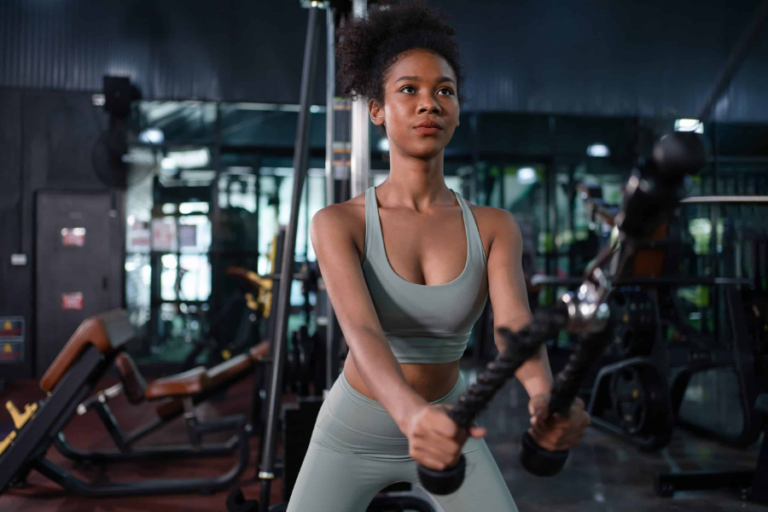
Single arm high cable bicep curl
The single arm high cable curl also targets the short head and keeps your muscles under constant tension.
How to do it
- Set a cable handle at or slightly above shoulder height.
- Stand side on to the machine and grab the handle with the arm farthest from the stack.
- Step out so your arm is slightly out to the side and externally rotated.
- Brace your core and keep your elbow lifted but stable.
- Curl the handle toward your forehead, focusing on bending the elbow rather than moving the shoulder.
- Pause briefly at the top, then lower in a controlled motion.
This setup brings the shoulder into a rotated position, which challenges your stabilizers, and it can help address strength differences between arms. Some recent findings suggest bilateral training might be superior for overall strength performance, but single arm cable curls still play a valuable role when you need targeted bicep work and symmetry.
Hammer curls, one arm at a time
Hammer curls use a neutral grip, with your palms facing each other. You can perform these one arm at a time to hone in on form.
They work:
- The long head of the biceps
- The brachialis, which adds thickness to your upper arm
- The brachioradialis in your forearm
How to do them
- Stand tall with a dumbbell in one hand, palm facing your body.
- Keep your elbow close to your side.
- Curl the weight until your forearm is vertical, keeping the neutral grip.
- Lower slowly, then repeat for your set before switching arms.
Hammer curls help create balanced strength and a fuller looking upper arm, especially when paired with exercises that emphasize the short head.
Single arm bicep curl
Simple, beginner friendly, and easy to load, the single arm bicep curl is a staple unilateral exercise.
How to do it
- Stand or sit with a dumbbell in one hand, arm straight and palm facing forward.
- Brace your core and keep your elbow close to your side.
- Curl the weight up toward your shoulder without swinging your torso.
- Squeeze at the top, then lower slowly.
Single arm curls:
- Target the biceps directly
- Involve your forearms for better grip and wrist stability
- Improve elbow joint control and strength
They are a good starting point if you are new to unilateral training or rebuilding after a break.
How to program unilateral bicep exercises
You can fold unilateral bicep work into your current strength routine without overhauling everything.
Choose your weekly structure
You have a few simple options:
- Add 1 or 2 unilateral bicep exercises to your usual upper body or pull days
- Dedicate part of one workout to focused arm symmetry work
Aim to train your biceps 1 to 3 times per week, depending on your overall program and recovery.
Sets, reps, and rest
The research you saw summarized suggests performing unilateral bicep exercises like concentration curls and single arm cable curls with:
- 3 sets
- 8 to 12 reps
- About 1 minute of rest between sets
This range supports muscle growth and gives you enough volume to address imbalances without drifting into junk volume that does not move the needle.
How to handle the weaker versus stronger side
This is where things get a bit more nuanced, and there is some debate.
Here are the main approaches:
- Same weight and reps for both arms
- Pros: Keeps things simple and balanced
- Cons: The stronger arm may always stay ahead
- Extra volume for the weaker arm
- Example: 3 sets for the strong side, 4 sets for the weak side
- Pros: Gives the weaker arm more practice and stimulus
- Cons: Adds training time and requires careful tracking so you do not overdo it
- Cap the stronger arm at what the weaker arm can do
- Use the same weight and reps as your weaker side, even if you could do more
- Pros: Gives the weaker side room to catch up
- Cons: You may temporarily leave some strength gains untapped on the stronger side
You can test each approach for a few weeks and see how your arms respond. Whatever you choose, stay consistent so you can actually tell what is working.
Sample unilateral bicep focused workout
Here is a simple routine you can plug into your program once or twice per week. Adjust weights to match your current level.
- Single arm bicep curl
- 3 sets of 8 to 10 reps per arm
- Focus on strict form and full range of motion
- Hammer curl, one arm at a time
- 3 sets of 10 to 12 reps per arm
- Control the lowering phase for 2 to 3 seconds
- Concentration curl
- 3 sets of 10 to 12 reps per arm
- Use a lighter weight and chase a strong contraction rather than numbers
If you use cables:
- Single arm high cable curl
- 3 sets of 10 to 12 reps per arm
- Keep constant tension and avoid shrugging your shoulder
Rest 60 seconds between sets. If one arm is clearly weaker, you can add one extra set of the last exercise just for that side.
Common mistakes to avoid
As you start doing more unilateral bicep exercises, keep an eye out for these easy to fix habits.
- Letting your torso twist or sway as you curl
- Rushing the lowering phase and letting gravity do the work
- Training only your biceps without addressing overall upper body strength
- Piling on volume for the weaker arm to the point that recovery suffers
- Ignoring pain or sharp discomfort instead of adjusting the exercise
Remember that unilateral work can be more demanding for your stabilizing muscles, so give yourself a few weeks to adapt before you judge your results.
Putting it all together
If you want stronger, more symmetrical arms, unilateral bicep exercises deserve a permanent spot in your routine. Working one arm at a time lets you:
- Spot and correct imbalances
- Target specific parts of the biceps for size and shape
- Build better joint control and core stability
Start by adding one or two single arm movements to your next workout. Focus on quality reps, even effort between sides, and small, steady progress. Over time, you will feel and see the difference every time you pick up a weight.
About the Author