A solid advanced quad workout does more than leave your legs shaking. It helps you build strength, power, and muscle in a way that actually protects your knees and keeps you training long term. With the right mix of exercises, volume, and recovery, you can take leg day from “going through the motions” to real, visible progress.
Below, you will learn how to structure an advanced quad workout, how often to train, and which exercises give you the most return for your effort.
Understand your quads and why they matter
Your quadriceps are a group of four muscles on the front of your thigh: vastus lateralis, vastus medialis, vastus intermedius, and rectus femoris. The rectus femoris is most often injured in sprinting and kicking and it plays a big role in running and jumping.
When you design your advanced quad workout, you are not just training for bigger legs. You are also:
- Supporting healthy knees by keeping the quads strong and balanced
- Improving performance in sports that involve sprinting, cutting, or jumping
- Reducing your risk of quad strains when intensity or volume increases
Thinking about function as much as size helps you choose movements that carry over into everyday life and sport, not just the mirror.
Prepare your body before advanced quad work
Heavy squats and deep knee bends are not where you want to skip a warm up. Most muscle injuries come from asking cold muscles to handle hard work too quickly.
Start each advanced quad workout with 5 to 10 minutes of light cardio, for example brisk walking or easy cycling, followed by dynamic leg work. This might include leg swings, bodyweight squats, and walking lunges. Then add one or two light sets of your first exercise before you load it heavily.
Cool downs matter too. Gentle cycling, walking, and light quad stretches can help you maintain mobility and keep your legs from feeling locked up the next day. Tight or stiff quads increase the risk of strains and pulls, especially as your training gets more advanced, so mobility is part of the work, not an optional extra.
If you are coming back from injury or you train very heavy, a supportive knee brace can sometimes help you feel more stable. For example, braces like the Ascender are designed to be light, under 1 lb, while unloading up to 40 lbs of force at the knee in high stress situations, which can be useful in certain rehab or return to sport phases.
Plan your training volume and frequency
An effective advanced quad workout is not about doing every leg exercise you know in one session. It is about choosing a few high quality movements and progressing them over time.
A practical structure is:
- 1 to 3 different quad exercises per session
- 2 to 5 different quad exercises across the whole week
If you are focused on hypertrophy, training quads twice a week works very well. Aim for at least 2 quad focused exercises per workout, with 3 to 4 sets per exercise. That gives you a minimum of about 10 sets per week, which is a solid target for muscle growth.
Many lifters grow best in the range of 10 to 20 hard sets per week for a muscle group. That might look like three quad exercises each day across two weekly sessions, with about three working sets of each. Push your sets close to failure with good form, but avoid going so high in volume that you cannot recover between sessions.
For advanced lifters, total quad training frequency can sit between 2 and 5 sessions per week if you manage volume carefully. You might squat heavier on some days and use leg presses or unilateral work on others to reduce joint stress while still accumulating quality work.
Use rep ranges strategically
Your advanced quad workout should not live only in one rep range. Different rep zones challenge your muscles and nervous system in different ways, and combining them builds size and strength more effectively.
A simple way to spread your sets is:
- Heavy: 5 to 10 reps per set
- Moderate: 10 to 20 reps per set
- Light: 20 to 30 reps per set
About half of your weekly working sets can sit in the moderate 10 to 20 rep range. This balances stimulus and fatigue, and lets you accumulate enough volume without your joints complaining.
Use heavy sets on stable compound lifts like front squats or hack squats. Use moderate and higher rep sets on slightly safer or more supported moves like leg presses, goblet squats, leg extensions, and split squats.
Prioritize full range of motion
If you want your advanced quad workout to translate into real hypertrophy, you need to move through as much safe range of motion as you can control. Deep squats, with your hips dropping low and your knees bending deeply, create a strong stretch on the quads under load and drive growth.
For example, squats where your hips drop close to your calves and leg presses where your knees travel near your chest place the quads under long, loaded stretches. That type of work has been linked to greater muscle growth compared to partial, shallow reps.
Do not force depth that your body cannot handle. Use heel elevation, lighter weights, or slower tempo work to gradually own deeper positions rather than bouncing into them.
Build your advanced quad workout with key exercises
You do not need a huge menu of exercises. You need a handful of reliable quad builders that you can progress. Here are some of the most effective advanced options and how to get the most from each one.
Front squats for upright quad loading
Front squats shift the weight to the front of your body, which keeps your torso more upright and increases quad activation compared to many back squat styles. Start with lighter loads than you use for back squats, focus on keeping your elbows high, chest up, and knees tracking over your toes.
Think of sitting straight down between your heels rather than pushing the hips far back. Lower until your thighs are at least parallel to the floor, or deeper if your mobility allows, then drive through the mid foot and heels to stand.
Heel elevated goblet squats for depth and control
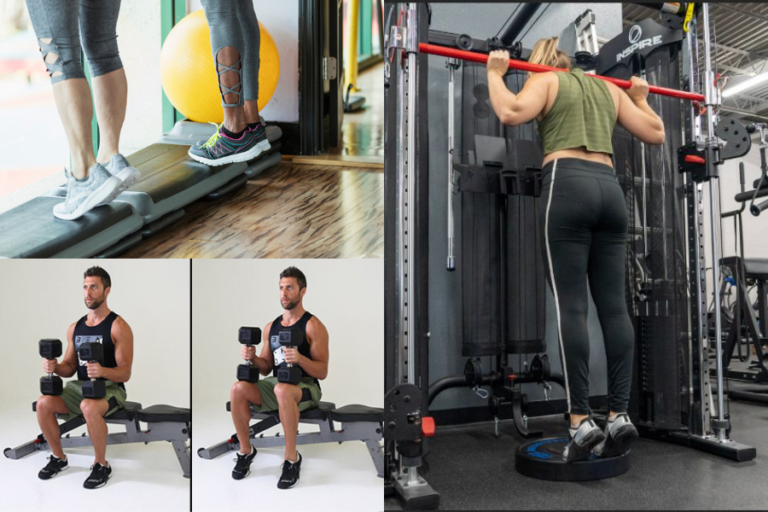
Standing on a 3 to 4 inch plate or slant board transforms a standard goblet squat into a powerful quad builder. Elevating your heels makes it easier to stay upright and reach deeper knee flexion, which hits the vastus medialis near the inner knee, often called the “tear drop” muscle.
Hold a dumbbell or kettlebell at your chest, keep your ribs stacked over your hips, and let your knees travel forward as you sink down. This variation is also friendly for people with limited ankle mobility because the heel lift reduces the demand on the ankles.
Hack squats for supported heavy work
Hack squat machines are excellent in an advanced quad workout because they support your upper body and force you into an upright position. This lets you load the quads hard without overtaxing the lower back.
Place your feet a bit lower on the platform to increase quad involvement. A wider stance will hit the inner thighs more, while a closer stance shifts emphasis to the outer quads. As you descend, avoid letting your pelvis tuck underneath you at the bottom, often called a “butt wink,” because that can place extra stress on your lower back.
Sissy squats for intense quad isolation
Sissy squats are not for beginners, but they are a very direct quad isolator. You rise onto your tiptoes, push your knees fully over your toes, and lean your torso back as you lower, which removes most hip involvement and keeps tension squarely on your quads.
In the beginning, use a sturdy support or a resistance band anchored in front of you for balance. Hold on lightly as you lean back and then pull yourself up as needed. Over time you can move to unassisted bodyweight, and eventually to more loaded or smith machine variations.
Bulgarian split squats and other unilateral work
Single leg exercises highlight and correct side to side differences. Bulgarian split squats, especially in deficit form with the front foot on a plate or block, increase range of motion and quad activation.
To make them more quad centric, keep your torso upright and let your front knee travel over your toes instead of leaning far forward at the hip. You can also elevate the front foot slightly to deepen the knee bend and drive more load into the quads.
Front foot elevated reverse lunges and split squats work similarly. They let you use moderate weights and still get a deep stimulus, which is helpful when you cannot or do not want to pile on more plates for heavy bilateral squats.
Leg extensions for rectus femoris focus
Leg extensions get a bad reputation sometimes, but they are highly effective for zeroing in on the rectus femoris. In advanced quad workouts, you can use them either to pre exhaust your quads before big compound lifts, or to finish the session with targeted work.
Leaning back slightly in the seat, using controlled low to moderate reps with relatively high intensity, will help you keep tension on the quads rather than swinging the weight. Just avoid locking out your knees aggressively at the top.
Simple template: Start with a compound squat pattern, follow with a unilateral move, and finish with an isolation exercise like leg extensions.
Example advanced quad workout structure
Here is a sample layout you can adapt to your equipment and schedule. Perform this twice per week with at least 48 hours between sessions.
Workout A
- Front squats
- 3 to 4 sets of 5 to 8 reps
- Hack squats
- 3 sets of 8 to 12 reps
- Bulgarian split squats (front foot elevated)
- 3 sets of 10 to 12 reps per leg
- Leg extensions
- 2 to 3 sets of 12 to 15 reps
Workout B
- Heel elevated goblet squats
- 3 to 4 sets of 10 to 15 reps
- Front foot elevated reverse lunges
- 3 sets of 10 to 12 reps per leg
- Sissy squats
- 3 sets of as many controlled reps as you can manage with good form
- Optional mechanical dropset finisher
- 5 rounds, resting 2 minutes between rounds:
- 10 dumbbell or kettlebell front squats
- 20 front foot elevated reverse lunges
- 30 heel elevated goblet squats
This finisher, known as a mechanical dropset, keeps increasing your mechanical advantage as you fatigue. It lets you wring out every last bit of effort from the quads without constantly adjusting weights.
Train hard without ignoring recovery or injury signs
The more advanced your quad workout becomes, the more important it is to watch how your body responds. Well planned training reduces injury risk, but it does not remove it.
A few practical guidelines:
- Take at least one lighter week, or “deload,” after 3 to 12 weeks of hard training depending on your level.
- Increase volume and frequency gradually, aiming for around 3 to 4 quad focused sessions per week only if you are recovering well.
- Alternate very demanding barbell squat days with machine or single leg focused days to reduce joint and lower back stress.
If you do strain a quad, early and appropriate rehab is key. Research has reported that starting rehab just 2 days after injury, compared with waiting 9 days, allowed athletes to return to sport roughly three weeks earlier without more reinjuries. Effective rehab focuses on loading the quad with exercises that create no more than about 4 out of 10 pain, starting with simple isometrics like quad sets and then moving to heavier isolated and compound work. Interestingly, allowing mild pain up to 4 out of 10 during rehab has been linked with about 15 percent greater strength at return to play and two months later compared to completely pain free protocols, suggesting better performance and possibly lower reinjury risk.
If in doubt, work with a qualified medical or rehab professional so you can return to your advanced quad workout safely.
Put it all together
An effective advanced quad workout is less about inventing new moves and more about doing the basics at a high level. When you:
- Warm up and move your joints through full, controlled ranges
- Use a mix of heavy, moderate, and lighter rep ranges
- Combine compound, unilateral, and isolation exercises
- Progress your volume and frequency over time while managing fatigue
you give your quads every reason to grow stronger and more resilient.
Pick one or two of the exercise changes above to add to your next leg day, such as swapping standard squats for front squats or elevating your heels for goblet squats. Then build from there week by week until your quad training feels as advanced as your goals.
About the Author