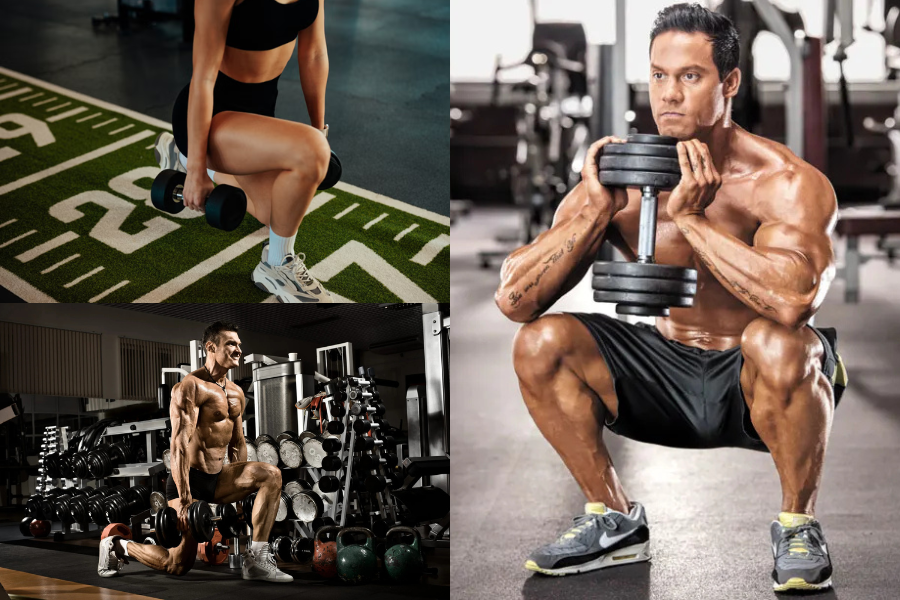
A quad workout with dumbbells is one of the simplest ways to build stronger legs without needing a full gym setup. With just a pair of dumbbells, you can target all four heads of your quadriceps, improve balance, and correct strength imbalances between your legs.
Below, you will learn why dumbbells work so well for quad training, how to perform the best quad exercises with dumbbells, and how to put them together into workouts for any fitness level.
Understand your quad muscles
Your quadriceps femoris is the large muscle group on the front of your thigh. It has four distinct parts that work together whenever you walk, squat, climb stairs, or jump:
- Vastus lateralis, the outer thigh
- Rectus femoris, the central front thigh
- Vastus medialis, the inner thigh near your knee
- Vastus intermedius, a deeper muscle beneath the rectus femoris
These muscles are primarily responsible for straightening your knee and helping stabilize your kneecap during movement, as explained in the 2024 Iron Bull Strength guide on dumbbell quad exercises. When you design a quad workout with dumbbells that hits all four heads, you get stronger legs, better knee support, and more power for sports or daily activities.
Why dumbbells are ideal for quad training
You might associate heavy leg work with barbells, but dumbbells offer some unique advantages.
Unilateral strength and balance
Dumbbells require each leg to work on its own. This is known as unilateral training and it is especially useful if one leg is stronger than the other. Because each side has to pull its own weight, you cannot easily let your dominant leg take over, which helps correct imbalances and reduce injury risk, as highlighted in both the 2021 and 2024 Iron Bull Strength articles.
Joint friendly and versatile
Dumbbells allow more natural arm and shoulder positioning during squats and lunges. This often feels better on your joints than a fixed barbell position. They are also:
- Easy to store at home
- Simple to bring with you when you travel
- Adaptable for beginners through advanced lifters
On top of quad development, dumbbell leg work also trains your grip, since you must hold the weights throughout every set. Over time this can help you handle heavier loads in many other exercises.
Best dumbbell exercises for your quads
The key to an effective quad workout with dumbbells is choosing moves that emphasize knee extension and strong, controlled leg drive. You will find the most effective options below, along with what each one targets.
1. Dumbbell squats
Dumbbell squats are a staple for building overall quad size and strength, with a strong emphasis on the rectus femoris.
How to do them:
Stand with feet about shoulder width apart, holding dumbbells at your sides or up at your shoulders. Brace your core, sit your hips back slightly, then bend your knees to lower until your thighs are at least parallel to the floor. Push through your midfoot and heel to stand back up.
Form tips:
Keep your chest up, knees in line with your toes, and avoid collapsing forward. If you struggle with depth, use a box or bench behind you as a target.
2. Dumbbell lunges
The dumbbell lunge is often ranked as one of the most effective quad exercises with dumbbells. It challenges your thighs, balance, and hip stability at the same time.
How to do them:
Stand tall with dumbbells by your sides. Step forward with one leg, bend your front knee, and lower your back knee toward the ground. Stop just before it touches, then push through the front foot to return to standing. Alternate legs, or complete all reps on one side before switching.
Form tips:
Take a long enough step that your front knee does not track far beyond your toes. Keep your torso upright and avoid leaning too far forward.
3. Close-stance dumbbell front squats
If you want to emphasize the outer quad (vastus lateralis), close-stance dumbbell front squats are a strong choice.
How to do them:
Hold a dumbbell in each hand at shoulder height, palms facing in. Bring your feet closer than shoulder width, with toes slightly turned out. Squat down by bending your knees and keeping your torso more upright, then stand back up.
Why they work:
The narrow stance and upright posture shift more of the work toward the front and outer portion of your thighs, according to the 2024 Iron Bull Strength guide on dumbbell quad exercises.
4. Dumbbell hack squats
Dumbbell hack squats also hit the vastus lateralis and give you an intense quad burn without a hack squat machine.
How to do them:
Stand with dumbbells held behind your body at arm’s length, palms facing back. Keep your feet about hip width apart. Bend your knees and sit your hips down while the dumbbells slide down the back of your legs, then push through your feet to return to standing.
Form tips:
Do not let the dumbbells drift far away from your legs. Keep your chest lifted and core tight to protect your lower back.
5. Split squats and Bulgarian split squats
Split squats and their more advanced cousin, the Bulgarian split squat, are excellent for the inner quad (vastus medialis) and knee stability.
How to do a split squat:
Step one foot forward and one foot back into a staggered stance, holding dumbbells by your sides. Bend both knees to lower your body straight down, then push through the front foot to stand back up. Your front leg should do most of the work.
How to do a Bulgarian split squat:
Place your back foot on a bench or sturdy chair behind you, laces down. Hold dumbbells at your sides and perform the same up and down motion on your front leg. This increases the load on the working quad.
Form tips:
Keep your front knee tracking over your middle toes and avoid collapsing inward. Adjust your stance length until you feel most of the tension in your front thigh, not your back.
6. Lateral and reverse lunges
Side and reverse lunges help you train your quads in multiple directions, which improves real world stability and control.
- Dumbbell side (lateral) lunge: Step out to the side, bend the stepping knee, and sit your hips back while the other leg stays straight. This challenges the inner thigh and hip.
- Dumbbell reverse lunge: Step backward instead of forward. This variation often feels easier on the knees and still heavily involves the quads and glutes.
The 2024 Iron Bull Strength guide notes that side and reverse lunges are useful for targeting the vastus medialis and overall knee stability.
7. Dumbbell step ups
Step ups are highly functional, since they closely mimic climbing stairs. They target the deep vastus intermedius as well as the rest of your quads.
How to do them:
Stand in front of a bench or sturdy box, holding dumbbells at your sides. Place one foot on the bench, drive through that leg to bring your body up, then step down under control. Either alternate legs or complete all reps on one side.
Form tips:
Choose a bench height that lets you keep your balance and maintain control. Focus on pushing through the entire front foot rather than bouncing off your back leg.
8. Goblet squats
Goblet squats are beginner friendly and great for learning proper squat mechanics while still challenging your thighs.
How to do them:
Hold one dumbbell vertically at your chest, gripping under the top plate. Stand with your feet slightly wider than hip width. Squat down, keeping the dumbbell close to your chest and your elbows inside your knees, then stand back up.
Why they work:
The front load helps you stay upright, which shifts more emphasis onto the quads and makes it easier to reach full depth.
9. Dumbbell lunge pulses
Lunge pulses are a small range of motion variation that creates intense time under tension for your quads.
How to do them:
Drop into the bottom of a lunge with dumbbells at your sides. Instead of standing all the way up, move up and down just a few inches, roughly 3 inches, for a set number of reps. According to Iron Bull Strength’s 2021 guidance, this short, repeated movement is excellent for targeting the quads.
Form tips:
Maintain your torso position and keep your front knee stable. Stop the set if your form starts to break down.
10. Dumbbell thrusters and overhead lunges
If you want more of a challenge, you can combine quad work with upper body and core training.
- Dumbbell thruster: Perform a front squat, then press the dumbbells overhead as you stand. This trains your quads, shoulders, and core in a powerful, full body movement that also improves coordination.
- Overhead dumbbell lunge: Hold one or two dumbbells overhead while doing walking or stationary lunges. This variation demands extra core and shoulder stability while still placing a heavy load on your quads.
Sample quad workout with dumbbells
You can build a complete leg session with just a few of these exercises. Here is a simple structure to follow, whether you are training at home or in the gym.
Aim for this workout 1 or 2 times per week, leaving at least one rest or light day between sessions so your legs can recover.
Beginner friendly routine
Start here if you are new to strength training or returning after a break.
- Goblet squat, 3 sets of 8 to 10 reps
- Dumbbell reverse lunge, 3 sets of 6 to 8 reps per leg
- Dumbbell step up, 2 to 3 sets of 8 reps per leg
Rest 60 to 90 seconds between sets. Focus on smooth, controlled movements and good posture.
Intermediate superset routine
Once you are comfortable with the basics, you can increase the challenge by pairing exercises back to back, as suggested by the 2024 Iron Bull Strength guide.
Perform each pair as a superset, with minimal rest between exercises:
-
Superset A
-
Dumbbell squat, 3 sets of 8 to 10 reps
-
Dumbbell lunge pulses, 3 sets of 10 to 12 pulses per leg
-
Superset B
-
Dumbbell step up, 3 sets of 8 reps per leg
-
Dumbbell side lunge, 3 sets of 6 to 8 reps per leg
Rest 60 to 90 seconds after each full superset.
Advanced quad focus split
If you already lift regularly and want to emphasize inner and outer quad development, you can split your focus within a single workout.
Outer and front quad focus (vastus lateralis and rectus femoris):
- Close-stance dumbbell front squat, 4 sets of 6 to 8 reps
- Dumbbell hack squat, 3 sets of 8 to 10 reps
Inner and deep quad focus (vastus medialis and intermedius):
- Bulgarian split squat, 3 sets of 8 reps per leg
- Dumbbell step up or goblet squat, 3 sets of 10 reps
Keep rests around 90 seconds, and adjust weights so that the last 2 reps of each set are challenging but still controlled.
How to progress your quad workout with dumbbells
To keep building strength and muscle, you will need to gradually make your quad workouts more demanding. You can do that in several ways:
- Increase the weight of your dumbbells
- Add more sets or a few extra reps
- Slow down the lowering phase to increase time under tension
- Try more advanced variations like Bulgarian split squats, thrusters, or overhead lunges
Most importantly, pay attention to your knees and hips. A little muscle burn is normal, but sharp joint pain is a sign to stop, adjust your form, or choose a more suitable variation.
With a thoughtful quad workout with dumbbells, you can build stronger, more balanced legs in a small space, with minimal equipment, and at any experience level. Start with two or three of the exercises above this week, focus on good form, and gradually build from there.
About the Author