Why a back workout for women matters
A consistent back workout for women does more than help you look toned in a tank top. When you strengthen your lats, traps, rhomboids, and the muscles that run along your spine, you support your posture, protect your lower back, and make everyday tasks like carrying groceries or lifting kids feel easier.
Experts note that women are more prone to back and spine related issues, especially as you age and go through menopause. Back training can help reduce pain linked to long hours of sitting, large breasts, repetitive lifting, and even protective hairstyles like braids that put extra strain on your neck and upper back. Strength work also supports better breathing and can reduce stress by helping you move and stand more efficiently.
If you often finish the day with a tight neck or sore low back, a smart, targeted back routine can be part of your long term fix.
Know your key back muscles
Before you start, it helps to know which muscles your back workout for women is actually training. You do not need an anatomy degree, just a quick mental map.
Upper back and shoulders
-
Trapezius (traps)
Runs from your neck across the tops of your shoulders and down toward the mid back. Strong traps help stabilize your neck and shoulder blades and improve posture. -
Rhomboids
Sit between your shoulder blades. These muscles pull your shoulder blades together and keep your shoulders from rounding forward. -
Rear deltoids (rear delts)
The back part of your shoulder muscles. They help control arm movement behind you and add shape to your upper back.
Mid back and lats
- Latissimus dorsi (lats)
Large muscles on the sides of your back that give you that “V” shape. They help you pull, row, and lift, and they are key for posture and spine support.
Lower back and core support
-
Erector spinae
Long muscles that run along each side of your spine. They help you stand tall, hinge from the hips, and resist rounding in your lower back. -
Core partners
Your glutes and deep ab muscles work with your back to keep your spine stable. A strong back is part of a strong core, not separate from it.
When your workout targets all of these areas, you build a back that is strong, balanced, and less prone to pain.
How to train your back safely
Back muscles tend to fatigue a bit faster than some other muscle groups, so how you structure your workout matters.
Use a smart rep and weight range
For most women, a good starting point is:
- 8 to 12 repetitions per set
- 2 to 3 sets per exercise
- A weight that makes the last 2 reps feel challenging but still lets you keep good form
Experts recommend lifting heavy enough to reach muscular fatigue in that 8 to 12 rep window. Staying with very light weights forever will not give you the strength or muscle tone you are looking for.
Progress gradually
Progressive overload simply means slowly asking your muscles to do a bit more over time. You can:
- Add a small amount of weight
- Add 1 or 2 reps to each set
- Add an extra set
- Reduce rest slightly between sets
Increase only one variable at a time, and never at the expense of your form.
Focus on form, not ego
To protect your spine:
- Keep a neutral back when you hinge or row. Your spine should look straight from the back of your head to your tailbone, not rounded or dramatically arched.
- Brace your core lightly, as if you were about to cough.
- Move with control, no jerking or swinging weights.
- Stop if you feel sharp or pinching pain in your back, shoulders, or neck.
Avoid lifting excessively heavy weights just because you feel pressured to advance quickly. Steady, safe progress will get you further than a single “hero” set that tweaks your back.
Warm up and cool down
Before your workout, spend 5 to 8 minutes warming up:
- Gentle cardio like brisk walking or easy cycling
- Arm circles
- Cat cow stretches
- Dynamic band pull aparts
- Thoracic spine rotations
After your workout, cool down with:
- Light walking or marching in place
- Full body stretches with extra focus on hips and hamstrings
- Simple back stretches that feel relieving, not painful
Static stretching is better saved for the end of your session rather than the beginning.
15 minute back workout for women
This quick back workout for women is built around guidance reported by Women’s Health in 2026, which recommends using free weights of 10 pounds or less, minimal rest, and higher repetitions to match how your back muscles naturally fatigue.
You will:
- Choose five exercises from the list below.
- Perform 8 to 10 reps of each.
- Move from one exercise to the next with minimal rest, just enough to catch your breath and reset.
- Rest 60 to 90 seconds, then repeat the circuit 2 to 3 times.
You can do this 2 to 3 times per week, allowing at least one rest day between sessions.
Exercise options for your circuit
Pick a mix that hits upper, mid, and lower back.
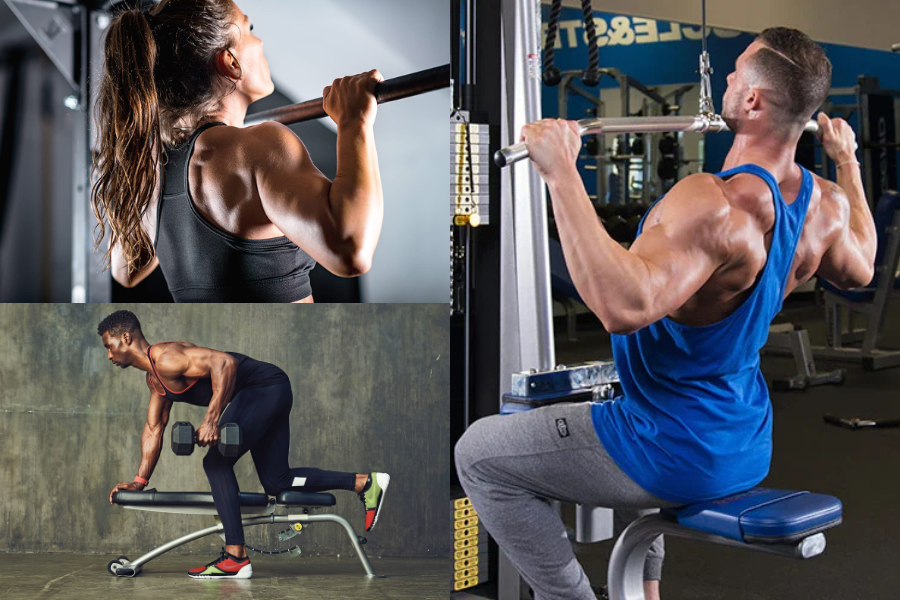
Bent over row
- Targets: Lats, rhomboids, mid back, biceps
- Equipment: Dumbbells, kettlebells, or barbell
How to:
- Stand with feet hip width apart, a weight in each hand, palms facing in.
- Hinge forward from your hips until your torso is about 45 degrees to the floor, back neutral.
- Let your arms hang straight down.
- Pull the weights toward your ribcage, squeezing your shoulder blades together.
- Lower with control.
Keep your neck in line with your spine by looking at a spot on the floor a few feet ahead of you.
Single arm bent over row
- Targets: Lats, mid back, core stabilizers
- Equipment: Dumbbell, bench or sturdy chair
How to:
- Place your left hand and left knee on the bench, right foot on the floor.
- Hold a dumbbell in your right hand, arm extended toward the floor.
- Keep your back flat and core braced.
- Row the weight toward your hip, leading with your elbow.
- Lower slowly and repeat.
- Switch sides.
This variation lets you focus on one side at a time, which is helpful if you have strength imbalances.
Reverse fly
- Targets: Rear delts, upper back, posture muscles
- Equipment: Light dumbbells or resistance bands
How to:
- Stand with feet hip width apart and a slight bend in your knees.
- Hinge forward a bit from your hips, back flat, arms hanging down with a weight in each hand, palms facing each other.
- Keeping a small bend in your elbows, open your arms out to the sides until they are in line with your shoulders.
- Squeeze your shoulder blades together at the top, then slowly lower.
Use lighter weights here and focus on control to avoid shrugging your shoulders toward your ears.
Renegade row
- Targets: Lats, mid back, core, shoulders
- Equipment: Dumbbells
How to:
- Start in a high plank with hands gripping dumbbells, shoulders over wrists, feet hip to shoulder width apart.
- Brace your core to keep your hips level.
- Row one dumbbell toward your ribcage, keeping elbow close to your body.
- Lower it back to the floor and repeat on the other side.
You can make this more accessible by widening your stance or dropping your knees to the floor while still keeping a straight line from knees to shoulders.
Superman hold
- Targets: Lower back, glutes, hamstrings, deep core
- Equipment: None
How to:
- Lie face down on a mat with arms extended overhead and legs straight.
- Simultaneously lift your arms, chest, and legs a few inches off the floor.
- Hold for 2 to 5 seconds, then lower with control.
- That is one rep.
This is a beginner friendly move that does not require equipment and directly strengthens the muscles that support your lower back.
Reverse snow angel
- Targets: Upper back, rear delts, lower back
- Equipment: None
How to:
- Lie face down on a mat with arms by your sides, palms facing down.
- Lift your chest slightly off the floor.
- Sweep your arms out and up in a wide arc until they are overhead, like making a snow angel.
- Sweep them back down to your sides.
Move slowly and keep your focus on squeezing between your shoulder blades, not how high you can lift your chest.
Sample back workouts by level
You can adapt the 15 minute format to your current fitness level. Use these as templates and adjust as needed.
Beginner back workout
Do this routine 2 to 3 times per week with at least one rest day between sessions.
- Lat pulldown machine
2 sets of 8 to 10 reps - One arm dumbbell row
2 sets of 8 to 10 reps per side - Seated cable row
2 sets of 8 to 10 reps - Plank
2 holds of 20 to 30 seconds
Rest 60 to 90 seconds between sets. Focus on learning how a good scapular squeeze feels, that gentle pinching between your shoulder blades.
If you do not have access to machines, substitute band pulldowns and band rows.
Intermediate back workout
Once you feel comfortable with the basics and your form is solid, you can try this 2 to 3 times per week.
- Cable pullover
3 sets of 10 to 12 reps - High row machine or band high row
3 sets of 10 to 12 reps - Bent over row
3 sets of 10 to 12 reps - Assisted pull up or band assisted pull up
3 sets of 6 to 8 reps - Reverse fly
3 sets of 10 to 12 reps - Plank
3 holds of 30 to 45 seconds
Rest 45 to 60 seconds between sets. Start your session with the multi joint lifts like rows and pull ups, then move to the single joint moves like reverse flys. This order keeps your smaller arm muscles from fatiguing too early, which lets you get more out of your back training.
Home back workout for women
You do not need a full gym to build a stronger back. With a couple of dumbbells, a kettlebell, or even just a resistance band, you can train effectively in a small space.
With minimal equipment
Choose 4 to 5 of these and complete 2 to 3 rounds:
- Bent over dumbbell rows
- Single arm dumbbell rows
- Renegade rows
- Gorilla rows with kettlebells or dumbbells
- Band pull aparts
- Band pulldowns attached to a sturdy anchor point
- Superman holds
Aim for 10 to 12 reps per move. If an exercise feels too easy, slow down the lowering part of the movement and add a slight pause at the top.
Without any equipment
If you are starting from scratch or traveling, bodyweight only back work is still valuable.
Try:
- Plank
3 holds of 20 to 45 seconds - Superman holds
3 sets of 8 to 12 reps - Reverse snow angels
3 sets of 10 to 15 reps - Cat cow stretches as active mobility
8 to 10 slow cycles - Wall slides
Stand with your back against a wall and glide your arms up and down while keeping wrists and elbows in contact with the wall.
2 sets of 10 reps
You can do this short routine 3 times per week. As you get stronger, consider adding a band set to your home gear so you can introduce rowing and pulldown patterns.
Combine back and biceps for efficiency
Most pulling movements already involve your biceps as helper muscles. That means you can combine your back workout for women with a bit of biceps work and save time.
For example:
- Bent over rows
- Lat pulldowns or band pulldowns
- Single arm dumbbell rows
- Reverse flys
- Then 1 or 2 direct biceps exercises like curls, 2 to 3 sets
Because your biceps are already working hard during rows and pulldowns, you usually do not need a long list of separate arm exercises.
How back training protects your health
Beyond strength and muscle tone, a regular back workout supports your long term health in several ways.
Less back pain and injury risk
A weak back is one of the most common contributors to back pain and injury. Sedentary work, like long hours at a desk or call center, is strongly linked with chronic or acute back pain. Strengthening the muscles that support your spine can help counteract this.
Balanced training helps:
- Stabilize your spine under load
- Reduce strain during everyday lifting and carrying
- Decrease the chance that one overworked area, like your lower back, has to do the job of your whole posterior chain
Better posture and breathing
Stronger traps, rhomboids, lats, and erector spinae make it easier to maintain upright posture without constant effort. That means:
- Less rounding of the shoulders
- A more neutral neck position
- Less tension through your upper back
Back exercises that support spinal alignment also encourage better breathing mechanics. When your upper body is not slumped, your rib cage can expand more easily, which may help reduce stress and improve focus and emotional control.
Support through hormonal and life changes
Women often see changes in back comfort and spinal health after pregnancy and during menopause. Strengthening your back and surrounding core muscles can support you through:
- Shifts in body weight and distribution
- Changes in bone density and joint comfort
- New daily demands like lifting and carrying children or caring for aging parents
A strong back gives you more capacity to handle what life throws at you.
Avoid common back training mistakes
A few simple adjustments can make your training more effective and more comfortable.
Relying only on crunches
If you are doing endless crunches in hopes of a stronger core or a flatter stomach, you may be irritating your back instead. Crunches tighten your hip flexors, which can tug your lumbar spine forward and add stress to your lower back, according to research discussed by Spine and Wellness Centers of America in 2026.
Instead, build a routine that includes:
- Anti extension core work like planks
- Hip strengthening for your glutes
- Back extension and rowing patterns
This combination supports your spine from all sides.
Skipping hips and hamstrings
Tight hips and hamstrings often show up as back pain. After your workout, take a few minutes for:
- Hip flexor stretches
- Hamstring stretches
- Gentle spinal mobility work
This can help reduce the risk of post workout back discomfort, especially if you spend most of your day sitting.
Ignoring early warning signs
A little muscle fatigue feels like warmth or mild burning that fades after your set. Problem pain can feel:
- Sharp or stabbing
- Pinchy in the joints
- Like numbness or tingling down a leg or arm
If you notice these, stop the exercise and, if needed, consult a medical professional, especially if you have a history of back issues. Beginners or anyone with preexisting back problems are often encouraged to check in with a physical therapist, chiropractor, or doctor before starting new back workouts.
Putting your back workout into a weekly plan
You do not have to train your back every day. In fact, recovery is when your muscles adapt and get stronger.
A simple weekly structure might be:
- Two to three back focused sessions per week
For example, Monday, Wednesday, and Friday. - At least one rest day between back sessions.
- Mix of:
- One gym based workout
- One at home dumbbell or band workout
- One shorter bodyweight or 15 minute circuit if your week is busy
You can pair back with:
- Chest and shoulders on a separate day
- Lower body on another day
- Or do full body workouts where back is one of your main movement categories
The “best” split is the one you can stick with consistently.
Key takeaways
- A back workout for women supports posture, eases everyday lifting, and helps protect you from common spine issues.
- Aim to train all major back muscles, including traps, rhomboids, lats, rear delts, and erector spinae, for balanced strength and shape.
- Use weights that challenge you in the 8 to 12 rep range for 2 to 3 sets, and progress gradually over time.
- Start with multi joint exercises like bent over rows, deadlifts, and pulldowns, then add isolation moves like reverse flys.
- You can build an effective back routine in the gym, at home with simple equipment, or even with bodyweight only.
- Warm up, focus on form, stretch your hips and hamstrings afterward, and listen to your body to avoid injury.
Pick two or three of the exercises that feel most approachable and add them to your next workout. As you build confidence and strength, you can expand your routine and enjoy the benefits of a strong, supported back in every part of your life.
About the Author