Calf workouts for athletes are about much more than building visible lower legs. Strong calves help you run faster, jump higher, cut and change direction with confidence, and protect your ankles and knees from injury. They are central to nearly every sport, from sprinting and soccer to basketball and long‑distance running.
This guide walks you through how your calves work, why they matter so much for performance, and exactly how to train them with effective, athlete‑focused workouts.
Understand your calf muscles
Before you load up the calf raise machine, it helps to know what you are actually training. The calf muscle group is often called the triceps surae. It includes three muscles that work together to support posture, balance, and movement.
Gastrocnemius
The gastrocnemius is the larger, more visible calf muscle that gives your lower leg its shape. It crosses both the knee and ankle joint, which means it helps bend your knee and point your toes.
Because it spans two joints, the gastrocnemius is heavily involved in explosive movements like sprinting, jumping, and powerful changes of direction. Standing calf raises are one of the best ways to target this muscle, and are often programmed for 4 to 6 sets of 20 or more reps depending on your goals, as highlighted by Westside Barbell in their calf training guidelines.
Soleus
The soleus sits underneath the gastrocnemius. It crosses only the ankle joint, not the knee, and is most active when your knee is bent.
This muscle is critical for endurance and stability, especially in distance running. Seated calf raises, where your knee is bent to about 90 degrees, specifically target the soleus by forcing it to handle most of the workload.
Plantaris and support role
The plantaris is a small muscle that assists the other two, but in most training plans you do not need special exercises for it. When you combine standing and seated calf work, you will naturally train the entire triceps surae to support your ankles and knees through a full range of motion.
Calf muscles also absorb very high forces every step you take. During running, your calves can experience internal loads up to several times your bodyweight, which makes dedicated strengthening important for both performance and long‑term joint health.
Why calf strength matters for athletes
If you have ever finished a game with burning calves or pulled up with a sudden tightness in your lower leg, you already know this area is a weak link for many athletes.
Pulled calf muscles account for roughly 12 percent of professional soccer injuries and 13 percent of football injuries, which hints at how often these muscles are overloaded without enough preparation.
Performance benefits
Well trained calves contribute to several key abilities.
- Sprint speed. Your calves provide the push that drives you forward with each step. Research has identified dynamic maximum calf strength as a prerequisite for short sprints, so stronger calves tend to mean better acceleration and top speed.
- Vertical jump and change of direction. A 2021 study on young male basketball players found that greater calf muscle size was linked to better vertical jump and improved speed, suggesting calf development directly supports explosive power and agility.
- Running economy and endurance. For endurance athletes, your soleus muscle in particular plays a major role in sustaining steady pace. Strong calves help you maintain form longer and delay fatigue, which can be the difference between finishing strong and breaking down late in a race.
Calf strength also helps with swimming kick power, tennis movement, hiking uphill, and nearly any sport that involves repeated jumping, pushing, or fast footwork.
Injury prevention
Calf workouts for athletes are equally important for staying healthy across a long season.
Your calves support your ankle joints and reduce strain on the Achilles tendon. When they are weak, the tendon takes on more stress, which increases the risk of tendonitis or more serious damage to tendon fibers.
Regular calf strengthening, combined with stretching and foam rolling, can help prevent issues such as:
- Shin splints
- Achilles tendon irritation
- Recurrent ankle sprains
- General calf tightness and cramps
By stabilizing both the ankle and knee, your calves also help you maintain better alignment during squats, deadlifts, and cutting movements on the field or court. This improved joint control can reduce wear and tear over time, something that becomes more important as training volumes and competition intensity increase.
Principles of effective calf training
To get the most out of your calf workouts, it is worth following a few basic training guidelines. These points apply whether you are a runner, team sport athlete, or strength athlete.
Train both straight‑leg and bent‑knee
Because the gastrocnemius and soleus are activated differently based on knee angle, you need two main categories of exercises.
- Straight‑leg exercises like standing calf raises and toe walks emphasize the gastrocnemius and explosive power.
- Bent‑knee exercises like seated calf raises emphasize the soleus and endurance‑oriented stability.
If you only ever do one type, your development will be incomplete and you may leave a performance gap.
Focus on control, not just load
It is easy to bounce through calf exercises and rely on tendon elasticity instead of true muscle work. Controlled, methodical training is more effective and safer.
Move slowly enough that you feel the muscle doing the work at each phase. Lower your heel under control, pause briefly at the bottom, then press up firmly and squeeze at the top. This style of training helps shift the emphasis away from your tendons and into the tissue you actually want to strengthen.
Use a full range of motion
Aim to work through full dorsiflexion and plantarflexion, in other words pulling the toes as far up as your ankle allows, then pushing as far down as you can without pain or losing balance.
If you cannot reach a full stretch at the bottom of the movement, you may benefit from some gentle ankle mobility work before loading heavy. Quality of movement is especially important if you are prone to stiff ankles or past lower‑leg injuries.
Prioritize volume and effort
Calf muscles can respond well to both heavy and light loads as long as effort is high. Research by Brad Schoenfeld and colleagues suggests that muscle growth in the calves occurs similarly across different loads if you work close to fatigue.
For you, this means you can perform higher rep sets, for example 15 to 25 reps, or moderate rep sets such as 8 to 12 reps, as long as you are nearing your limit by the end of each set. Many athletes benefit from slightly higher repetitions because of the endurance demands on the calves in sport.
Vary your foot position
To effectively train all parts of the gastrocnemius, you can rotate your foot position during calf raises. A 2020 study by Nunes and team suggested using:
- Feet forward
- Feet turned slightly inward
- Feet turned slightly outward
You might perform two sets with feet forward, then one inward and one outward to cover the full range of fiber orientation in the muscle.
Key calf exercises for athletes
You do not need a long list of movements. A small group of well performed exercises will cover most of your needs. Start with bodyweight, then progress to added load when you can complete your target reps with good control.
Standing calf raise
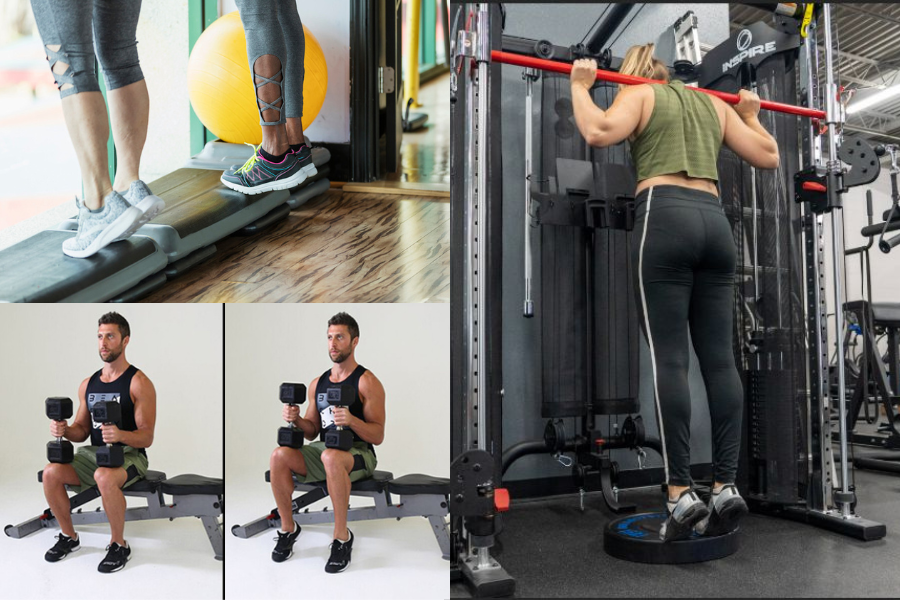
Standing calf raises are one of the best all‑around calf workouts for athletes. You can do them on a machine, in a squat rack with a barbell, or holding dumbbells.
- Stand with the balls of your feet on a sturdy edge or step and your heels hanging off.
- Keep your legs mostly straight but not locked.
- Lower your heels slowly until you feel a strong stretch in your calves.
- Press through the balls of your feet to raise your heels as high as possible.
- Pause and squeeze at the top, then repeat.
For performance‑focused training, Westside Barbell suggests 4 to 6 sets of 20 or more reps, sometimes as many as possible, depending on the goal of the session.
To increase intensity further, switch to single‑leg calf raises. These significantly boost the load on each calf and are a useful progression once double‑leg raises become easy.
Seated calf raise
Seated calf raises target the soleus by working with your knees bent around 90 degrees.
- Sit on a bench or machine with your knees bent.
- Place the balls of your feet on a platform with your heels hanging off.
- Rest a padded bar, dumbbells, or weight plates on your knees.
- Lower your heels as far as comfortable under control.
- Press the balls of your feet down to raise your heels high.
- Pause briefly, then lower again.
Aim for 3 to 5 sets of 12 to 20 reps. Concentrate on moving through the full range without bouncing. If your ankle mobility is limited and you cannot lower very far, include some gentle mobilization and gradually expand the range over time.
Lying banded calf flexion and extension
Resistance bands let you hit different angles and are convenient if you do not have access to machines.
- Lie on your back with one or both legs extended.
- Loop a band around the balls of your feet and hold the ends.
- Pull your toes toward you against the band to work dorsiflexion, then press away to work plantarflexion.
- Maintain a smooth, steady rhythm without letting the band snap you back.
Adjust your knee angle to emphasize different parts of the calves. With straighter legs you will feel more gastrocnemius, and with more bend you will emphasize soleus. Recommendations generally fall in the 3 to 5 sets of 15 to 20 reps range, either as a warmup or a finisher depending on band strength and volume.
Loaded toe walks
Loaded toe walks or farmer’s walks on toes challenge your calves, balance, and foot muscles together, which transfers well to running and field sports.
- Hold a pair of dumbbells or kettlebells at your sides.
- Rise up onto the balls of your feet.
- Walk forward in a straight line, keeping your heels off the ground.
- Take small, controlled steps and maintain good posture.
Start with shorter walks, for example 20 to 30 seconds, and build up as your calves adapt. These are especially helpful for distance runners who need better lower‑leg resilience for long training blocks.
How to build your calf workout plan
You can structure calf workouts for athletes in several ways. The right choice depends on your sport, your current training load, and how often you can realistically add extra work without compromising recovery.
Frequency and timing
Most athletes do well with 2 to 3 focused lower‑leg sessions per week. Runners in particular benefit from including this amount of calf, shin, and Achilles work to boost speed and reduce aches, as described in a Runner’s World overview of lower‑leg strength training for runners.
Try adding calf work:
- At the end of lower‑body strength days
- After light running or skill sessions
- In short standalone sessions if you are in a low‑impact training block
Avoid doing very high volume calf work immediately before important games, heavy squat sessions, or key speed workouts, as excessive soreness could affect your performance or mechanics.
Sample beginner routine
If you are new to dedicated calf training, start with something simple like:
- Standing calf raise, 3 sets of 15 to 20 reps
- Seated calf raise, 3 sets of 15 to 20 reps
Perform this two times per week with at least one rest day between sessions. Focus on smooth reps and full range of motion.
Sample intermediate routine
Once your calves are used to regular work and you want more athletic carryover, you can move to:
-
Standing calf raise
-
4 sets of 20 reps
-
Foot positions: 2 sets forward, 1 inward, 1 outward
-
Seated calf raise
-
3 sets of 12 to 15 reps
-
Loaded toe walks
-
3 rounds of 20 to 30 seconds
Do this two or three times per week. As you progress, gradually increase load about 10 to 15 percent every couple of weeks, as long as your lower legs are recovering well and you are not noticing unusual pain.
Progression and safety tips
To keep making gains safely:
- Increase either load or total weekly reps, not both at once.
- Hydrate well and consider gentle stretching or foam rolling for your calves after sessions.
- Ease up if you notice sharp pain or persistent tightness around the Achilles tendon, and consider consulting a medical professional before continuing.
- Adjust volume down during heavy competition periods. Maintenance work will help you hold your gains without overtaxing your legs.
Calf workouts for athletes do not have to be complicated, but they do need to be consistent and intentional. When you train both the gastrocnemius and soleus through controlled, full‑range movements, you build a lower‑leg foundation that supports every sprint, jump, and change of direction you make.
About the Author