A strong lower body starts at your calves. Fun and friendly calf workouts for women can fit easily into your home routine, and you do not need a lot of space or equipment to see results. With just your body weight and a few simple moves, you can build strength, stability, and definition in your lower legs.
Why calf workouts for women matter
Your calves do more than help you look toned in shorts or heels. They play a big role in how you walk, run, jump, and balance. Strong calf muscles stabilize your ankle joint and help reduce the risk of ankle sprains and other lower leg injuries, explains Michael Hamlin, CSCS, founder of Everflex Fitness, as highlighted in a 2026 article in Women’s Health.
The calf muscle group, known as the triceps surae, is made of three muscles: the gastrocnemius, the soleus, and the smaller plantaris. The gastrocnemius runs from behind your knee to your mid-calf, and the soleus sits underneath it and runs from the back of the knee to your heel. When you target both, you improve posture, movement, and balance.
If you enjoy activities like walking, running, hiking, dance, or sports, stronger calves help you move with more power and control. They also support everyday tasks, such as climbing stairs or carrying groceries, so your legs feel more capable and less tired.
How often to train your calves
You do not need to train your calves every day to see progress. For most calf workouts for women, two to three dedicated sessions per week are enough. This schedule gives your muscles time to recover and grow stronger between workouts.
Aim for:
- 2 to 3 calf-focused workouts per week
- At least 1 rest day between sessions
- 2 to 4 exercises per workout
- 2 to 3 sets of each exercise
Move slowly and with control so you can focus on form. When you are ready to increase difficulty, you can gradually add weight or reps. A good rule of thumb is to increase weight by about 10% to 15% every two weeks, as long as you feel good and your joints do not complain. If you have old injuries or notice new pain, it is wise to talk with a health professional before you push harder.
Simple warm up moves
Before you jump into calf-specific exercises, take a few minutes to wake up your muscles and joints. A brief warm up boosts circulation and makes your tendons more resilient.
You can try this quick routine:
- March in place for 1 to 2 minutes, swinging your arms gently.
- Do 10 ankle circles in each direction per foot.
- Perform 10 slow bodyweight squats, going as low as feels comfortable.
- Finish with 20 easy heel raises, lifting and lowering your heels from the floor with both feet.
Once your ankles and calves feel warm rather than stiff, you are ready to move into the main part of your workout.
Classic standing calf raises
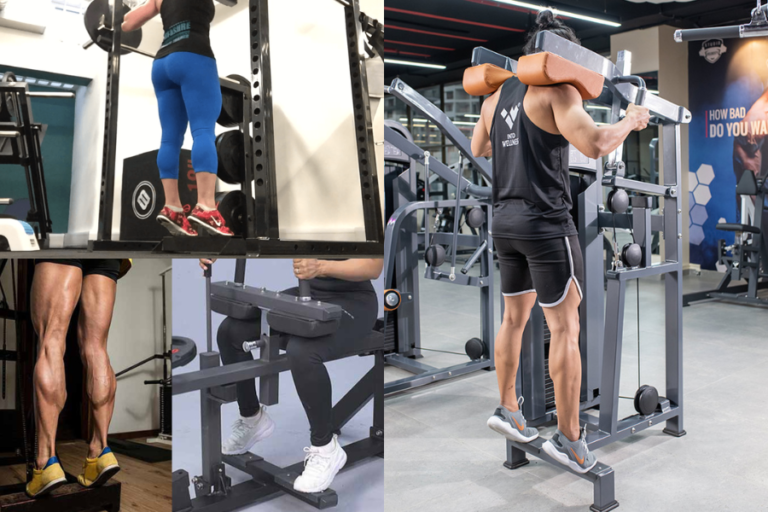
Standing calf raises are one of the most straightforward calf workouts for women. They primarily target the gastrocnemius, the larger upper calf muscle, and they also help improve ankle balance and stability.
To do them:
- Stand tall with your feet hip-width apart and your hands resting lightly on a wall, chair back, or countertop for balance.
- Press through the balls of your feet and lift your heels as high as possible.
- Pause briefly at the top and squeeze your calves.
- Lower your heels slowly back to the floor.
Start with 2 to 3 sets of 12 to 15 reps. Move at a controlled pace instead of bouncing. If the move feels too easy, you can hold a dumbbell, a filled water bottle, or a backpack in one hand to add resistance.
Stair edge variation
If you have a safe step or sturdy stair, you can increase the stretch and range of motion:
- Stand on the edge of the step with the balls of your feet on the step and your heels hanging off.
- Hold the railing or wall for support.
- Rise onto your tiptoes as high as you can and pulse three times at the top.
- Slowly lower your heels below the level of the step to stretch your calves and Achilles tendon.
This version tones your calves without straining your back or feet, as long as you move slowly and avoid jerking motions.
Single leg calf raises for balance
Single leg calf raises build unilateral strength, which means you work one side at a time. This helps even out strength differences between your legs and improves overall stability in your feet and ankles.
Here is how to perform them:
- Stand near a wall or sturdy surface and lightly rest one hand on it.
- Lift one foot slightly behind you so you are standing on the other foot only.
- Press through the ball of your standing foot and lift your heel as high as you can.
- Hold for a second, then lower your heel in a slow, controlled motion.
Try 2 to 3 sets of 8 to 12 reps per leg. Keep your hips level and avoid leaning heavily into the wall. When you gain confidence, you can reduce how much you use your hands for support or hold a light weight.
Seated calf raises for deeper activation
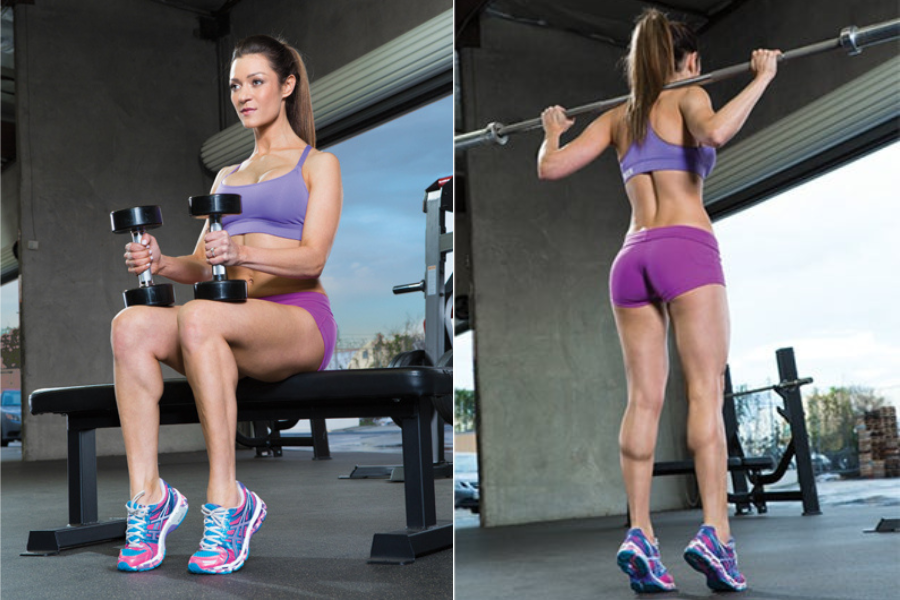
Seated calf raises focus on the soleus muscle, which sits underneath the gastrocnemius and is especially active in movements such as walking upstairs or running uphill. Targeting the soleus helps build well-rounded strength in your lower legs.
To perform seated calf raises at home, you do not need a machine:
- Sit on a sturdy chair with your feet flat on the floor and knees bent at 90 degrees.
- Keep your torso upright and your hands resting lightly on your thighs or the sides of the chair.
- Rise up high onto your tiptoes, lifting your heels as much as you can.
- Lower your heels back down slowly.
You can start with 1 to 2 sets of 16 reps three times per week. Over several weeks, you may notice better endurance when you walk or climb stairs. To increase difficulty, place a weight, a heavy book, or a backpack on your thighs right above your knees and keep your movements slow and controlled.
Barre inspired elevé to relevé
If you enjoy dance inspired movement, the elevé to relevé move from barre training is a nice way to tone the whole calf area and work on posture at the same time.
Follow these steps:
- Stand with your feet hip-width apart or in a narrow V shape, toes turned slightly outward.
- Hold onto the back of a chair or a countertop lightly for balance.
- Elevé: Straighten your knees and lift high onto your tiptoes.
- Relevé: From that lifted position, drop your tailbone slightly while keeping your heels raised, so your body is tall but not arched.
- Straighten your knees again, then gently lower your heels to the floor.
Aim for 2 to 3 sets of 10 to 12 slow repetitions. Focus on moving gracefully, keeping your core engaged, and avoiding locking out your knees at the top.
Cardio moves that train your calves
You can also strengthen and tone your calves through everyday activities that you might already enjoy. Running, walking, hiking, especially uphill, soccer, basketball, tennis, step classes, and swimming all engage your calf muscles through dynamic movement.
If you like treadmill workouts, you can use an incline to increase the challenge. Hill treks at about an 8.0 incline at speeds between 3.5 and 4.2 mph for a power walk, or 4.3 mph and up for a light jog, can help burn body fat that may cover your calf muscles and improve overall conditioning. Once you are comfortable, you can increase intensity by adding a 10 pound weighted vest, as long as your joints feel good and your posture remains steady.
Jump rope workouts are another fun option. Every landing is essentially a small plyometric standing calf raise. Adjust the rope to your height, keep your jumps low, and use your wrists to turn the rope instead of big arm swings. Even 2 to 3 short sets of 30 seconds can leave your calves pleasantly worked.
A sample at home calf workout
Here is a simple routine you can follow two or three times per week. It combines strength and a small dose of cardio for a well rounded calf workout.
-
Warm up
March in place, ankle circles, and 20 easy heel raises. -
Standing calf raises
3 sets of 12 to 15 reps. -
Single leg calf raises
2 sets of 8 to 10 reps per leg. -
Seated calf raises
2 sets of 16 reps. -
Elevé to relevé
2 sets of 10 reps. -
Optional finisher: jump rope or brisk incline walk
3 rounds of 30 seconds jump rope with 30 to 60 seconds rest,
or a 5 to 10 minute walk on an incline if you have a treadmill or hill nearby.
Take 30 to 60 seconds of rest between sets. Sip water throughout your workout so you stay hydrated.
If an exercise causes sharp pain, stop immediately and check your form. A gentle muscle burn and mild fatigue are normal, but joint pain is a signal to ease up or consult a professional.
Safety tips and recovery
To keep your calf workouts for women safe and sustainable, pay attention to a few key habits. Move slowly and focus on alignment. Keep your knees tracking over your toes, your weight centered over the balls of your feet, and avoid locking out your joints at the top of each rep.
Try to stay consistent instead of doing too much all at once. Exercising your calves two to three times per week is usually enough. Gradually increase weights or difficulty by about 10% to 15% every couple of weeks rather than jumping ahead too quickly. This approach gives your muscles, tendons, and ligaments time to adapt.
After your workout, a few minutes of light stretching can help your calves feel less tight. Stand facing a wall with one leg back and your heel pressed into the floor to stretch the gastrocnemius. Then bend your back knee slightly to target the deeper soleus. If you have a history of lower leg or ankle injuries, or if new pain appears and does not settle with rest, it is a good idea to check in with a doctor or physical therapist.
With a little consistency, these simple home exercises can make your legs feel stronger and more stable in everything you do, from daily errands to your favorite workouts. Start with one or two moves today, notice how your calves feel, and build from there at your own pace.
About the Author