Why a dumbbell chest workout at home works
If you want a stronger, more defined chest without a gym membership, a dumbbell chest workout at home is one of your most effective options. Dumbbells give you a greater range of motion than barbells, let you train each side of your body separately, and fit easily into small spaces like apartments or spare rooms.
Compared to machines, dumbbells challenge stabilizer muscles and help correct strength imbalances between your left and right sides. You can also tilt, rotate, or change angles quickly to hit your upper, middle, and lower chest in one simple setup.
In this guide, you will learn:
- The best dumbbell chest exercises you can do at home, with or without a bench
- How many sets and reps to use for strength, muscle size, or endurance
- Sample beginner, intermediate, and advanced routines
- Technique tips to protect your shoulders and wrists
You only need a pair of dumbbells and a bit of floor space to get started.
Get set up safely at home
Before you jump into your at home dumbbell chest workout, take a few minutes to set up your space and plan your weights.
Choose the right weights
You will adjust loads over time, but these ranges give you a starting point:
- 50 to 60 percent of your estimated one rep max for endurance
- 70 to 80 percent for muscle growth (hypertrophy)
- 85 to 90 percent for pure strength
Use trial and error in your first session. On your final set of an exercise, you should feel challenged on the last 2 to 3 reps without losing form.
Prepare your training space
You do not need a full home gym. You only need:
- A clear patch of floor long enough for you to lie down
- A mat or folded blankets for comfort and to slightly increase range of motion on floor presses
- Hex dumbbells if possible, since they will not roll during floor exercises or push ups
If you have wrist or elbow issues, consider wrist wraps or compression elbow sleeves to add stability during heavier sets.
Warm up your upper body
Spend 5 to 8 minutes on:
- Light cardio like marching in place or brisk walking
- Shoulder circles and arm swings
- 1 or 2 easy sets of push ups or wall push ups
A short warm up raises your temperature, lubricates your joints, and prepares your shoulders for pressing.
Master the key chest movements
These are the core exercises that make a dumbbell chest workout at home both effective and joint friendly. You do not need to do all of them in one session. You will choose 2 to 4 per workout and rotate them over time.
Dumbbell bench press (or floor press)
If you have a bench, the dumbbell bench press is a classic for building size and strength. If you do not, the dumbbell floor press is your go to option.
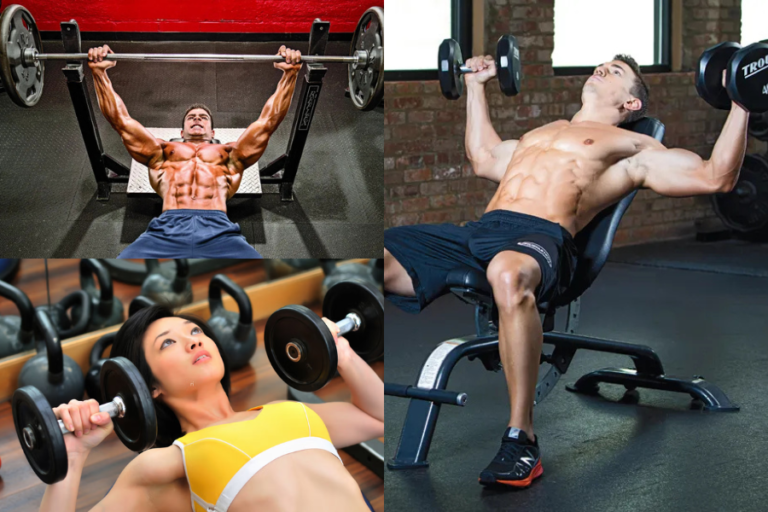
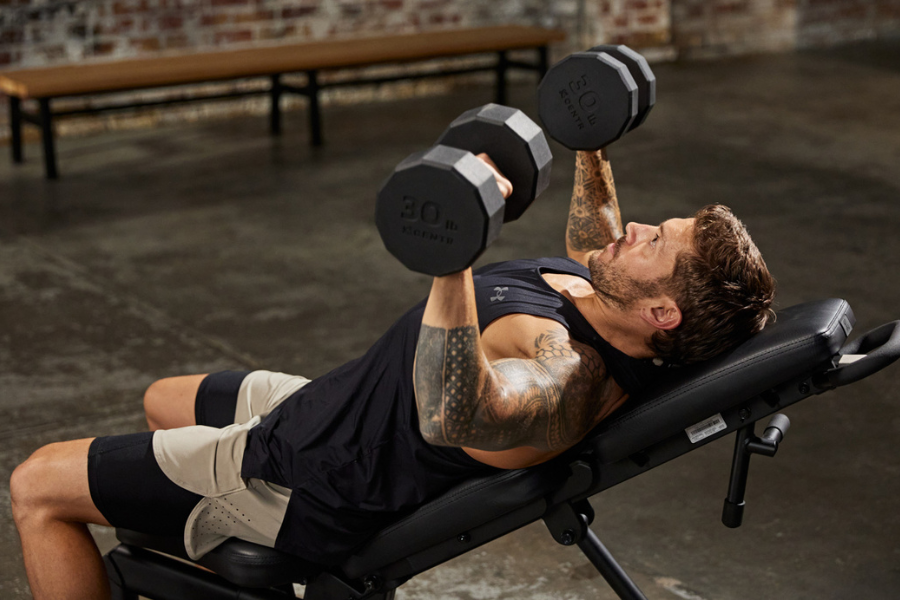
How to do the dumbbell bench press
- Lie on a flat bench with feet planted on the floor.
- Hold a dumbbell in each hand, arms extended above your chest with palms facing forward.
- Keep wrists straight and use a full grip. Avoid a thumbless grip to reduce injury risk.
- Lower the dumbbells toward your chest, roughly around the nipple line.
- Press back up, actively squeezing your chest at the top.
- Sets and reps: 3 to 4 sets of 6 to 8 reps
- Focus: Strength and size in the overall chest
If you feel elbow discomfort when lowering to the nipple line, try bringing the dumbbells slightly lower on your torso or experiment with elbow sleeves.
How to do the dumbbell floor press
The floor press is ideal when you do not have a bench. It also protects your shoulders by limiting range of motion to about a 90 degree elbow bend.
- Lie on your back on the floor, knees bent and feet flat.
- Hold the dumbbells above your chest with arms straight.
- Slowly lower until your upper arms or elbows gently touch the floor.
- Pause briefly, then press back up and squeeze your chest.
- Sets and reps: 3 to 4 sets of 8 to 10 reps
- Focus: Chest, triceps, shoulders with less shoulder strain
Because the floor stops your elbows, you avoid overstretching the shoulder joint and can often press slightly heavier loads more safely.
Dumbbell chest fly and floor fly
The dumbbell fly complements pressing movements by focusing on adduction, which is bringing your arms across the midline of your body.
How to do the dumbbell chest fly (with bench)
- Lie on a flat bench with dumbbells held together above your chest, palms facing each other.
- Maintain a slight bend in your elbows.
- Open your arms out to the sides in a wide arc, lowering until your chest feels a deep but comfortable stretch.
- Bring the dumbbells back up along the same path, squeezing your chest at the top.
- Sets and reps: 3 sets of 10 to 12 reps
- Focus: Chest stretch and adduction, inner and outer pecs
How to do floor flyes (without bench)
Floor flyes give you similar benefits while the floor prevents harmful overstretching.
- Lie on your back on the floor with knees bent.
- Start with dumbbells above your chest, palms facing each other.
- Lower your arms out to the sides until your elbows gently touch the floor.
- Use your chest to pull the dumbbells back together over your chest.
- Sets and reps: 3 sets of 10 to 12 reps
- Focus: Safe chest stretch without stressing the shoulders
Bridge dumbbell chest press
The bridge dumbbell chest press combines a floor press with a hip bridge for extra posterior chain work.
- Lie on your back with knees bent and feet hip width apart.
- Hold dumbbells above your chest.
- Drive through your heels to lift your hips into a bridge so your body forms a straight line from shoulders to knees.
- Maintain the bridge as you lower the dumbbells until your elbows approach the floor.
- Press back up while keeping your hips lifted.
- Muscles worked: Chest, shoulders, triceps, glutes, hamstrings, erector spinae
- Sets and reps: 3 sets of 8 to 10 reps
This variation teaches you to brace your core and glutes while pressing, which improves overall stability.
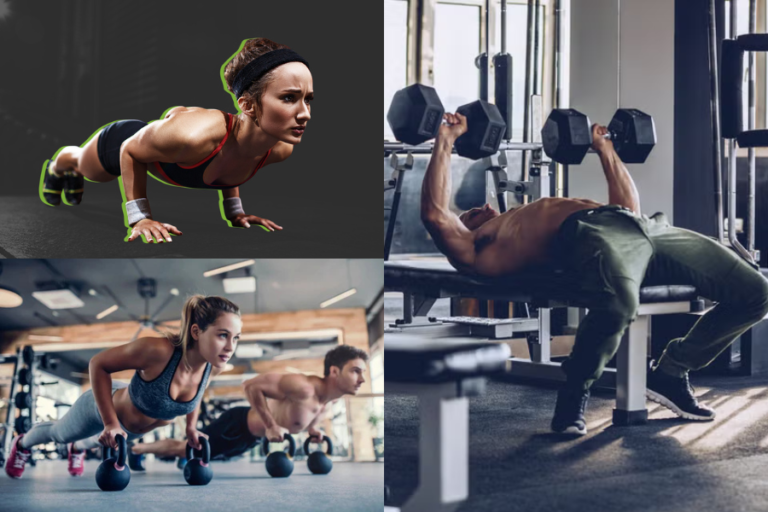
Dumbbell push ups
Using hex dumbbells for push ups gives you a deeper range of motion and can be easier on your wrists.
- Place two dumbbells on the floor, roughly shoulder width apart, handles parallel.
- Grip the handles and step back into a plank position, body in a straight line.
- Lower your chest between the dumbbells, going slightly deeper than a regular push up.
- Press back up while keeping your core tight.
- Sets and reps: 2 to 4 sets, aiming for 8 to 15 reps
- Focus: Chest, shoulders, triceps, core, wrist friendly pressing
If standard push ups are too challenging, drop your knees to the floor and work up slowly.
Alternating dumbbell floor press
This unilateral variation helps correct strength imbalances and forces your core to stabilize.
- Lie on the floor with dumbbells above your chest, palms facing forward or neutral.
- Lower one dumbbell until the upper arm touches the floor while the other arm stays locked out.
- Press the working arm back up, then repeat on the opposite side.
- Continue alternating in a controlled tempo.
- Sets and reps: 3 sets of 8 to 10 reps per arm
- Focus: Symmetry, core stability, individual pec activation
Eccentric floor fly
If your main goal is muscle growth, the eccentric floor fly emphasizes the lowering phase, which is key for hypertrophy.
- Set up as you would for a floor fly.
- Lower the dumbbells out to the sides over 3 to 5 slow seconds until elbows touch the floor.
- Bring the weights back up in 1 to 2 seconds.
Because the floor supports heavier weights safely at the bottom, you can challenge your chest more on the eccentric phase, which increases muscle fiber damage and growth stimulus.
- Sets and reps: 3 sets of 8 to 10 controlled reps
Power and metabolic chest options
Once you have a base of strength, you can add more advanced options to your dumbbell chest workout at home.
- Plyo tap push up: Use dumbbells as targets. Push explosively from the floor and tap the dumbbells between reps to train chest power and endurance.
- Ladder style incline dumbbell bench press: If you can incline your bench, hold each rep at the top a little longer than the last, adding one second each rep. This increasing hold time creates metabolic stress that supports muscle growth.
These are best reserved for intermediate or advanced lifters who already move well with basic presses and flyes.
Structure your chest workouts
You do not need a complicated plan. The key is to choose the right number of exercises, use good form, and progress gradually.
General programming guidelines
For a typical dumbbell chest workout at home:
- Choose 2 to 4 chest exercises per session
- Start with compound presses, then move to flyes or other isolation moves
- Do 2 to 5 sets per exercise
- Stay within 5 to 30 reps depending on your goal
You will usually see better results if you train your chest twice per week and allow at least one day of rest between chest sessions.
Beginner chest workout at home
If you are new to training, keep things simple and focus on learning the movement patterns.
Try this 2 times per week:
- Dumbbell floor press
- 3 sets of 8 to 10 reps
- Floor flyes
- 3 sets of 10 to 12 reps
- Push ups to finish
- 1 set to comfortable failure
- Use knee push ups if needed
Rest 60 to 90 seconds between sets. You should finish feeling like you worked, not completely exhausted.
Intermediate dumbbell chest workout
Once you are comfortable with basic presses and flyes, you can use supersets to increase the challenge without spending more time.
Perform this 1 to 2 times per week:
Superset 1
- Dumbbell bench press or floor press
- 4 sets of 6 to 8 reps
- Dumbbell push ups
- 4 sets of 8 to 12 reps
Rest 45 to 60 seconds between supersets.
Superset 2
- Dumbbell chest fly or floor fly
- 3 sets of 10 to 12 reps
- Alternating dumbbell floor press
- 3 sets of 8 to 10 reps per arm
Rest 60 seconds between supersets. The back to back format raises intensity and makes your home workouts more efficient.
Advanced dumbbell chest workout at home
If you have been training consistently and want to push for maximum growth, you can combine supersets with a bodyweight burnout.
Superset 1
- Dumbbell bench press or floor press
- 4 sets of 6 to 8 reps
- Eccentric floor fly
- 4 sets of 8 slow, controlled reps
Rest 60 seconds between supersets.
Superset 2
- Bridge dumbbell chest press
- 3 sets of 8 to 10 reps
- Dumbbell push ups
- 3 sets of 10 to 15 reps
After you complete the supersets, finish with a 5 minute bodyweight chest burnout:
- Alternate standard push ups and knee push ups with as little rest as possible
- Stop only long enough to shake out your arms, then resume
This final phase pushes your muscles toward fatigue, which supports hypertrophy and firmness.
Form tips to protect your shoulders and wrists
Good technique keeps you training consistently and prevents small aches from turning into bigger problems.
Engage more than just your chest
During every chest exercise, lightly brace your entire body:
- Squeeze your glutes
- Tighten your abdominal muscles
- Press your feet firmly into the floor
This whole body tension stabilizes your spine and shoulders and lets your chest do more work safely.
Keep joints aligned
Pay attention to:
- Wrists: Keep them straight, not bent back, especially during heavier presses. A solid full grip also helps stability.
- Elbows: Avoid flaring your elbows straight out at 90 degrees to your torso. A slight tuck protects your shoulders.
- Range of motion: Only lower until you feel a stretch you can control. If elbows or shoulders hurt, shorten the range slightly.
For floor based chest exercises, the ground already acts as a natural safety stop and helps you avoid excessive range.
How often you should train and when to expect results
To make progress from your dumbbell chest workout at home, consistency matters more than perfection.
- Frequency: Aim to train your chest about twice per week.
- Recovery: Allow at least one rest day between chest focused sessions, especially if you are using higher intensities.
- Timeline: Many people notice improvements in performance, such as more reps or heavier weights, in 3 to 4 weeks. Visible changes in muscle size and shape typically appear over 6 to 12 weeks, assuming you train regularly and support your workouts with good nutrition.
Dumbbells also let you adjust quickly as you get stronger. You can increase weight, add sets, slow down your tempo, or shorten rest periods to keep challenging your chest muscles.
Putting it all together
You do not need a commercial gym or elaborate equipment to build an impressive chest. With a thoughtful dumbbell chest workout at home, you can:
- Target every part of the chest with presses, flyes, and push ups
- Protect your shoulders using floor based variations and controlled ranges of motion
- Fix left to right imbalances through unilateral exercises
- Build strength, size, or endurance by adjusting reps, sets, and tempo
Pick one of the routines that matches your current level, commit to it for 4 to 6 weeks, and track your reps and loads. As you feel more comfortable, rotate in new variations like the bridge dumbbell chest press or eccentric floor fly to keep your progress moving.
Start with one small step today, such as learning the floor press with an easy weight, and build from there.
About the Author