Why a home chest workout belongs in your routine
If you want stronger upper body muscles but do not have access to a full gym, a structured home gym chest workout is a smart place to start. Your chest is made up mostly of the pectoralis major and pectoralis minor. These muscles help you push, lift, and support your arms, and when you train them regularly you also increase overall energy expenditure and metabolism.
You can build an effective chest routine at home using just your body weight, a pair of dumbbells, or simple equipment like a bench or push up handles. Research comparing push ups and bench presses in trained men has found similar muscle growth when total effort is matched, which shows how effective home training can be when you use good form and progressive overload.
In this guide, you will learn how to train your chest at home, whether you are a beginner or ready for advanced variations.
Understand your chest muscles
Before you dive into your home gym chest workout, it helps to know which areas you are targeting and how different movements work them.
Main chest muscles
- Pectoralis major
The large, fan shaped muscle that covers most of your chest. It has upper, middle, and lower fibers that respond slightly differently depending on your arm angle. - Pectoralis minor
A smaller muscle under the pec major. It helps move and stabilize your shoulder blade during pushing movements.
When you do push ups or presses, you also involve your triceps, front shoulders, and core, so a solid chest day often feels like a full upper body workout.
Why chest training matters
A consistent home gym chest workout can help you:
- Improve pushing strength for daily tasks like lifting groceries or getting up from the floor
- Support better posture and shoulder stability
- Build muscle definition across your upper body
- Increase overall functional strength for sports and other workouts
Warm up before chest training
A proper warm up prepares your chest, shoulders, and elbows so you can work hard without pain.
Simple 5 to 7 minute warm up
- Light cardio for 2 minutes
March in place or do gentle star jumps to raise your heart rate. - Arm circles and shoulder rolls for 1 to 2 minutes
Move through small to large circles, forward and backward. - Wall or incline push ups for 2 to 3 minutes
Do 2 light sets of 8 to 10 reps to practice form and activate the chest.
If you are following a beginner dumbbell chest routine, you can also use 1 or 2 very light warm up sets of your first exercise to get used to the movement before your working sets, as suggested in beginner programs from strength sites like Muscle & Strength.
Build a bodyweight chest workout at home
If you do not have equipment, you can still design a complete home gym chest workout using only push up variations and dips. These moves engage the upper, mid, and lower chest, as well as your triceps, shoulders, and core (Gymshark, 2024).
Key push up variations and what they target
Push ups require you to lift about 64 percent of your body weight, which is enough load to stimulate strength and muscle growth similar to the bench press when you work close to fatigue.
Here are useful variations to mix into your routine:
- Regular push ups
Great all round chest builder that works the mid chest, triceps, and shoulders. - Incline push ups
Hands on a bench or chair. Easier for beginners and shifts more focus to the lower pecs. Recommended: 3 to 4 sets of 8 to 15 reps. - Decline push ups
Feet on a chair or bench. Harder, with more emphasis on the upper chest. Recommended: 3 to 4 sets of 5 to 15 reps. - Diamond push ups
Hands close together under your chest. These hit your triceps hard and also train the inner chest fibers. You can do 3 to 4 sets of 8 to 15 reps with 30 to 60 seconds rest between sets. - Wide push ups
Hands set slightly wider than your shoulders to emphasize the outer chest. - Plyometric (explosive) push ups
You push off the floor so your hands leave the ground, sometimes with a clap. These create maximum contraction and power. Aim for 3 to 4 sets of 8 to 15 reps, resting 45 to 60 seconds.
Deficit push ups, where your hands are on handles or blocks, can increase your range of motion at the shoulders and elbows, which may enhance muscle growth due to more stretch. Take care not to drop too low if you have shoulder issues.
Simple bodyweight chest workout (no equipment)
Try this routine 2 or 3 times per week, leaving at least one rest day between sessions:
- Incline push ups
3 sets of 10 to 15 reps
Focus on a straight body line and controlled lowering. - Regular push ups
3 sets of 8 to 12 reps
Stop 1 or 2 reps before failure to keep form clean. - Decline push ups
3 sets of 5 to 10 reps
Keep your hips level and avoid arching your lower back. - Diamond push ups
2 to 3 sets of 6 to 10 reps
Move slowly and keep elbows close to your body. - Bodyweight dips using a chair or sofa
2 to 3 sets of 8 to 12 reps
Place your hands on the edge behind you, feet extended forward to emphasize your lower chest, as highlighted by Gymshark (2024).
Rest 45 to 90 seconds between sets. If this is too hard, start with more incline push ups and fewer decline or diamond reps. If it is too easy, add reps or slow down the lowering phase.
Add dumbbells for faster progress
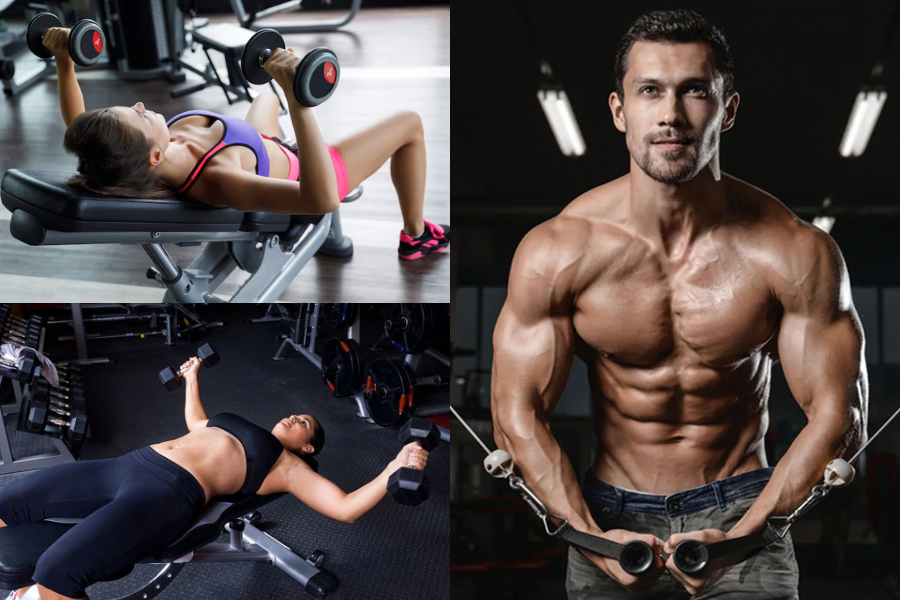
Once you have built a base with bodyweight, adding dumbbells to your home gym chest workout lets you challenge your pecs in new ways. Dumbbells also highlight strength differences between sides and can improve balance and stability.
According to Gymshark, dumbbell presses and flyes are especially useful for increasing muscle stretch and contraction, which supports hypertrophy and a fuller chest.
Core dumbbell chest exercises
You can do all of these lying on a flat bench, an incline bench, or a stable surface like a sturdy box or step.
- Dumbbell chest press
Press the weights up from chest level, palms facing forward or slightly in. This mimics a bench press and trains overall chest mass, deltoids, and triceps. Suggested: 2 to 4 sets of 8 to 15 reps. - Incline dumbbell press
Set your bench at an incline to emphasize the upper chest and front shoulders. - Decline dumbbell press
A declined angle will slightly increase focus on the lower chest. - Dumbbell flyes
With a slight bend in your elbows, open your arms wide and then bring them together over your chest. This isolates your chest and improves the stretch across the pecs. Beginner routines like those from Muscle & Strength often include flyes even for people with small chests, since they help expand the chest muscles over time.
Beginner dumbbell chest routine
Try this 1 to 2 times per week:
- Flat dumbbell press
- 2 warm up sets with light weights
- 3 working sets of 8 to 12 reps
- Incline dumbbell press
- 3 sets of 8 to 12 reps
- Dumbbell flyes
- 2 to 3 sets of 10 to 15 reps
Choose a weight that makes the last 2 reps of each set challenging, but not so heavy that you lose control of the movement.
Use simple home equipment for more options
If you have space and budget, a few pieces of home gym chest equipment can make your workouts more flexible and comfortable.
Compact training tools
- Foldable push up racks
These give your wrists a more neutral position, add range of motion, and increase stability for push ups. They are portable and suitable for both men and women who want a stronger chest at home. - Twister Arm Trainer
This device usually offers multiple resistance levels, sometimes from about 20 pounds up to 440 pounds, and targets your chest, arms, shoulders, and forearms. Many models have ergonomic, anti slip grips and can be taken apart for travel, and some include a workout poster for guidance.
Multi function home gym setups
Some home gym systems combine chest twister trainers, ab rollers, and resistance bands. These are useful if you want full body strength training without a large rack or machine. They can support pressing and fly like movements for your chest along with core and arm work.
If you have more space and want a classic bench press feel, products like the GMWD Chest Press Machine provide a home bench press solution with a high weight capacity and adjustable flat and incline bench settings so you can train chest, abs, and shoulders in one station.
What if you use chest machines at a gym
Even if your main focus is a home gym chest workout, you might occasionally train in a commercial gym or want to know how machines fit into the bigger picture.
Common chest machines and how they help
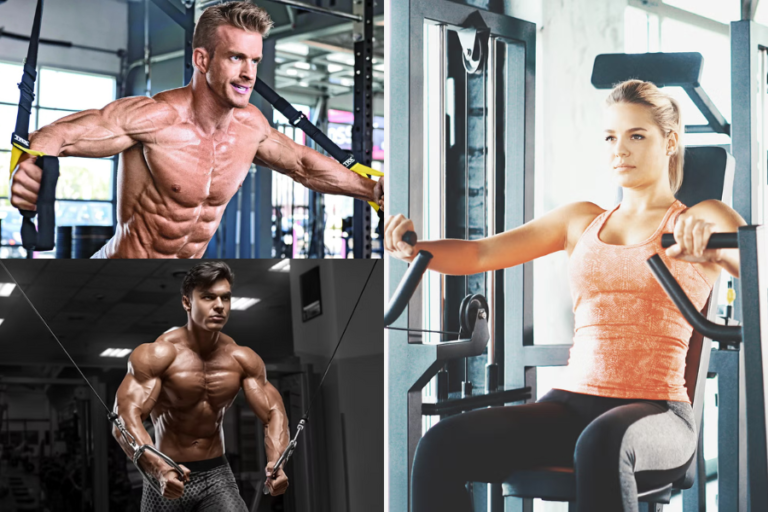
- Chest press machine
Mimics the bench press in a more controlled setting and targets the pec major and minor. Good for beginners and experienced lifters because it removes the need to balance free weights. - Pec deck or chest fly machine
Designed to isolate the inner chest. You sit with your back on the pad and bring the handles together slowly to increase definition and mind muscle connection. - Incline chest press machine
Places extra focus on the upper pecs and front shoulders by pressing at an angle.
For all machines, adjust the seat and handles so your elbows are roughly in line with your chest. Move slowly and keep tension on the chest rather than bouncing the weight.
Progress your home chest workouts safely
To keep building strength and muscle with a home gym chest workout, you need progressive overload. Gymshark recommends these simple methods that do not require extra weight:
- Increase total reps or sets
For example, move from 3 sets of 8 push ups to 3 sets of 12. - Reduce rest periods
Shorter rests make the same workout more demanding. - Increase time under tension
Slow your lowering phase to 3 or 4 seconds per rep or pause just above the floor. - Advance your exercise variation
Progress from incline push ups to regular push ups, then to decline or deficit push ups.
Form tips and pain signals to watch for
Chest training should feel challenging in your muscles, not sharp in your joints.
- Keep a straight body line during push ups and dips
- Lower the weight or modify the angle if you feel shoulder pain
- If bench presses at any angle hurt your shoulders, shift to push ups, flyes with lighter weights, or chest machines to find a pain free path, as suggested by strength and conditioning sources
If pain persists, stop the movement and consider consulting a medical or fitness professional to check your technique.
Sample weekly chest focused plan
Use this example as a starting point and adjust to your schedule and level.
Option 1: Bodyweight focused week
- Day 1: Chest and triceps
- Incline push ups, regular push ups, diamond push ups, chair dips
- Day 3: Chest and core
- Decline push ups, wide push ups, deficit push ups, plank variations
- Day 5: Power and conditioning
- Plyometric push ups, star jumps, incline push ups, light bodyweight dips
Option 2: Mixed dumbbell and bodyweight week
- Day 1: Dumbbell chest
- Flat dumbbell press, incline dumbbell press, dumbbell flyes
- Day 3: Bodyweight chest
- Regular push ups, decline push ups, diamond push ups
- Day 5: Accessories and arms
- Twister Arm Trainer or resistance bands, light push ups, core work
Aim to perform each workout once per week at first. As your recovery improves, you can add more overall sets or a third chest focused day.
Bringing it all together
Your home gym chest workout does not need expensive gear or complicated programming. With a few push up variations, simple tools like dumbbells or a push up rack, and a plan to progress over time, you can build stronger pecs, better posture, and more upper body strength in your own space.
Start with the variation that matches your current level, such as incline push ups for beginners, focus on smooth, controlled reps, and add small challenges each week. Over time, you will feel the difference every time you push, lift, or carry something in your day to day life.
About the Author