A quad workout for beginners does not have to be complicated or intimidating. With a few simple exercises, you can build stronger, more toned legs at home or in the gym, using little or no equipment. This guide walks you through a beginner-friendly routine, explains what your quads actually do, and shows you how to avoid the most common mistakes that slow progress.
Understand your quads and why they matter
Your quadriceps, or quads, are the four muscles at the front of your thigh. They help you straighten your knee, support you when you stand, walk, climb stairs, and squat, and they play a big role in almost every lower body movement. Strong quads are important for both performance and everyday life, as highlighted in a 2026 overview from Muscle & Fitness that connects quad development with better squats, deadlifts, and overall functional strength.
When you follow a quad workout for beginners, you are not just training for appearance. You are also:
- Making it easier to get up from chairs and climb stairs
- Supporting your knees during daily activities
- Building a foundation for more advanced strength training later
Before you jump into exercises, it helps to understand that your quads work at different muscle lengths. Some moves target them when they are fully stretched, others when they are in a neutral or shortened position. A balanced routine should eventually include all three, but as a beginner you can start with the basics and build from there.
How often to train your quads as a beginner
You do not need to train quads every day to see results. In fact, recovery is when your muscles grow and get stronger.
For most beginners, a simple plan looks like this:
- Train your quads 2 times per week
- Include at least 2 quad-focused exercises per session
- Perform 3 to 4 sets of 8 to 12 repetitions for each exercise
- Rest at least 48 hours before training quads again
This matches standard hypertrophy guidelines and helps you build strength and muscle without overtraining. If you are completely new to exercise, you can start on the lighter side with 2 sets of 10 to 12 reps and gradually build up as your legs adapt.
Essential form tips for safe quad training
Good technique makes your quad workout more effective and protects your joints. A few key principles apply to almost every movement:
Use a full but comfortable range of motion
You want your thighs to reach at least roughly parallel to your calves in exercises like squats and leg presses. Stopping too high limits muscle activation and slows progress. At the same time, you should never force a depth that causes pain in your knees or lower back.
If full range feels tough at first, you can:
- Reduce depth slightly while you build strength
- Use a stable support, like a chair or countertop, to help you balance
- Focus on controlled, slow movements rather than rushing the reps
Start lighter than you think you need
Going too heavy too soon is one of the most common beginner mistakes. It often leads to partial reps, shaky form, and unnecessary strain. You will get better results by using a moderate weight that you can move smoothly for 8 to 12 reps with good control.
Once those reps feel easy and your form is solid, you can either add a little more weight or do an extra set.
Keep your posture upright
When you squat or lunge, try to keep your chest lifted instead of folding far forward at the hips. Excessive forward lean shifts more work to your hips and lower back and takes some stress away from the quads.
A simple cue is to imagine you have a logo on the front of your shirt and you want someone in front of you to see it the whole time. Your torso will still tilt naturally, just not excessively.
Simple bodyweight quad exercises at home
Most quad exercises can be done at home without special equipment. That makes them accessible when you are new to working out or do not have time for the gym.
Bodyweight squats
Bodyweight squats are one of the best all-around moves for your quads, hamstrings, glutes, core, and the muscles along your spine.
How to do them:
- Stand with your feet about hip to shoulder width apart.
- Point your toes slightly outward if that feels more natural.
- Bend your knees and hips at the same time, as if you are sitting back into a chair.
- Lower until your thighs are roughly parallel to the floor or as low as you comfortably can.
- Push through your whole foot to stand back up, keeping your knees tracking over your toes.
Beginner prescription:
Start with 2 sets of 10 to 12 reps. Rest about 60 seconds between sets. If this feels too hard, reduce the depth and gradually go lower as you get stronger.
Walking lunges
Walking lunges build quad strength and also challenge your balance and coordination.
How to do them:
- Stand tall with your feet hip width apart.
- Step forward with one leg and bend both knees to lower your body.
- Aim for your front thigh to be roughly parallel to the ground and your back knee close to, but not touching, the floor.
- Push through your front foot to bring your back foot forward into the next step.
- Alternate legs with each step.
To make this easier, you can lunge only halfway down or hold onto a stable surface for support. Reducing the range of motion is a simple way to keep the movement manageable while still targeting your quads.
Beginner prescription:
Perform 2 sets of 10 steps per leg. Rest 60 seconds between sets.
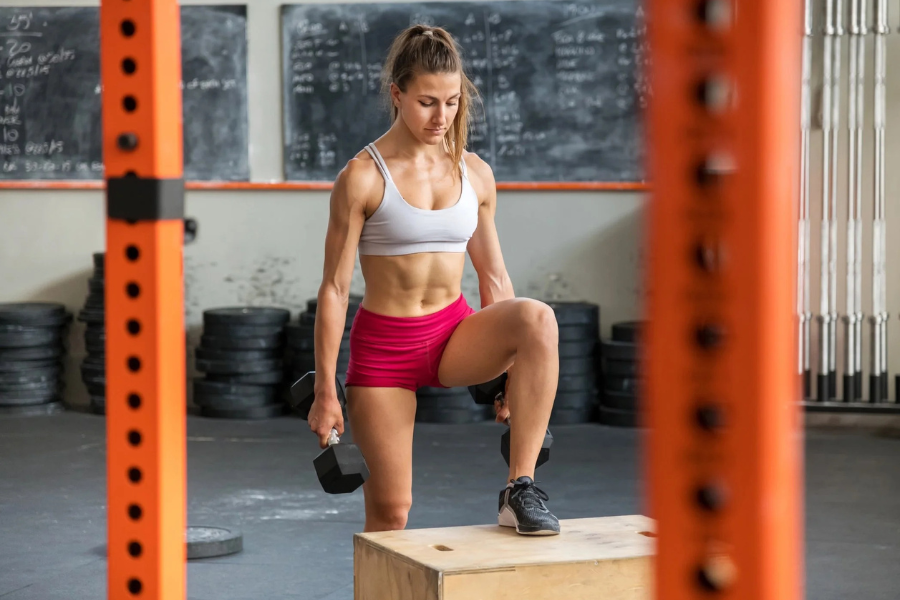
Step-ups
Step-ups are great if you have a low bench or a sturdy step at home. They closely mimic everyday movements like climbing stairs.
How to do them:
- Stand in front of a step or low box.
- Place one foot completely on the step.
- Press through that foot to lift your body up, bringing your other foot to meet it.
- Step back down with control, leading with the same leg.
- Complete all reps on one side, then switch.
If this feels difficult, choose a lower step height or decrease the number of reps.
Beginner prescription:
Aim for 2 sets of 10 reps per leg, with 60 seconds of rest.
Beginner-friendly weighted quad exercises
When you feel comfortable with bodyweight movements, you can introduce light weights. Even a single dumbbell or kettlebell adds a new challenge and helps your quads grow.
Goblet squat
The Goblet Squat is a beginner-friendly full body exercise that strongly involves the quads while easing stress on your lower back. You hold a kettlebell or dumbbell close to your chest, which naturally encourages an upright torso.
How to do them:
- Stand with your feet shoulder width apart.
- Hold a kettlebell or dumbbell under your chest, elbows pointing down.
- Brace your core and squat down, keeping your chest up and knees in line with your toes.
- Lower until your thighs are parallel to the floor if possible.
- Push through your feet to return to standing.
Recommended prescription:
2 sets of 10 reps, resting 60 seconds between sets. If you do not have a weight, you can mimic the position with your hands clasped in front of your chest and add weight later.
A helpful variation for beginners is the heel elevated goblet squat. Placing a small plate under your heels shifts more of the load to your quads and requires less ankle mobility, which can make it feel more comfortable.
Split squats
Split squats are like lunges without the forward step. They build quad strength and improve balance.
How to do them:
- Stand in a staggered stance, one foot forward and one back.
- Keep your torso mostly upright and your hands at your sides or holding light dumbbells.
- Bend both knees to lower your body straight down.
- Stop just before your back knee touches the floor.
- Push through your front foot to rise back up.
Beginner prescription:
2 sets of 10 reps on each leg, with about 30 seconds of rest between sets. Focus on control rather than speed.
Wall sits
Wall sits are simple, but they challenge your quad endurance quickly and require no equipment beyond a wall.
How to do them:
- Stand with your back against a wall.
- Walk your feet forward and slide your back down until your knees are bent at roughly 90 degrees.
- Keep your knees stacked over your ankles, not collapsing inward.
- Hold this position, keeping your back flat against the wall.
Beginner prescription:
Hold for 2 sets of 30 seconds, or as long as you can manage, resting 30 seconds in between. If 30 seconds is too much at first, start with shorter holds and build up.
Advanced moves to save for later
Some quad exercises look impressive but are not ideal for your first few weeks or months of training. Two examples are the pistol squat and the sissy squat.
The pistol squat is a single leg squat where one leg extends out in front while you lower all the way down on the other. This requires a combination of strength, mobility, and balance that most beginners do not have yet. It is better to master the basics and feel completely comfortable with regular squats and split squats before you try it.
The sissy squat is another advanced movement that isolates the quads by driving your knees far over your toes while you lift onto the balls of your feet. Beginners can eventually work toward this using assistance, for example by holding a resistance band attached to a squat rack for balance and control, but it is not essential for getting started.
You will get more benefit right now from nailing simple exercises with good form.
Sample two day quad workout for beginners
To pull everything together, here is a simple weekly structure you can follow. Adjust sets and reps based on your comfort level.
Aim for 2 quad focused sessions per week with at least 48 hours between them so your muscles can recover and grow.
Day 1
- Bodyweight squats
- 3 sets of 10 to 12 reps
- Walking lunges
- 2 sets of 10 steps per leg
- Wall sits
- 2 sets of 30 seconds
Day 2
- Goblet squats or heel elevated goblet squats
- 3 sets of 8 to 10 reps
- Split squats
- 2 sets of 10 reps per leg
- Quadruped rocking (for mobility)
- 2 sets of 10 gentle rocks, 30 seconds rest
Quadruped rocking combines elements of yoga’s cow and child’s poses and gives your hips and quads a comfortable stretch. You start on hands and knees, then gently rock your hips back toward your heels and forward again. This drill is often used at 2 sets of 10 reps with 30 seconds rest and works well at the end of a workout to improve mobility and reduce stiffness.
Common beginner mistakes and how to avoid them
When you begin a quad workout routine, a few predictable issues can get in the way of progress.
- Relying on partial reps. If you only move through the top half of a squat or leg press, you leave a lot of muscle stimulation on the table. Work toward deeper, controlled reps within your comfortable range.
- Chasing weight instead of form. Heavy loads with poor form often mean less quad work and more joint stress. Focus on smooth, full reps with a weight that matches your current strength.
- Trying to “isolate” quads with foot changes alone. Shifting your feet higher or lower on machines, like a hack squat or Smith machine, does not completely separate quads from glutes. Good setup and execution, as well as range of motion, matter more.
- Skipping anatomy and setup basics. Understanding what the quads do makes it easier to pick movements and align your body correctly. Resources like the “Training Mistakes Pt. 5: QUADS” episode from the Living Lean podcast go deep on anatomy, exercise selection, and execution mistakes that limit growth, which is especially helpful when you are learning the basics.
Listening to guidance like this also helps you navigate pain and discomfort so you can tell the difference between normal training effort and signals that something is off.
Take your first step today
A quad workout for beginners does not require special gear or a long time commitment. Start with one or two of the exercises above, such as bodyweight squats and wall sits, and add more as your confidence grows.
If you train your quads twice a week, use a full but comfortable range of motion, and choose weights that let you control each rep, you will notice stronger, more toned legs in the weeks ahead. Pick one exercise to try today, even if it is just a single set, and build from there.
About the Author