A focused quad workout for men does more than build bigger thighs. Strong quadriceps support your knees, boost your squat and deadlift numbers, and make everyday movements like climbing stairs feel easier. When you train your quads with smart exercise choices and good form, you build muscle and protect your joints at the same time.
Below, you will find how your quads work, common mistakes to avoid, and practical quad workouts you can use whether you lift at home or in the gym.
Understand your quad muscles
Your quadriceps are the large muscles on the front of your thighs. They are called quadriceps because they are made of four muscles that work together to extend your knee and help flex your hip.
Those four muscles are:
- Rectus femoris
- Vastus lateralis
- Vastus medialis
- Vastus intermedius
When you walk, squat, run, or get up from a chair, your quads are doing a lot of the work. Well developed quads improve performance in big lifts like the squat and deadlift and give your legs that strong, athletic look that many men want, as highlighted in a 2026 article from Muscle & Fitness.
Research also shows that consistent quad exercises can enhance knee stability and reduce the risk of knee osteoarthritis and injury, which is important if you want to keep training long term.
Avoid common quad training mistakes
Many men work hard in the gym but leave quad gains on the table because of a few fixable habits. Before you overhaul your routine, it helps to spot what might be holding you back.
Short or skipped leg sessions
Leg day is often the first workout to get shortened or skipped. If you rush through a couple of sets of leg press and call it done, your quads never get the volume they need to grow. Evidence based recommendations suggest that for optimal quad muscle growth, you should train them at least twice per week, with a minimum of 10 quality sets per week and around 48 hours of recovery between sessions.
Half reps and limited range of motion
A common quad training mistake is using a truncated range of motion. That means only lowering halfway on squats, leg presses, hack squats, or leg extensions. This shortens the time your muscles spend under tension and reduces overall stimulation.
Full range of motion, where you bend your knees deeply while staying in control, engages more muscle fibers and is linked to better quad growth. Going lower usually requires you to use slightly lighter weights, but you gain more muscle from each rep.
Going too heavy and chasing numbers
It is tempting to load up the leg press or squat bar and move the weight a few inches just to hit a big number. The problem is that very heavy weights with partial reps often shift work away from the quads and onto your hips and lower back.
Instead, you want weights that let you:
- Perform full range of motion
- Control the eccentric (lowering) phase
- Hit 8 to 12 reps with good form
- Get within 0 to 3 reps of failure on most sets
This rep range and effort level is effective for hypertrophy, while going far beyond 12 to 20 sets per week brings diminishing returns for muscle growth.
Choose the most effective quad exercises
The best quad workout for men focuses on movements that load the knee joint, allow good depth, and target all four quad muscles. A mix of bilateral and unilateral exercises works well for size, strength, and balance.
Quad focused squat variations
Squats are still one of the best tools you can use, especially when you tweak them to emphasize knee extension over hip extension.
Front squat
By shifting the barbell to the front of your body, front squats naturally keep your torso more upright and put more stress on your quads than standard back squats. This makes them a strong choice if you want more quad emphasis and less lower back strain.
Key cues:
- Keep elbows high and chest lifted
- Sit straight down between your hips instead of far back
- Stop just above the point where your lower back would round
Heels elevated goblet squat
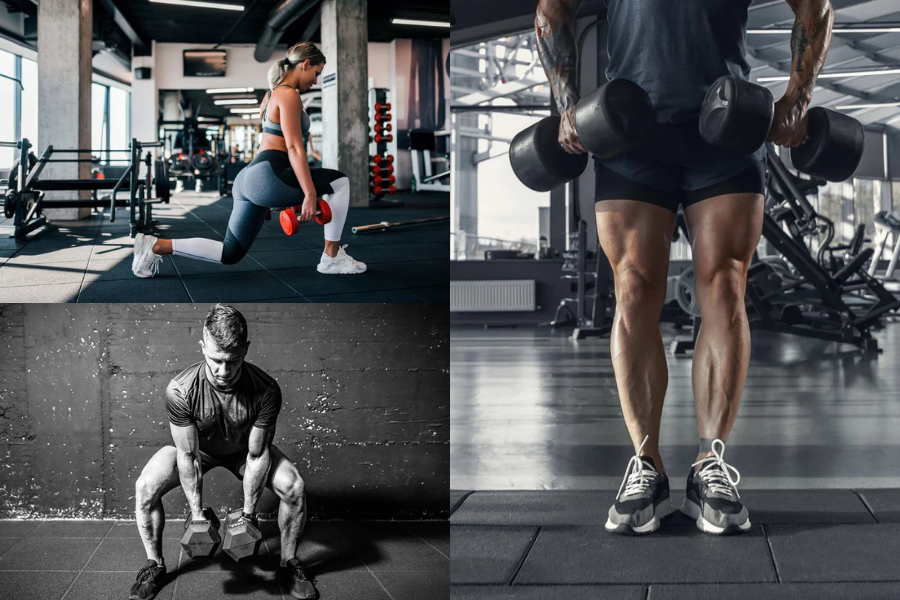
If you struggle to squat deep while staying upright, elevating your heels on small plates or a wedge can help. Holding a dumbbell or kettlebell in front as a goblet also encourages better posture.
This setup increases your range of motion and recruits more fibers in the quadriceps, especially in the vastus medialis, often called the teardrop muscle on the inside of your thigh. Gymshark notes this is a very effective way to increase quad activation in mid 2024 guidance.
Unilateral quad exercises for balance
Training one leg at a time reduces side to side strength gaps and improves stability. Gymshark highlights that unilateral work like lunges and Bulgarian split squats is key for equal quad development on each leg.
Bulgarian split squat
With your back foot elevated on a bench and your front foot out in front, you lower your hips straight down. A shorter stance and more upright torso push more work into your front quad.
Front foot elevated reverse lunge
In this variation, the front foot is raised on a small step or plate. Stepping back into a reverse lunge from this position increases knee flexion and stretches the quad under load, which is a powerful stimulus for growth.
Machine and isolation options
Machine work lets you focus on your quads without worrying about balance as much, which can be useful later in a workout when you are tired.
Leg press with low foot placement
Putting your feet lower on the platform and a bit closer together increases knee flexion, decreases hip involvement, and places more load on the quads. This position lets many men handle heavier loads with good control, which is useful for building size.
Leg extensions
Leg extensions are one of the few exercises that isolate the quadriceps. Because they are not as demanding on your whole body, they create less systemic fatigue and let you push your quads close to failure safely. Gymshark recommends them as a valuable addition when you want more quad size and definition.
Structure an effective quad workout for men
You do not need an advanced bodybuilding plan to build impressive quads. What you do need is a simple structure you can repeat and progress over time.
Below is a sample quad focused day you can run 1 to 2 times per week.
Sample gym based quad workout
- Front squat
- 3 to 4 sets of 6 to 8 reps
- Rest 2 to 3 minutes between sets
- Heels elevated goblet squat
- 3 sets of 10 to 12 reps
- Rest 90 seconds between sets
- Bulgarian split squat
- 3 sets of 8 to 10 reps per leg
- Rest 60 to 90 seconds between sets
- Leg press, low foot placement
- 3 sets of 10 to 12 reps
- Rest 90 seconds between sets
- Leg extensions
- 2 to 3 sets of 12 to 15 reps
- Short 45 to 60 second rests, focusing on slow control
For each exercise, select a weight that has you finishing the set with 1 to 2 tough reps left in the tank. On the last set of your main movement, you can occasionally push to near failure to encourage more muscle growth.
Quad dominant circuit option
If you prefer a conditioning style session, you can use a quad dominant circuit similar to what has been highlighted in training articles:
- 10 dumbbell front squats
- 20 front foot elevated reverse lunges, total reps
- 30 heels elevated goblet squats
Rest for 2 minutes, then repeat for 5 total rounds. The high volume and short rest periods recruit a large number of quad fibers and build serious endurance. Scale the weight down if you cannot keep good form by the third round.
Try at home quad workout ideas
You can still build a stronger quad focused lower body without machines or a full rack, especially if you are willing to control tempo and push sets close to failure.
Beginner friendly bodyweight options
These movements work well if you are new to leg training or coming back after a break.
Goblet squat
Holding a single dumbbell or kettlebell in front of your chest makes it easier to sit back and down into a deep squat. It also reduces back strain and encourages good alignment.
- Start with 2 sets of 10 reps
- Rest around 60 seconds between sets
Split squat
Step into a lunge position, then lower your hips while keeping your torso tall and your back knee just off the floor.
- Aim for 2 sets of 10 reps per leg
- Rest 30 seconds between legs
Wall sit
Slide your back down a wall until your knees are bent at roughly 90 degrees. Hold this position as long as you can.
- Try 2 sets of 30 seconds or more
- Rest 30 seconds between holds
Power and athleticism builders
Once you are comfortable with basic squats and lunges, adding power focused drills can help your quads produce force faster.
Squat jumps
Drop into a quarter to half squat, hold briefly, then jump vertically. In the air, pull your toes up toward your shins to prepare for a soft landing back into the squat.
- Start with 2 sets of 10 reps
- Rest 30 to 60 seconds between sets
Combine these exercises into a simple home circuit, repeating for 3 to 4 rounds:
- Goblet squat, 10 reps
- Split squat, 10 reps per leg
- Squat jumps, 8 to 10 reps
- Wall sit, 30 seconds
Rest 60 to 90 seconds between rounds.
Set your training volume and frequency
To actually grow from your quad workout, you need enough weekly volume and the right frequency.
Evidence based recommendations and the Gymshark 2024 guide suggest:
- Train quads twice per week when possible
- Perform at least 2 quad exercises per session
- Aim for 8 to 12 reps for 3 to 4 sets on most movements
- Target a total of about 10 to 20 weekly sets for quads
Performing 3 exercises per muscle group with 5 to 10 sets per week is generally effective. Pushing beyond 12 to 20 sets per week typically leads to diminishing returns, especially if those sets are not close to failure.
Quality matters more than chasing extreme volume. You get the best hypertrophy results when you work hard within good form, keeping most working sets within 0 to 3 reps of failure.
Put it all together
A smart quad workout for men does three things well. It uses exercises that hit all four quad muscles, it respects full range of motion and controlled form, and it delivers enough hard sets across the week to drive growth.
Start by picking one squat variation, one unilateral movement, and one machine or isolation exercise for each quad day. Train them consistently, stay patient with progression, and your quads will not only look stronger, they will support you better in every lift and every step you take.
About the Author