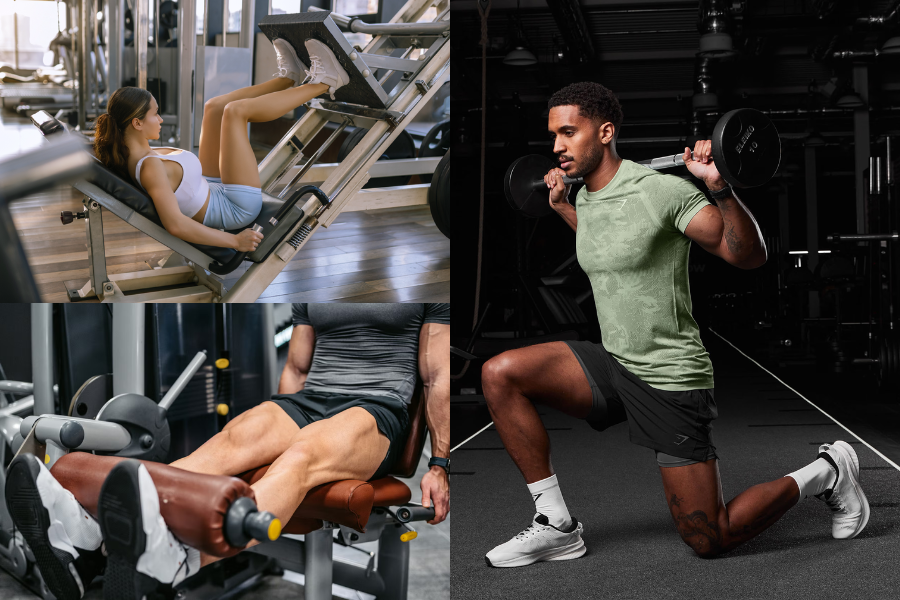
A quad workout without weights is one of the simplest ways to build strong, stable legs at home. With just your body weight, you can strengthen your quadriceps, support your knees, and make everyday movements like climbing stairs or getting up from the floor feel easier.
Below, you will find a practical routine you can try today, plus form tips and progressions so you can keep challenging yourself without any equipment.
Why your quads matter
Your quadriceps are the large muscles on the front of your thighs. They straighten your knees and help stabilize your hips. You use them every time you walk, run, jump, squat, or stand up from a chair.
Stronger quads can:
- Improve knee stability and reduce the risk of knee injuries
- Boost athletic performance in running, jumping, and change-of-direction sports
- Make daily activities, such as climbing stairs or carrying groceries, feel easier
You do not need machines or barbells to get these benefits. Many quad exercises can be performed at home with just your body weight, which makes a quad workout without weights a practical option for almost everyone.
Key principles for training quads without weights
Bodyweight exercises can effectively build quad muscle when you use them strategically. Before you jump into the workout, it helps to understand a few basics.
Focus on form first
Good form keeps your knees happy and your quads doing the work. During any squat or lunge variation, think about:
- Keeping your knees in line with your toes
- Avoiding inward knee collapse
- Not letting your knees shoot excessively past your toes
- Keeping your core engaged and your chest gently lifted
If an exercise causes sharp pain around the knee joint, back off the depth, slow down the movement, or choose an easier variation.
Use progressive overload
Your body adapts quickly. To keep getting stronger, gradually increase the challenge by:
- Adding reps or sets
- Slowing down the tempo, for example 3 seconds down, 1 second up
- Pausing at the bottom of a squat or lunge
- Progressing from two-leg to single-leg movements
You can also add household resistance, such as a backpack filled with books, once bodyweight alone becomes easy.
Aim for strength and muscle growth
For muscle growth, you generally want a moderate rep range. A practical rule of thumb:
- Pick a variation that feels challenging in about 8 to 15 reps
- Rest 45 to 90 seconds between sets
- Perform each exercise with control, no bouncing at the bottom
If you can easily do more than 20 reps without fatigue, it is time to make the movement harder.
Your no equipment quad workout
You can do this quad workout without weights two or three times per week. Rest at least one day between sessions to let your muscles recover.
Warm up first
Spend 5 to 8 minutes preparing your joints and muscles:
- March in place or jog lightly
- Do leg swings front to back and side to side
- Try a few gentle bodyweight squats and lunges
A warmup increases blood flow and can reduce your risk of knee pain during the workout.
Main workout structure
Perform the following exercises in order. Start with 2 rounds if you are a beginner. Work up to 3 or 4 rounds as you get stronger.
- Bodyweight squats, 15 to 20 reps
- Walking lunges, 10 to 12 steps per leg
- Step-ups, 12 to 15 reps per leg
- Wall sit, 30 to 60 seconds
- Single-leg squats or supported single-leg squats, 5 to 8 reps per leg
Rest 30 to 60 seconds between exercises, and 1 to 2 minutes between rounds.
Exercise breakdown and technique tips
Each movement in this quad workout without weights targets your quads slightly differently. Use the cues below to get the most from every rep.
Bodyweight squats
Bodyweight squats are a foundational movement that strengthen your quadriceps, hamstrings, glutes, core, and spinal erectors.
How to do them:
- Stand with your feet about hip to shoulder width apart, toes slightly turned out.
- Brace your core, then sit your hips back as if you are lowering into a chair.
- Bend your knees and lower until your thighs are roughly parallel to the floor, or as far as comfortable.
- Drive through your midfoot and heel to stand back up.
If you are a beginner, you can modify the exercise by reducing squat depth, using a chair behind you, or holding onto a countertop for balance while you practice the movement pattern.
To make squats harder without weights, you can:
- Slow the lowering phase
- Pause at the bottom for 2 to 3 seconds
- Elevate your heels slightly to place more emphasis on the quads
Walking lunges
Walking lunges build single-leg strength and help correct side-to-side imbalances.
How to do them:
- Stand tall with your feet hip width apart.
- Step forward with your right foot and lower your body until both knees are bent around 90 degrees.
- Keep your front knee stacked over your ankle and your torso upright.
- Push through your front heel to bring your back leg forward into the next step.
If you are newer to lunges, take shorter steps and do them in place instead of walking. As you gain strength, lengthen your stride slightly and focus on control.
Step-ups
Step-ups are useful if you have a sturdy chair, bench, or step. They closely mimic climbing stairs and are great for real-world strength.
How to do them:
- Place one foot on the step, whole foot flat.
- Lean slightly forward and press through your front heel to lift your body up.
- Bring your trailing foot up lightly to meet the lead foot.
- Step back down with control, then repeat all reps on one side before switching.
Choose a step height that allows you to push mainly through your working leg, without using a lot of momentum from your lower back or arms.
Wall sit
The wall sit is an isometric hold that lights up your quads and builds muscular endurance without any movement.
How to do it:
- Stand with your back against a wall and your feet about 2 feet in front of you.
- Slide down the wall until your knees are roughly at a 90 degree angle.
- Keep your knees over your ankles and press your lower back gently into the wall.
- Hold for 30 to 60 seconds, breathing steadily.
If 30 seconds is too much at first, start with 10 to 15 seconds and add time each session.
Single-leg squats
Single-leg squats are one of the most challenging exercises in a quad workout without weights. They demand strength, mobility, and balance. The full version is often called the pistol squat.
A safe way to progress is to start with supported or assisted variations:
- Stand in front of a chair or hold onto a doorframe or sturdy surface for balance.
- Shift your weight onto one leg and extend the other leg slightly in front of you or let it hover just off the floor.
- Sit your hips back and bend your standing knee, lowering as far as you can control.
- Press through your heel to return to standing.
Begin with a small range of motion and plenty of support. Only attempt deeper or unsupported reps after you have mastered other simpler quad exercises and can move without pain.
Additional quad focused moves to explore
Once the main workout feels comfortable, you can rotate in other bodyweight quadriceps exercises to keep things fresh and challenging. Options include:
- Bulgarian split squats, rear foot elevated
- Lateral lunges, stepping to the side
- Squat jumps or box jumps, for power
- Reverse lunges
- Single-leg raises, which target the rectus femoris muscle that crosses the hip joint
You can also experiment with more specialized quad moves, such as assisted sissy squats or kneeling quad extensions. These drills place extra emphasis on the front of the thigh. Start with partial ranges of motion and use a support, like a countertop, while you learn the movement.
How to protect your knees
A well designed quad workout without weights should make your knees feel more stable, not more irritated. To avoid knee pain:
- Warm up your muscles and joints before training
- Keep your knees tracking in line with your toes
- Avoid letting your knees buckle inward
- Do not force extreme depth if your mobility is limited
- Increase volume and difficulty gradually, week by week
If an exercise consistently causes discomfort around the patella or deep in the joint, scale it back or swap it for a different variation while you build strength.
How often to train your quads
For most people, training quads two or three times per week is enough to see progress. You might schedule your week like this:
- Monday, Quad workout
- Wednesday, Light cardio or upper body
- Friday, Quad workout
As your fitness improves, you can add a third leg session or increase sets within your existing workouts. Just be sure you can recover between sessions. Mild soreness is normal, but you should still feel capable of moving without limping or sharp pain.
If you consistently increase reps, tempo, or difficulty and stay patient, bodyweight quad training can build impressive strength and muscle without a single piece of gym equipment.
Putting it all together
A quad workout without weights does not need to be complicated. With bodyweight squats, lunges, step-ups, wall sits, and single-leg variations, you can train all the major muscles on the front of your thighs while also improving balance and knee stability.
Start with two rounds of the main circuit, focus on clean form, and track your reps over time. As you get stronger, add a third or fourth round, experiment with harder variations, or add a backpack for extra resistance.
Try the routine once this week and notice how climbing stairs or standing from a chair feels afterward. Strong quads support nearly every move you make, and you can build them right where you are, no weights required.
About the Author