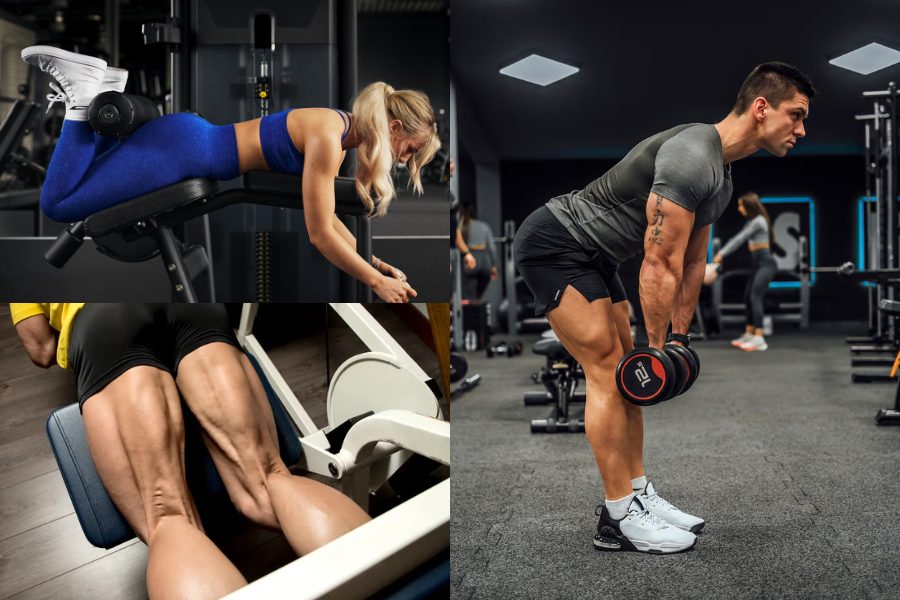
A hamstring workout without weights is one of the simplest ways to build strength, protect your knees, and improve your running or walking form. You can train your hamstrings in your living room, at the office, or in a hotel room with little more than a towel, a chair, or your body and the floor.
Below, you will find bodyweight hamstring exercises organized by fitness level, plus tips on form, sets, and weekly programming so you can safely build stronger legs without a single machine or dumbbell.
Understand what your hamstrings do
Your hamstrings are the group of muscles running along the back of your thigh. They start at the hip and attach just below the knee. These muscles bend your knee and extend your hip, which means they help you walk, run, squat, and bend over.
According to Peloton instructor Matty Maggiacomo, the hamstring group includes the semimembranosus, semitendinosus, and biceps femoris and they are essential for everyday movement. When these muscles are weak compared to your quadriceps, your knees can take on extra stress, your running may feel unstable, and you might notice more aches or tightness in the back of your legs.
A consistent hamstring workout without weights helps you:
- Balance your leg strength
- Support your knees and hips
- Improve posture and walking or running mechanics
- Reduce the risk of hamstring strains and pulls
How often to train your hamstrings
You do not need long, complicated workouts to see progress. What matters most is consistency and total weekly volume.
Research summarized in a Rehab 2 Perform feature that draws on Muscle & Fitness suggests that performing 10 to 16 sets of hamstring work per week can significantly lower hamstring injury risk and support muscle growth. You can spread those sets across two or three shorter workouts or do them in one focused lower body session.
A simple plan is:
- Beginners: 2 hamstring sessions per week
- Intermediate: 2 to 3 sessions per week
- Advanced: 3 sessions per week or 2 harder sessions plus one lighter “maintenance” day
You will find suggested sets and reps below. Use those as a starting point and adjust based on how your body feels.
Beginner bodyweight hamstring exercises
If you are new to strength training, recovering from a break, or dealing with occasional knee discomfort, start here. The goal is to wake up the hamstrings, learn good positions, and move in a slow, controlled way.
Good mornings
Good mornings teach you to hinge at the hips rather than rounding your back.
- Stand with your feet hip width apart and a soft bend in your knees.
- Place your fingertips lightly behind your head or cross your arms over your chest.
- Push your hips back as if you are closing a car door behind you.
- Keep your back flat and chest lifted as you lean forward.
- Stop when you feel a stretch in the back of your thighs, then squeeze your glutes and stand up.
Start with 2 sets of 10 to 12 controlled reps. Move slowly, especially at the bottom of the movement.
Bodyweight Romanian deadlifts
Unweighted Romanian deadlifts are very similar to good mornings, but your arms hang down instead of resting on your head.
- Stand tall with feet hip width apart and knees slightly bent.
- Let your arms hang straight toward the floor.
- Hinge at your hips, push them back, and let your torso tip forward.
- Keep your shins mostly vertical and your back flat.
- Stand up by driving your hips forward and squeezing your glutes.
The Rehab 2 Perform article recommends 2 sets of 10 reps with about 30 seconds of rest between sets. Focus on feeling the hamstrings stretch and contract.
Glute bridges
Glute bridges target your hamstrings and glutes and are gentle on your joints.
- Lie on your back with knees bent and feet flat on the floor, hip width apart.
- Brace your core and press your lower back lightly into the floor.
- Push through your heels and lift your hips until your shoulders, hips, and knees form a straight line.
- Squeeze your glutes and hamstrings at the top, pause for one second, then lower with control.
Try 3 sets of 10 to 15 reps. If you feel this only in your lower back, move your feet slightly closer to your body and focus on pushing through your heels.
Standing hamstring curl
This is a simple way to work knee flexion without any equipment.
- Stand tall and hold the back of a chair or counter for balance if you need it.
- Shift your weight to your left leg.
- Bend your right knee and curl your heel toward your glutes.
- Lower the foot back to the floor with control.
Aim for 2 sets of 12 to 15 reps per leg. Physical therapists often use this as a gentle option after a hamstring or knee injury.
Intermediate bodyweight hamstring exercises
Once basic movements feel comfortable and you can complete them without wobbling or pain, you can move to unilateral exercises and longer ranges of motion. These build strength and improve balance.
Reverse lunges
Reverse lunges put slightly more emphasis on the hamstrings and glutes than forward lunges.
- Stand with your feet hip width apart.
- Step your right foot back and lower into a lunge until both knees are bent about 90 degrees.
- Keep your front knee stacked over the middle of your foot.
- Push through the front heel to return to standing.
Perform 3 sets of 8 to 10 reps per leg. Keep your torso tall and your core engaged.
Single leg Romanian deadlifts
Single leg RDLs challenge your balance and the back of your legs at the same time. Done without weights, they still provide a solid hamstring workout without weights, especially if you slow them down.
- Stand on your right leg with a soft bend in the knee.
- Hinge at your hips and let your torso tip forward as your left leg extends straight behind you.
- Keep your hips square to the floor and your back flat.
- When your torso is roughly parallel to the floor or you feel a strong stretch, squeeze your glutes and return to standing.
Experts recommend high reps, such as 12 to 20 per leg, when you are using just body weight. Start with 2 to 3 sets per side. Use a wall or counter for light support if your balance feels shaky at first.
Straight single leg bridges
This variation of the bridge increases the challenge on each hamstring.
- Lie on your back with one knee bent and that foot flat on the floor.
- Extend the opposite leg straight so your thighs are level.
- Press through the heel of the bent leg and lift your hips.
- Pause at the top, then lower slowly.
Do 2 to 3 sets of 10 to 12 reps per leg. If you cramp, lower the range slightly and move more slowly.
Inverted hamstring (balance hinge)
The inverted hamstring exercise, highlighted by Rehab 2 Perform, combines strength, balance, and core stability.
- Stand tall on your right leg with a soft knee bend.
- Extend your left leg straight back as you hinge forward at the hips.
- Keep a straight line from your shoulder to your heel.
- Return to standing, keeping your hips square.
Try 2 sets of 10 reps per side, resting about 30 seconds between sets.
Advanced bodyweight hamstring exercises
If you already train your legs regularly and want a challenging hamstring workout without weights, these options increase intensity with unilateral work, eccentric control, and explosive movement. Warm up thoroughly before you start.
Bulgarian split squats
Bulgarian split squats hammer your quads and glutes, but if you lean your torso slightly forward and push through your front heel, your hamstrings get a serious workout too.
- Stand about two feet in front of a sturdy chair or bench.
- Place the top of your back foot on the bench.
- Lower your back knee toward the floor, keeping your front knee in line with your toes.
- Push through the front heel to return to standing.
Use 3 sets of 8 to 10 reps per leg. If you have trouble with balance, move your front foot a bit wider and hold your arms out to the sides.
Jump squats
Jump squats introduce power and teach your hamstrings to work explosively.
- Stand with your feet shoulder width apart.
- Lower into a squat, keeping your chest up and weight in your heels.
- Swing your arms and explode upward into a jump.
- Land softly with bent knees, then go right into the next squat.
Start with 2 sets of 6 to 8 reps. Focus on soft, quiet landings and stop if your form starts to fall apart.
Nordic hamstring curls (glute ham raises)
Nordic curls are one of the most demanding bodyweight hamstring exercises you can do. They emphasize the eccentric (lowering) phase, which is powerful for building strength and resilience.
You can set these up at home by securing your feet under a heavy piece of furniture or having a partner hold your ankles.
- Kneel on a soft surface with your feet anchored.
- Keep your body in a straight line from your knees to your head.
- Slowly lean forward from the knees, resisting with your hamstrings.
- When you can no longer control the descent, catch yourself with your hands, then push lightly off the floor to return to the starting position.
Begin with 2 sets of 4 to 6 controlled reps. Progress by lowering more slowly over time.
Sliding leg curls
Sliding curls mimic a hamstring curl machine without weights and they are perfect if you have hardwood or tile floors. You can use socks, towels, paper plates, or furniture sliders under your heels.
- Lie on your back with your legs straight and heels on the sliders.
- Lift your hips into a bridge so your body forms a straight line.
- Keeping your hips up, slide your heels toward your glutes, bending your knees.
- Slowly slide your legs back out to the starting position.
Try 2 sets of 10 reps with about 30 seconds of rest. Once that feels easy, you can progress to single leg curls or V curls, where you move your heels in and out in a V shape.
Simple hamstring mobility and stretching
Stronger hamstrings are great, but flexible hamstrings help you move more comfortably and reduce the feeling of constant tightness. After your hamstring workout without weights, add a few minutes of stretching.
Real Simple recommends several effective options:
- Standing straight leg hamstring stretch or forward fold
- Downward Dog
- Half kneeling hamstring stretch
- Supine hamstring stretch with a strap or towel
Hold each stretch for 20 to 30 seconds, breathe steadily, and avoid bouncing.
Aim to feel a comfortable pull in the back of your thigh, not sharp pain around the knee or hip.
If you sit for long periods, sprinkling these stretches into your workday can also help offset tightness.
Putting it all together
You can mix and match these moves to build a hamstring workout without weights that fits your level and schedule. Here is a sample routine for each stage:
- Beginner: Good mornings, glute bridges, standing hamstring curls
- Intermediate: Reverse lunges, single leg RDLs, straight single leg bridges
- Advanced: Bulgarian split squats, Nordic curls, sliding leg curls
Start with 2 sets of each exercise and gradually work toward 3 sets as your strength and confidence grow. Pay attention to how your body responds and give yourself at least one day of rest between hard leg sessions.
Choose one exercise from this list to add to your next workout, even if it is just a set of glute bridges while you watch TV. Over time, those small efforts will add up to stronger, more resilient hamstrings without any need for weights.
About the Author