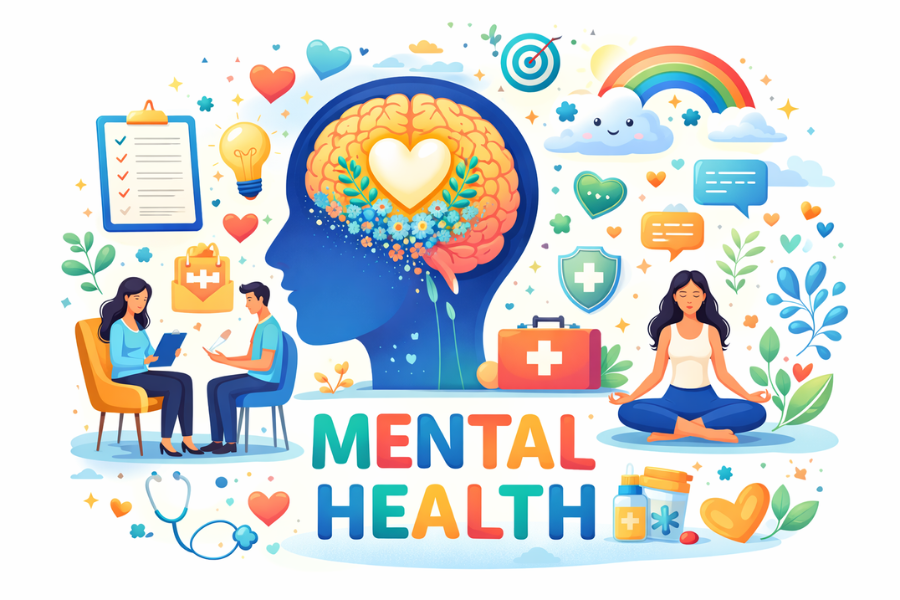
Understand what mental health stigma is
When you hear the phrase mental health stigma, you might think of rude comments or outdated stereotypes. That is part of it, but stigma reaches much further into daily life.
Mental health stigma refers to the negative attitudes, beliefs, and behaviors directed at people living with mental health conditions. It can show up as judgment, exclusion, or subtle changes in how others treat you once they know what you are going through. According to the Mayo Clinic, stigma can lead to discrimination, social rejection, and hurtful assumptions about instability or dangerousness (Mayo Clinic).
Because the term mental illness itself can feel loaded, many people now prefer to say mental health condition to reduce some of the negative weight that language carries (Mayo Clinic).
The three main types of stigma
Mental health stigma is not just one thing. You are usually dealing with several layers at once:
-
Social or public stigma
These are the beliefs held by the general public. For example, assuming people with depression are weak or that people with schizophrenia are violent. Public stigma often leads to avoidance, gossip, and discrimination in jobs or housing (PMC, Mental Health America). -
Self‑stigma
This happens when you start to believe the negative things you hear about mental health. You might think you are broken, lazy, or dangerous, even when that is not true. Self stigma is linked to poorer recovery and greater distress over time (American Psychiatric Association). -
Structural stigma
This is stigma built into systems and policies. Examples include workplace cultures where people fear using mental health benefits, or laws and practices that make it hard to access care or maintain employment while managing a mental health condition (Mental Health America).
You might feel all three at the same time. For example, public stigma at work, self stigma when you judge yourself, and structural stigma when your insurance limits the mental health care you can receive.
See how stigma affects your life
Mental health stigma is not just hurt feelings. It can reshape your choices, your relationships, and even your health.
Barriers to getting help
Stigma is one of the biggest reasons people delay or avoid treatment. The American Psychiatric Association notes that more than half of people living with mental health conditions do not receive treatment, often because they fear being treated differently or losing their job if anyone finds out (American Psychiatric Association).
You might recognize some of these thoughts in yourself:
- “If I talk to a therapist, it means I am weak.”
- “If work finds out, they will see me as unreliable.”
- “People will think I am dangerous or unstable.”
Over time, these fears can keep you from reaching out, even when your symptoms are getting worse.
Impact on work and daily functioning
Stigma follows you into the workplace too. In a 2022 national poll, less than half of workers reported feeling comfortable discussing their mental health with supervisors, and just over half felt comfortable using mental health services at work. Both numbers had declined from previous years, which shows how persistent workplace stigma is (American Psychiatric Association).
The result is that you might:
- Hide panic attacks or depressive episodes.
- Avoid taking time off to manage your health.
- Push yourself past your limits, then feel ashamed when you cannot keep up.
Workplace stigma can also show up in how performance issues are handled. Instead of offering support or accommodations, some employers are more likely to punish or fire employees whose symptoms affect job performance (BrainsWay).
Effects on recovery and self‑worth
Self stigma does not just hurt your feelings. It can shape your entire recovery path. In a 2017 study of more than 200 people with mental health conditions, higher levels of self stigma were linked with poorer recovery outcomes one and two years later (American Psychiatric Association).
You might notice self stigma if you:
- Call yourself “crazy” or “broken” in your own head.
- Feel you do not deserve help or compassion.
- Downplay your struggles because you think others “have it worse.”
- Give up on goals because you assume your condition defines you.
When you believe those messages, it becomes much harder to reach out, stay with treatment, and imagine a future where you are doing well.
Look at where stigma comes from
To understand why mental health stigma still exists, it helps to see the forces that created it in the first place. You are not imagining it. Stigma has deep roots.
Centuries of misunderstanding
For a long time, people with mental health conditions were misunderstood and mistreated. Many were isolated, locked away, or subjected to harmful “treatments.” BrainsWay notes that stigma developed over centuries of poor treatment and incomplete understanding of mental health, even though more recent research has led to more compassionate approaches (BrainsWay).
Those old beliefs did not disappear. They show up today when people still picture “insane asylums,” or assume that hospitalization is always dangerous or humiliating.
Fear and lack of accurate information
Stigma thrives in the absence of good information. Misunderstanding, fear, and assumptions feed each other (BrainsWay).
Common myths include:
- “People with mental health conditions are violent.”
- “Depression is just sadness.”
- “If you really tried, you could snap out of it.”
- “Anxiety means you are overreacting.”
Studies from the United States and Western Europe show that many people still endorse stigmatizing attitudes, and surprisingly, some trained professionals also hold these views (PMC).
The role of media and entertainment
Media has a powerful influence on how you picture mental health. Sensational stories and dramatic portrayals get more attention, which means quiet, realistic depictions often get ignored.
For example, a 2020 study on the film Joker found that viewing its portrayal of a violent character with a mental health condition increased prejudice toward people with mental illness and appeared to worsen self stigma and delay help seeking (American Psychiatric Association).
BrainsWay notes that media often links mental health and substance use conditions with violence or instability, which reinforces harmful stereotypes and makes it harder to challenge stigma (BrainsWay).
Social norms and identity expectations
Stigma is not just about individual bias. It is tied to what your culture expects from you.
For example:
- Many men and boys are taught that showing emotion is a sign of weakness. Social norms tell them to “man up” instead of seeking support. This gendered expectation adds another layer of stigma around mental health challenges (BrainsWay).
- Some communities associate mental health struggles with family shame or spiritual failure. That can make it harder to talk openly and to seek professional help.
These norms can make you feel like your mental health challenges are a personal failure rather than a human experience that deserves care.
Structural and legal barriers
Even as awareness improves, systems often lag behind. The World Health Organization notes that fewer than half of countries fully follow international human rights standards in their mental health laws, and many still depend heavily on institutional care and involuntary admissions (WHO).
This can:
- Reinforce the idea that mental health conditions are something to hide away.
- Make humane, community based care harder to access.
- Signal that people with mental health conditions are problems to be managed, not people to be included.
When laws and systems treat mental health as an afterthought, that structural stigma trickles down into everyday life.
Recognize the different faces of stigma
Stigma does not always look extreme. Often, it shows up in quiet, everyday ways. Noticing these patterns can help you respond with more clarity and less self blame.
Social stigma in your relationships
Social stigma can look like:
- Friends or family joking about someone being “psycho” or “OCD.”
- People pulling away after you mention therapy or medication.
- Loved ones discouraging you from talking about your condition because it might make others “uncomfortable.”
- Communities treating mental health challenges as something embarrassing or shameful.
Over time, this can lead to social exclusion. The CDC notes that people with mental health conditions may be treated negatively and left out of social groups, which deepens isolation and distress (CDC).
Self stigma in your inner dialogue
Self stigma can feel like:
- Reluctance to say “I live with depression” or “I have PTSD.”
- Believing you are less capable, less lovable, or less worthy because of your diagnosis.
- Deciding not to go to therapy because “it will not help someone like me.”
- Feeling ashamed for taking medication or needing time off.
Mental Health America describes self stigma as internalized negative beliefs that lead to low self esteem, shame, and avoidance of help (Mental Health America). When that inner voice takes over, it can be just as harmful as any comment from the outside.
Structural stigma in systems and policies
You might encounter structural stigma if you:
- Struggle to find affordable mental healthcare covered by insurance.
- Notice that your workplace has no clear mental health policies or supports.
- Live in an area where hospitalization is easier to access than community based services.
- See that your legal protections at work are unclear or hard to use.
The World Health Organization’s recent reports highlight that community based care is still limited in many countries and that mental health policies often fall short of human rights standards (WHO). This structural stigma makes it harder to get help even when you want it.
Explore why stigma still persists today
With all the awareness campaigns and conversations about self care, it can be frustrating to see how stubborn mental health stigma remains. Several forces help explain why it is still so present in daily life.
Progress is uneven across groups and places
In many societies, people feel more comfortable talking about anxiety or depression than they did a decade ago. Yet, stigma often remains high around certain conditions like schizophrenia, bipolar disorder, or substance use disorders (PMC).
Research also suggests that stigma is more severe in some regions than others, and in some places it is simply less studied, which makes it harder to address effectively (PMC).
So you might see open conversations on social media while still facing harsh judgment in your own family, workplace, or community.
Awareness without behavior change
You might notice that people use the right words in public but act differently in private. This gap between knowledge and behavior is common.
Someone might:
- Say “mental health matters” and still dismiss a colleague’s need for a mental health day.
- Post supportive messages online and still gossip about a friend’s hospitalization.
- Encourage therapy in general but judge you specifically for needing medication.
Mental Health America notes that real stigma reduction requires not just awareness, but ongoing education, policy advocacy, and supportive environments where people actually feel safe seeking help (Mental Health America).
Powerful stereotypes in media and culture
Even as some shows and movies handle mental health more responsibly, sensational and inaccurate portrayals still get a lot of attention.
The research on Joker is just one example of how a single film can increase prejudice and self stigma in viewers (American Psychiatric Association). Multiply that by decades of similar content, and it is easy to see how the idea of “dangerous” or “unpredictable” mental illness sticks around.
Until everyday, nuanced portrayals of people living with mental health conditions become the norm, those old storylines will continue to influence how you and others think.
Deeply rooted fears about vulnerability
Talking openly about mental health means acknowledging vulnerability, dependence, and sometimes a loss of control. Many people feel deeply uncomfortable with that, especially in cultures that value constant productivity and self reliance.
You might hear phrases like:
- “Just push through it.”
- “Everyone is stressed, you will be fine.”
- “You are overthinking this.”
That discomfort with vulnerability can make people shut down or change the subject when mental health comes up, which keeps stigma in place.
Gaps in resources and support
Globally, more than one billion people are living with mental health conditions, yet services still need urgent scaling up to meet this need (WHO).
When systems are underfunded and overwhelmed:
- Waitlists are long.
- Community supports are patchy.
- Crisis responses may feel unsafe or unpredictable.
These gaps can strengthen the belief that seeking help is a last resort instead of a normal part of caring for your health.
Learn what helps reduce stigma
The good news is that mental health stigma is not fixed. You can play a part in changing it, for yourself and for others.
Talk openly about mental health
Sharing your experiences, at your own pace and with people you trust, can challenge stereotypes more powerfully than facts alone. NAMI highlights that people who talk openly about living with conditions like bipolar disorder and PTSD help others feel less alone and reduce stigma in their communities (NAMI).
You do not have to share everything. You can start small:
- Mention that you are going to therapy, the same way you might mention a dentist appointment.
- Say “I am working on my anxiety” rather than hiding it when it affects your plans.
- If you feel safe, share a piece of your story with a trusted friend or group.
Research has shown that even brief videos featuring personal stories can increase recognition of mental health needs and improve access to care, especially among students and young people (American Psychiatric Association).
Use respectful, accurate language
Language shapes how you think, which means small changes in how you talk can make a big difference.
Try to:
- Avoid using diagnoses as jokes or insults, such as “I am so OCD” or “She is crazy.”
- Say “a person living with schizophrenia,” not “a schizophrenic,” so you remember that the person is more than their diagnosis.
- Choose “mental health condition” when the term mental illness might add unnecessary weight.
NAMI and Mental Health America both emphasize that conscious, respectful language is a simple but powerful way to reduce stigma in everyday life (NAMI, Mental Health America).
Gently challenge misinformation
You do not have to let rude remarks or misinformation slide, especially when they hurt you or others. NAMI encourages you to thoughtfully intervene when you hear incorrect or harmful comments, which can help correct misunderstandings without shaming the other person (NAMI).
You might say:
- “Actually, many people with that diagnosis are not violent. That is a stereotype from movies.”
- “Depression is more than feeling sad. It affects sleep, energy, and thinking too.”
- “Therapy is not just for crises. It can be maintenance care, like seeing a doctor for a chronic condition.”
You do not have to argue with everyone. Choosing your moments and speaking calmly can still plant important seeds.
Build real connections with people who struggle
Research shows that having genuine contact with people living with mental health conditions reduces stigmatizing attitudes (PMC). This can look like:
- Listening when a friend shares their diagnosis, instead of changing the subject.
- Spending time with someone in recovery without treating them as fragile or dangerous.
- Supporting peers in group settings where people talk openly about their experiences.
When you know real people, stereotypes lose some of their power.
Support compassionate policies and environments
Changing systems takes longer, but your voice still matters. Mental Health America recommends steps like:
- Supporting workplaces that offer mental health benefits and flexible accommodations.
- Encouraging schools to provide mental health education and suicide prevention programs.
- Backing policies that improve access to community based care and protect human rights in mental health treatment (Mental Health America).
The World Health Organization calls for sustained investment in mental health services and stigma reduction, describing mental health care as a basic human right (WHO). When you support that message, you help shift the larger culture.
Protect your own mental health in a stigmatizing world
While society catches up, you still have to live with the reality of mental health stigma. Focusing on what you can control can make a real difference day to day.
Separate your identity from your condition
Even if you have heard hurtful messages for years, you are not your diagnosis. You are a person who happens to live with a mental health condition, not a condition who happens to be a person.
You can:
- Name specific symptoms instead of labeling your whole self. For example, “I am having a depressive episode” rather than “I am a failure.”
- Remember that many people with mental health conditions work, parent, create art, and build fulfilling lives.
- Notice when you use harsh labels about yourself and gently replace them with more accurate, compassionate language.
According to Mayo Clinic, accepting your condition as one part of your life and not your entire identity can reduce the power of stigma and support your well being (Mayo Clinic).
Choose your support network with care
You deserve people who take your mental health seriously. That might mean:
- Spending more time with friends who listen without judgment.
- Finding a support group, peer community, or online space where mental health is normalized.
- Setting boundaries with people who repeatedly dismiss or belittle your struggles.
Mental Health America highlights peer support and inclusive communities as key parts of reducing stigma and protecting well being (Mental Health America).
Seek professional help when you need it
Stigma may tell you to wait until things are unbearable. Your health benefits when you act sooner.
You might reach out if you notice:
- Persistent sadness, anxiety, or mood changes that interfere with daily life.
- Changes in sleep, appetite, motivation, or concentration.
- Thoughts that you or others would be better off if you were gone.
You can start with a primary care provider, therapist, or community mental health clinic. If you are in the United States and you are in crisis or want immediate support, you can call or text 988, or chat at 988lifeline.org, where free, confidential help is available 24 hours a day, every day (CDC).
Practice self compassion instead of self blame
You did not cause the stigma you face, and you did not choose to struggle with mental health. When you notice self critical thoughts, you can:
- Ask yourself, “Would I talk to a friend this way?”
- Remind yourself that mental health conditions are common and treatable (CDC).
- Celebrate small steps, like making a phone call, showing up to an appointment, or talking honestly with someone you trust.
Over time, treating yourself with even a little more kindness can weaken self stigma and strengthen your resilience.
Take your next small step
Mental health stigma still exists because of history, fear, misinformation, and systems that have been slow to change. Yet research is clear that things do improve when people share personal stories, challenge stereotypes, create supportive environments, and push for better policies.
You do not have to change everything at once. You might choose just one step today:
- Reaching out to a friend or professional for support.
- Noticing and gently correcting a stigmatizing thought about yourself.
- Using more respectful language when you talk about mental health.
- Listening more closely when someone shares their own struggle.
Every time you treat mental health as a normal, important part of being human, you help loosen the grip of stigma, for yourself and for others.
About the Author