Why tricep training matters for athletes
If you are serious about performance, you need a focused tricep workout for athletes, not just a few random pushdowns at the end of arm day. Your triceps account for a large share of your upper arm mass, and they play a major role in powerful, stable pushing movements. Strong triceps help you:
- Extend the elbow explosively in pressing, throwing, striking, and blocking
- Stabilize the shoulder in overhead positions
- Protect your joints by decelerating high speed movements
For overhead athletes such as baseball and softball players, volleyball and tennis athletes, and track and field throwers, the triceps act as an important “brake” that slows the arm down. If you skip tricep work, you increase your risk of overuse injuries from the constant overhead stress.
Understand your tricep anatomy
Training your triceps effectively starts with knowing what you are trying to build. The triceps brachii has three distinct heads that work together to straighten your elbow and stabilize your shoulder.
Three heads, three roles
-
Long head
-
Attaches to your scapula
-
Assists with shoulder stability and overhead control
-
Works hard in overhead extension movements
-
Lateral head
-
Contributes to “horseshoe” shape and visible size
-
Responds well to heavy pushing and pronated grip exercises
-
Medial head
-
Lies deeper and supports precision and endurance
-
Activated with lighter loads and higher reps, especially with a supinated grip
Targeting all three heads helps you build size, lockout strength, and joint stability that actually transfer to sport.
Key benefits for different athletes
A dedicated tricep workout for athletes looks different from a typical bodybuilding “arm day.” Your goal is not just bigger arms but better performance and fewer injuries.
Overhead and throwing athletes
For pitchers, volleyball players, tennis players, and throwers, the long head of the triceps is critical. It helps extend the elbow and stabilize the shoulder while you decelerate the arm after a throw or spike.
Research referenced by Manske and Ellenbecker in 2013 highlighted how common “silent” shoulder issues are in overhead athletes. They reported that 34% of rotator cuffs labeled as painless shoulders actually had tears on MRI, and 79% of professional baseball pitchers without pain symptoms showed abnormalities in the glenoid labrum. Those numbers underline why supporting muscles like the triceps need specific attention to help reduce gradual shoulder damage.
Strength and power athletes
If you compete in powerlifting, strongman, CrossFit, or weightlifting, strong triceps are non negotiable. They are heavily involved in:
- Bench press and close grip bench press lockouts
- Overhead pressing, jerks, and push presses
- Events that require powerful pushing and bracing
Close grip bench press, dips, skull crushers, and overhead extensions all contribute directly to better performance in these lifts.
Contact and combat athletes
Football, wrestling, and other contact sports rely on triceps for:
- Stiff arm techniques
- Pummeling and hand fighting
- Rapid elbow extension in grappling and striking
Isolating the triceps improves how your arms coordinate with your lats and shoulders, which translated into more powerful and controlled upper body contact.
Climbers and general athletes
Even if you are not pressing heavy, strong triceps help with:
- Mantling and pressing down on holds
- Controlling the rope above your head when climbing
- Push ups, handstands, and general upper body stability
You do not need to be a strength athlete to benefit. If you push, press, or reach, strong triceps matter.
Training principles for athletic triceps
Before you jump into the workout, it helps to understand how to structure your training so each session moves you closer to your goals.
Frequency and volume
For most athletes, aim to train triceps at least twice per week. You can:
- Pair one tricep focused day with an upper body push day
- Add targeted tricep work after your main sport or lifting sessions
Hypertrophy guidelines for muscle growth recommend:
- 3 to 6 sets per exercise
- 6 to 12 repetitions per set
- Around 60 to 80% of your one rep max
- Rest intervals of about 60 seconds between sets
This structure helps build both size and strength without overwhelming your recovery.
Exercise selection and variety
To cover the full tricep, rotate through movements that emphasize each head:
- Long head: overhead tricep extensions, seated Miracle Gro variations
- Lateral head: tricep dips, skull crushers, pushdowns, close grip bench
- Medial head: reverse grip pushdowns, higher rep isolation work
A balanced program will combine compound presses with a couple of isolation exercises that let you focus on feel and control.
Intensity and rep ranges
To build both strength and size, you want a mix of:
- Low reps with heavy loads for strength and power
- Moderate to high reps with moderate loads for hypertrophy and endurance
You can also use intensity techniques used in many athlete focused routines, such as drop sets and rest pause work, to get more stimulus in less time. One Muscle & Fitness triceps routine, for example, recommends just four main exercises with a blend of heavy sets and high rep dropsets, all within about 35 minutes, to build upper body push strength and visible triceps definition.
The six core tricep exercises for athletes
You will see many variations, but a few staples come up in nearly every effective tricep workout for athletes. These six will form the backbone of your program.
1. Overhead tricep extension
Best for: Long head, shoulder stability, overhead athletes
You can do this standing or seated, with a dumbbell, barbell, or cable.
How to do it:
- Stand with your feet shoulder width apart or sit tall with your back supported.
- Hold a light to moderate weight overhead with both hands.
- Keep your elbows pointed forward and close to your head.
- Lower the weight behind your head in a controlled arc.
- Extend your arms to return to the starting position without locking out aggressively.
Why it helps athletes:
- Strengthens the long head in an overhead position
- Teaches you to stabilize your shoulder while extending your elbow
- Transfers to throwing, serving, pressing, and overhead lifting
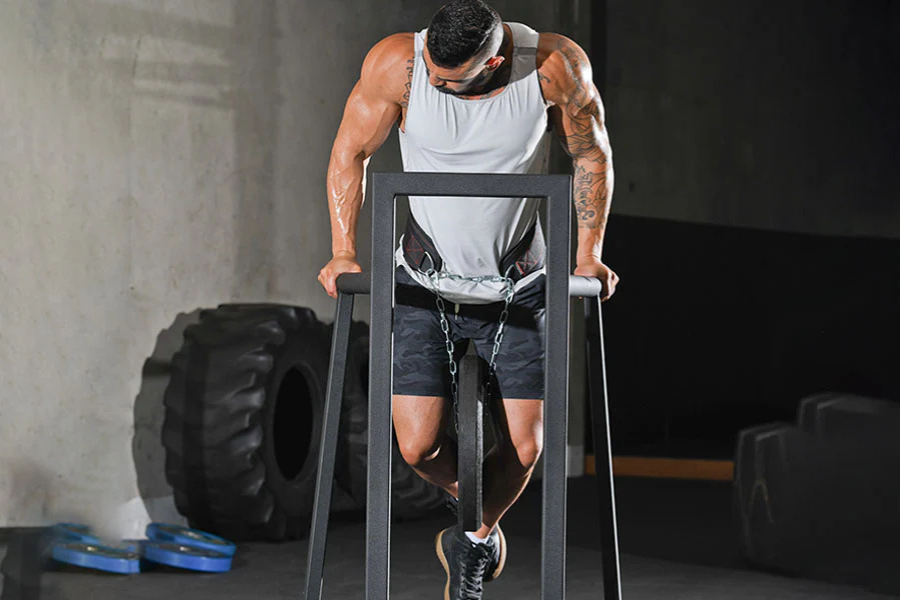
2. Tricep dips
Best for: Overall tricep mass, lockout strength, pressing power
You can use parallel bars or a sturdy bench.
How to do it:
- Place your hands on parallel bars or on the edge of a bench.
- Lower your body slowly by bending your elbows.
- Keep your torso slightly forward if you want more tricep emphasis.
- Press back up until your arms are straight but not hyperextended.
Programming idea:
- 4 sets of 4 heavy, weighted reps
- Followed by 2 drop sets of 12 to 17 bodyweight reps
This combination targets both strength (low rep, heavy) and hypertrophy (higher rep, lighter) to build serious mass and explosive elbow extension.
3. Skull crushers
Best for: Lateral head, controlled eccentric strength
How to do it:
- Lie on a flat bench with a barbell or EZ bar.
- Press the weight up so it is above your chest.
- Keeping your upper arms still, bend your elbows and lower the bar toward your forehead or just behind your head.
- Extend your elbows to lift the weight back up.
Use a full range of motion and controlled lowering to build strength without irritating your elbows.
4. Tricep pushdowns
Best for: Lateral and medial heads, endurance, lockout finish
Use a cable machine with a straight bar, V bar, or rope attachment.
How to do it:
- Stand tall with your elbows tucked by your sides.
- Grip the attachment with a pronated or neutral grip.
- Push down until your arms are straight and your triceps are fully contracted.
- Return to the starting position under control.
You can also use a reverse (supinated) grip to shift more emphasis onto the medial head and refine elbow control.
5. Close grip bench press
Best for: Heavy tricep strength, bench lockout, full arm mass
How to do it:
- Lie on a flat bench with your feet planted.
- Grip the bar with your hands slightly narrower than shoulder width.
- Lower the bar to your lower chest, keeping your elbows close to your body.
- Press the bar back up, focusing on driving through your triceps.
Close grip bench presses are a staple in powerlifting and strongman because the long head of the triceps is responsible for much of the triceps size and strength that carries over to heavier benches.
6. Diamond push ups
Best for: At home tricep training, endurance, medial head focus
How to do it:
- Get into a push up position with your hands close together under your chest.
- Form a diamond shape with your thumbs and index fingers.
- Keep your body in a straight line from head to heels.
- Lower your chest toward your hands, then push back up.
Diamond push ups load your triceps more than regular push ups and are convenient when you do not have equipment.
Advanced athletic tricep builders
Once you have mastered the basics, you can start using more targeted movements and methods that are especially useful for competitive athletes.
Seated Miracle Gro exercise
Best for: Long head strength, shoulder stability, overhead power
This movement is performed in a seated military press style position and uses an open palm grip for a deep stretch.
How to do it:
- Sit on a bench with a back support.
- Hold a dumbbell with both hands using an open palm grip.
- Lift the weight overhead, then slowly lower it behind your head to achieve a deep stretch.
- Keep your chest up and your elbows close to your ears.
- Extend your elbows to bring the dumbbell back overhead.
Recommended programming:
- 4 to 5 sets of 7 to 9 heavy reps
- Then 2 drop sets of about 20 reps
This combination improves overhead lockout strength and shoulder stability, which carries over to jerks, snatches, push presses, shot putting, and pitching.
Standing cable overhead tricep extensions
Best for: Shoulder co contraction, thoracic extension, overhead lockout
Athletes who are internally rotated, such as wrestlers and some weightlifters, benefit especially from this exercise.
How to do it:
- Set a cable at a low position and face away from the machine.
- Step forward so the cable is behind you and grab the handle with both hands.
- Bring your hands behind your head, elbows pointing forward.
- Slightly lean forward with your back supported by your own tension.
- Extend your elbows to press your hands overhead, then return with control.
This movement trains your triceps while forcing your upper back and shoulders to work together, helping you maintain better overhead positions with less forward drift.
Ghostface kickbacks into close grip bench press
Best for: Fast twitch recruitment, explosive strength, hypertrophy
Using a pre fatigue method, you first isolate the triceps with band kickbacks, then go into heavy close grip bench sets.
Step 1: Ghostface kickbacks
- Attach bands to a sturdy anchor.
- Bend slightly forward, elbows up by your sides.
- Extend your arms straight back, squeezing your triceps at the top.
Perform 15 to 20 reps, then rest 30 to 60 seconds.
Step 2: Close grip bench press
- Move to a bench and use a close grip on the barbell.
- Lower the bar slowly with a controlled eccentric.
- Press up quickly with a rapid concentric phase.
This sequence helps activate fast twitch fibers and stimulates growth and strength with less total load, which is useful when you need to manage joint stress and overall fatigue.
Sample tricep workout for athletes
Use this example plan as a starting point. You can run it 1 or 2 times per week depending on your schedule and recovery.
Workout A: Strength focused
- Close grip bench press
- 4 sets of 4 to 6 reps
- Rest 2 to 3 minutes
- Weighted dips
- 4 sets of 4 reps heavy
- Then 2 drop sets of 12 to 17 reps bodyweight
- Skull crushers
- 3 sets of 8 to 10 reps
- Rest about 60 to 90 seconds
- Tricep pushdowns
- 3 sets of 12 to 15 reps
- 60 seconds rest, focus on constant tension
Workout B: Hypertrophy and overhead stability
- Seated Miracle Gro
- 4 to 5 sets of 7 to 9 heavy reps
- Then 2 drop sets of around 20 reps
- Standing cable overhead tricep extensions
- 3 sets of 10 to 12 reps
- Focus on posture and smooth overhead lockout
- Ghostface kickbacks + close grip bench combo
- 1 set of 15 to 20 band kickbacks
- 30 to 60 seconds rest
- 3 sets of close grip bench with slow eccentric and fast concentric, 6 to 8 reps
- Diamond push ups
- 2 to 3 sets to technical fatigue, staying 1 to 2 reps shy of failure
You can alternate these two workouts across the week, or combine elements depending on your sport season and total training load.
Tricep training at home
If you do not have a full gym, you can still build powerful triceps with bodyweight and basic equipment. According to training guidance from Gymshark, you can make steady progress at home by carefully increasing exercise difficulty, reps, or reducing rest time.
Bodyweight tricep options
- Diamond push ups
- Bench or chair dips
- Decline diamond push ups for extra load
Band based tricep options
- Band pushdowns
- Overhead band extensions
- Band kickbacks
Focus on:
- Pushing close to, but not to, failure on the last set
- Adding a few reps each week or slowing down the eccentric portion
- Short rests, around 45 to 60 seconds, to increase the challenge
Simple guidelines to avoid injury
Hard tricep training should not come at the cost of your elbows or shoulders. Keep these checks in mind:
- Warm up your shoulders and elbows with light band work and easy push ups
- Start with lighter weights to groove the movement before going heavy
- Use full but controlled ranges of motion
- Stop a set if you feel sharp pain rather than normal muscle fatigue
- Increase your weekly volume or load gradually
Remember that the triceps often act as stabilizers during other pressing work, so account for your total weekly stress from benching, push pressing, and other sport specific training.
Putting it all together
A well designed tricep workout for athletes does more than build bigger arms. It helps you:
- Press heavier and more confidently
- Protect your shoulders in overhead and throwing sports
- Extend and lock out faster in contact, combat, and strength events
Choose 3 or 4 of the exercises above, train your triceps twice a week, and follow the rep and set ranges that match your current season. Start with technique, then gradually build load and volume. Over the next few months you will feel the difference every time you press, throw, or push.
About the Author