Calf workouts at the gym feel straightforward at first. You grab a machine, bounce up and down on your toes, and hope your calves finally grow. Then months pass, and your lower legs look exactly the same.
If that sounds familiar, you are probably not lazy. You are most likely making a few common mistakes in how you structure and perform your calf workouts at the gym. Small changes in technique, load, and exercise selection can make a big difference in strength, size, and even lower body durability.
Below, you will learn what to stop doing and what to start doing instead so your time in the gym actually shows up in your calves.
Relying on genetics as an excuse
Calf size is influenced by genetics, especially the structure of your gastrocnemius muscle. A 2004 article on Simplyshredded.com notes that this anatomy is a big reason calves can feel stubborn compared to other body parts. That is why you see some people walk around with big calves despite never training, while you grind away for every millimeter.
Genetics matter, but they are not the whole story. Sports rehab specialist David Grey points out that many athletes have weak calves simply because they rarely train them seriously, especially after issues like Achilles problems. In other words, you might not be able to turn your calves into a cartoon bodybuilder feature, but you can absolutely make them bigger, stronger, and more resilient than they are now.
Instead of assuming your calves are hopeless, treat them like any other muscle. Give them a clear plan, consistent effort, and time. You will probably be surprised by what actually changes.
Training calves like you walk
If most of your calf workouts at the gym look like short, quick, half reps, you are basically repeating what your calves already do all day when you walk. The research summary you saw above notes that low‑intensity, walking‑like reps are a common mistake. Your calves are already adapted to this.
To send a new signal, you need to change one or more of the following:
- Range of motion
- Load
- Tempo
- Time under tension
That means slower reps, a real stretch at the bottom, a strong squeeze at the top, and enough weight that you cannot just bounce.
Try this simple adjustment the next time you step onto a calf machine: pause for one to two seconds at the bottom, then rise up forcefully and hold for one to two seconds at the top. The set suddenly feels harder without changing the weight, and your calves finally realize this is not just more walking.
Ignoring half of your lower leg
Many people think “calves” and only picture the big gastrocnemius muscle on the back of the leg. Effective calf training involves more than that. You also need to address the soleus and the tibialis anterior along the front of your shin.
When you only hammer the gastrocnemius, you set yourself up for:
- Imbalanced development
- Tight, overworked calves
- A higher chance of issues like shin splints
Research in the summary above highlights that including all the lower leg muscles helps both performance and injury prevention. The tibialis anterior is particularly overlooked, even though it plays a key role in ankle stability and deceleration.
A simple way to round out your calf workouts at the gym is to include:
- A straight‑leg exercise for the gastrocnemius
- A bent‑knee exercise for the soleus
- A shin‑focused movement, like tibialis raises, at least once or twice a week
You will feel the difference not just in how your calves look, but also in how solid your ankles and lower legs feel when you run, jump, or lift.
Never changing your exercises
Your calves adapt quickly to the same movement done the same way. If you do only one calf machine every leg day, your body eventually treats it as routine work and progress slows down.
The research you saw recommends adding at least a bit of variety, for example seated calf raises and tibialis raises, so you can target different muscles and avoid plateau. This does not mean you need a long list of fancy moves. It means rotating through a small set of effective exercises and occasionally changing how you use them.
Some proven options for calf workouts at the gym include:
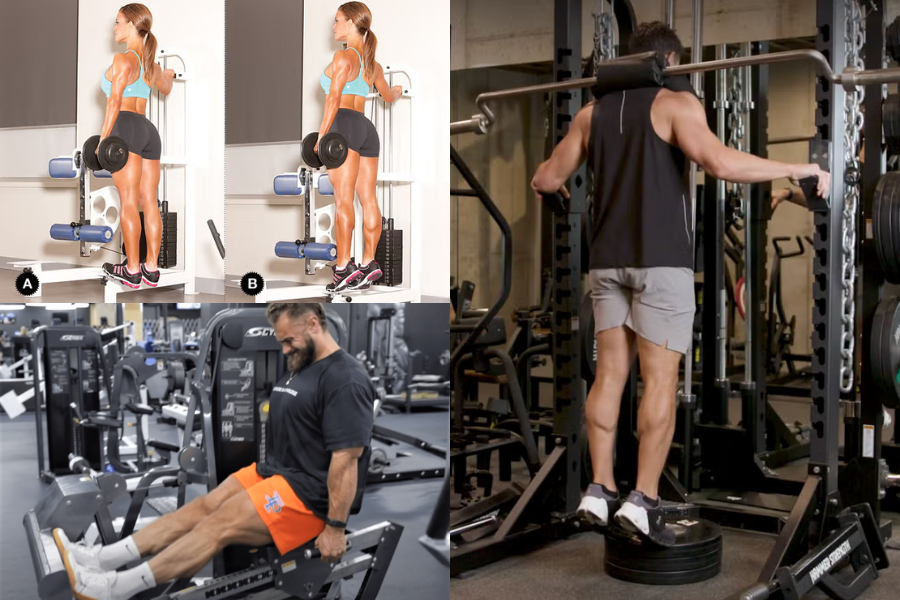
- Standing calf raises
- Seated calf raises
- Leg press calf raises
- Donkey calf raises
- Eccentric calf raises
- Tiptoe farmer’s carries
- Squats into calf raises
Trainer David Grey, however, also warns against going too far with variety. He suggests making standing calf raises your mainstay and treating other movements as supporting players. This balance lets you practice a key pattern often enough to get strong at it, while still hitting your calves from a few different angles over the week.
Using the wrong rep ranges every time
Your calves contain both slow and fast twitch fibers. They are built to handle a lot of low‑intensity work, like walking, but they also respond when you push them with different loads and rep schemes.
Calves also adapt to whatever rep range you stick with. If you always do 15 reps with the same weight, your calves will get better at exactly that and then stall.
The research summary recommends:
- Mixing high‑rep sets, around 25 to 30 or more
- Moderate rep sets, around 10 to 20
- Combining these with some form of progressive overload
A Muscle & Fitness article from 2026 notes that a focused 15‑minute session, done three to five times per week and built around both high‑rep and moderate‑rep work with added weight, can be enough to stimulate growth.
You can use a pattern like this for one of your weekly sessions:
3 sets of 10 to 15 heavy standing calf raises, then
2 sets of 25 to 30 lighter standing calf raises with slower tempo
Over time, increase the weight for the moderate sets and try to add a rep or two to the high‑rep sets. This approach gives your calves more than one kind of challenge, which usually translates into better results.
Forgetting about load and intensity
A lot of people train calves with whatever weight “feels nice” rather than what is actually challenging. David Grey points out that many lifters stay too light because they focus on going as low as possible, and as a result their calves never get a real strength stimulus.
On the other hand, some sources emphasize high volume with lower loads. A 2020 paper by Brad Schoenfeld and colleagues notes that calves are predominantly slow twitch, which means they may respond especially well to high volume and lower loads when you train them with enough intensity and range.
You do not have to pick one camp only. You can:
- Use heavier loads on standing calf raises, where your joints feel strong and supported
- Use lighter loads and higher reps on seated or leg press calf raises, where you can emphasize control and burn
The key is that your last few reps should actually feel difficult. If you can hold a conversation, scroll your phone, or think about dinner while doing calf raises, the set is probably too light.
Rushing the range of motion
Full range of motion with control is one of the biggest drivers of calf development. Arnold Schwarzenegger famously talked about hitting an almost ballerina‑like position at the top of each rep. Research and coaching notes in the summary above echo this, emphasizing a deep stretch at the bottom and a strong rise onto your toes at the top.
Where many people go wrong is turning that range of motion into a fast bounce. The heels drop quickly, then shoot up again, using the spring of the Achilles tendon more than the muscle. You feel movement, but not much muscular work.
To fix this, use a simple rule on most of your sets:
- One to two seconds down
- One to two seconds pause in the stretch
- One second up
- One to two seconds hold at the top
You can still do some more explosive reps, especially if you are training for sport, but make controlled, full‑range work your base. Your calves will feel a very different kind of fatigue, which is exactly what you want.
Misjudging frequency and volume
When calves are not growing, many people decide to train them every day with countless sets. That can work for a short burst, but it is not a sustainable long‑term plan, especially if the weights are too light to matter.
David Grey suggests not going overboard with frequency if you are not using challenging loads. He emphasizes progressive overload over simply doing calf raises more often. At the same time, other sources indicate that higher volume and frequency, such as 18 to 24 sets per week spread over three to four sessions, can drive calf growth when paired with good technique and controlled eccentrics.
You can combine these ideas by:
- Training calves two to four days per week
- Aiming for roughly 12 to 20 total working sets per week at first
- Splitting that volume across standing, seated, and leg press variations
Pay attention to how your Achilles and ankles feel. Mild soreness is fine. Sharp or persistent pain is not. If your lower legs never stop aching, pull the volume back, focus on quality sets, and then build up again.
Ignoring foot position and shin work
Foot angle might seem like a cosmetic detail, but it can change how your gastrocnemius is targeted. A 2020 study by Nunes and colleagues, summarized in the research, shows that:
- Toes pointed outward emphasize the medial head
- Toes pointed inward emphasize the lateral head
- Toes forward hit both heads more evenly
Rotating between these positions across your sets or workouts helps you develop more balanced calves. It also changes the feel of the exercise, which can help you keep effort high rather than zoning out.
Just as important is adding some kind of tibialis anterior work. Tibialis raises, whether on a machine or simply leaning back against a wall and pulling your toes toward your shins, help balance all the pushing you do in calf raises. They support ankle stability and may reduce your risk of shin splints when you run or jump.
You do not need an entire workout dedicated to the front of your lower leg. Even 2 or 3 sets of 15 to 20 tibialis raises twice a week can make a noticeable difference over time.
Skipping the best gym calf exercises
With so many machines in a gym, it is easy to feel like you need a huge menu of calf moves. In reality, you can make progress with a short list of well‑chosen exercises performed with focus.
Some of the most consistently recommended moves in the research summary include:
-
Standing calf raises
A staple that you can do on a machine, Smith machine, or simply on a step. Many coaches and even Reddit communities in 2023 highlighted standing calf raises with full, deep motion and a strong, explosive rise as one of the best growth tools. Aim for 3 to 4 sets of 20 to 25 reps in at least one weekly session. -
Seated calf raises
These place your knees in a bent position, which targets the soleus more directly. Research notes that slow, controlled eccentrics and brief holds at the bottom and top increase muscle tension and growth potential. Try 3 sets of 8 to 15 reps with two‑second holds at each end. -
Leg press calf raises
These let you load heavier without extra pressure on your spine, while still getting a deep stretch. They are ideal for those days when you want to push load but your lower back feels tired. -
Single‑leg leg press calf raises
These are especially helpful for athletes, such as basketball players, to spot and correct left‑right differences. The research suggests 3 sets of 12 to 20 reps with a focus on lighter weight and perfect range. -
Jump rope
Short intervals, such as 30 seconds on and 30 seconds off for 3 to 4 rounds, give you a plyometric and conditioning hit that also builds more springy, defined calves. -
Tiptoe farmer’s carry and squats into calf raises
These add calf work into loaded carries and squats, making your lower legs work in more functional patterns instead of only in isolation.
You do not have to include every exercise every week. Start with two or three main choices and rotate others in as needed.
Putting it all together
You do not need a complicated plan to fix the most common calf workout mistakes at the gym. You mainly need to:
- Stop treating calves as an afterthought
- Use deliberate technique and real effort
- Cover all the major muscles of the lower leg
- Gradually increase workload over time
If you want a starting point, try this simple structure for three days per week:
-
Day 1
Standing calf raises, 4 sets of 10 to 15 heavy reps
Seated calf raises, 3 sets of 15 to 20 reps, slow tempo -
Day 2
Leg press calf raises, 3 sets of 12 to 20 reps
Tibialis raises, 3 sets of 15 to 20 reps -
Day 3
Standing calf raises, 3 sets of 20 to 25 reps, lighter load, full stretch
Jump rope, 3 rounds of 30 seconds on and 30 seconds off
Pair that with consistent tracking of your loads and reps, and a bit of patience, and you give your calves a much better reason to finally grow.
About the Author