Why core strength matters for women
If you are looking for an effective ab workout for women that goes beyond chasing a six pack, you are in the right place. A strong core does far more than make your midsection look toned. It supports your spine, protects your organs, stabilizes your movements, and can even improve pelvic floor function and posture.
Experts describe the core as a 360º powerhouse that wraps around your midsection. When you train it well, you move more comfortably, feel steadier on your feet, and are better equipped for everything from carrying groceries to lifting weights.
According to strength coach Lindsey Benoit O’Connell, a strong core is the foundation of overall strength and well-being for women, helping with mobility, posture, pain reduction, and injury prevention, as reported by Good Housekeeping in 2026. Other trainers stress that your abs workout should target all the major core muscles, not just the visible “six pack.”
In short, you are not only working for definition. You are building a body that supports you in daily life.
Understand your core muscles
To build a balanced ab workout for women, it helps to know what you are actually training. Your “core” includes several muscle groups that wrap around your trunk.
Main core muscle groups
- Rectus abdominis
The front muscle that can form a “six pack.” Helps you bend your spine forward, for example in crunches or sit ups. - Transverse abdominis (TVA)
A deep corset like muscle that wraps horizontally around your torso. Often called the body’s built in “weightlifting belt,” it stabilizes the spine and pelvis during lifting and daily movement. - Internal and external obliques
These sit on the sides of your waist. They help you twist, bend sideways, and stabilize your spine when you move in different directions. - Multifidi and erector spinae
Deep back muscles that support and move your spine. Strong back and front muscles together create a resilient core. - Diaphragm and pelvic floor
These often overlooked muscles are key for breathing, intra abdominal pressure, and continence. Trainer Kira Jones notes that strengthening the diaphragm and pelvic floor along with the rest of the core helps protect your spine and organs and can reduce injury risk.
When your routine covers all of these, you get better posture, balance, and stability, not just a stronger looking midsection.
Benefits of a strong core for women
A thoughtful ab workout for women delivers benefits you feel all day, not only during your workout.
Everyday movement feels easier
Functional core training mimics how you move in real life. Trainers recommend moves like squats, hip hinges, carries, and twists to help with tasks such as:
- Lifting kids or heavy bags
- Loading groceries into the car
- Reaching, twisting, and bending around the house
- Walking, running, or hiking with better balance
Unlike isolated crunches, functional core exercises strengthen the muscles that connect to your pelvis and spine so you are better prepared for real life movements.
Posture, pain, and pelvic floor support
A strong, well balanced core can help:
- Reduce lower back discomfort by supporting your spine
- Improve posture so you are not slumping over your desk or phone
- Support your pelvic floor, which may reduce incontinence issues
Heel touches, planks, bird dogs, and other deep core moves help engage the lower abs and pelvic floor, an area that is especially important for women.
Better performance in workouts and sports
When your core is strong and responsive, you can:
- Lift more safely in squats, presses, and deadlifts
- Generate more power in sports like running, tennis, or cycling
- Maintain form longer, which reduces your injury risk
Your transverse abdominis in particular acts like built in support when you press, squat, or deadlift. You will feel more stable and controlled as you move.
How often to train your abs
You do not need to train abs every single day to see results. In fact, overdoing it can backfire.
Many trainers recommend:
- 2 to 3 dedicated core sessions per week
This gives your muscles time to recover and grow between workouts. - 10 to 20 minutes per session
Short focused sessions using bodyweight moves can be very effective. - Rest days for your core
Just like any other muscle group, your abs need time to repair. Training them intensely every day can stall progress and increase injury risk.
Remember, many compound exercises like squats and deadlifts already work your core. Extra ab sessions are meant to complement, not replace, a well rounded fitness routine.
Form tips for safe, effective ab work
Whether you are a beginner or experienced, technique matters more than speed.
Move slowly and with control
Slow, controlled movements help you:
- Target the right muscles
- Avoid straining your neck or lower back
- Get more benefit out of fewer reps
Trainers often recommend focusing on form first, then adding difficulty by increasing time under tension, reps, or rounds.
Breathe and engage your core
For most core exercises:
- Inhale to prepare.
- Exhale as you exert effort, like lifting or twisting.
- Think about gently drawing your navel toward your spine without tensing your whole body.
This helps engage your deep core, diaphragm, and pelvic floor together.
Use modifications without hesitation
Many common exercises have beginner friendly options, for example:
- Planks
Drop to your forearms or your knees if your lower back sags. This keeps alignment safer while you build strength. - Dead bugs
Keep your legs in tabletop and move only your arms at first. Add leg extension as you get stronger. - Toe touches or leg raises
Bend your knees or keep legs in tabletop instead of straight up to reduce strain on your lower back and hip flexors.
Modifications are not “cheating.” They are tools that help you work the right muscles safely.
Sample 10 minute ab workout at home
You can do a simple ab workout for women using just your bodyweight and a mat. Here is a 10 minute routine inspired by trainers who specialize in at home circuits.
How to structure it
- Set a timer for 30 to 45 seconds of work per exercise.
- Rest 15 seconds between moves.
- Complete all 5 exercises, rest for 1 minute, then repeat for a second round.
Aim for 2 to 3 total rounds depending on your fitness level.
The routine
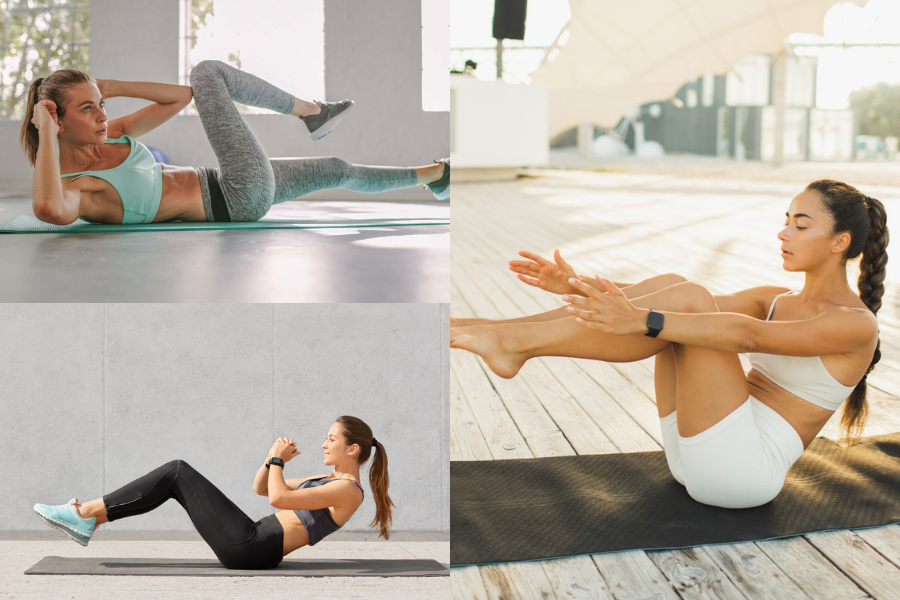
Tabletop crunch and reach
- Lie on your back, knees bent at 90 degrees in tabletop.
- Reach your arms toward your thighs and lift your head, neck, and shoulders.
- Exhale as you crunch up, inhale as you lower.
- Keep your lower back gently pressed toward the mat.
Heel touches
- Lie on your back with knees bent, feet flat and slightly wider than hip width.
- Lift your head and shoulders, reach your right hand toward your right heel, then left hand toward left heel.
- Move side to side in a slow, controlled way.
- This targets the lower abs and obliques and can also help strengthen the pelvic floor.
Standing knee drive
- Stand tall, hands behind your head or at your chest.
- Drive one knee up toward your chest as you crunch your ribs down.
- Lower and repeat on the same side, then switch halfway through or next round.
- Focus on engaging your core rather than just swinging your leg.
Plank (high or forearm)
- Set up with shoulders stacked over wrists or elbows, body in a straight line from head to heels.
- Slightly tuck your pelvis and pull your belly button toward your spine.
- Hold without letting your hips sag or pike up.
- Drop to your knees if needed to maintain good form.
Mountain climbers (slow and controlled)
- Start in a high plank.
- Draw one knee toward your chest, then switch legs.
- Move at a steady, deliberate pace instead of sprinting.
- Keep your hips level and core braced.
As you get stronger, you can add a third round or extend work intervals to 45 seconds.
Beginner friendly 15 minute core circuit
If you are new to ab workouts, start with a gentle yet effective 15 minute session. Trainers often suggest picking five basic moves and cycling through them.
Suggested structure
- Work for 30 to 45 seconds per exercise.
- Rest 15 seconds between moves.
- Complete 3 rounds.
Beginner exercise ideas
Choose five of the following:
- Bird dog
Great for core stability and lower back support. From hands and knees, extend opposite arm and leg, pause, then switch sides. - Dead bug (modified)
Lie on your back, knees in tabletop. Lower one arm overhead while tapping the opposite toe toward the floor, then return. Switch sides. - Side plank on knees
Support yourself on your forearm and bottom knee, hips stacked. Lift hips and hold. Progress to full side plank when ready. - Glute bridge
Lie on your back, feet flat. Press through your heels to lift your hips. This works your glutes and helps support your lower back and core. - Seated rotation (unweighted Russian twist)
Sit tall, lean back slightly, feet on the floor or lifted. Rotate your torso side to side, keeping your chest open. - Hollow body hold (beginner)
Lie on your back, arms by your sides. Lift your head and shoulders, bring knees over hips. Hold, keeping your lower back gently pressed toward the mat.
Focus more on feeling your core engage than on how long you can last. Quality beats quantity.
Functional core moves you can add
To build a truly resilient midsection, include movements that mimic life outside your workout.
Examples of functional core exercises
- Farmer’s carry
Hold a weight in each hand and walk with tall posture. Your core works to stabilize every step. - Halo
Holding a dumbbell or weight plate, circle it slowly around your head. This challenges shoulder mobility and core control. - Russian twists
With or without a weight, rotate your torso side to side from a seated position. This trains rotational strength. - Plank knee to nose
From a plank, draw one knee toward your nose while rounding your upper back slightly. Return and switch sides. - Forearm side plank
Target your obliques and posture by holding your body in a straight line on your side, supported by your forearm and feet or knees.
Rotational and multi directional moves like these help your core handle twisting, bending, and stabilizing in daily life.
How abs training fits with visible results
You might be wondering how all this translates into visible abs. Trainers consistently point out that core work alone is not usually enough.
The role of body fat and genetics
Experts quoted in Women’s Health explain that most women need to reach a relatively low body fat range to reveal distinct six pack abs. Many cite about 15 to 19 percent as a typical range, although this varies by individual genetics and body fat distribution.
Genetics also affect:
- Where you naturally store fat
- How easily you build muscle
- The shape and spacing of the bands that form your “six pack”
So two women can follow the same routine and diet and still end up with different looking midsections.
Why nutrition matters so much
Several trainers emphasize that nutrition is the foundation of visible abs. Clients often see meaningful changes in waist measurements by:
- Eating mostly minimally processed foods
- Increasing protein intake to around 25 to 30 grams per meal, which can help with muscle recovery and body composition
- Managing overall calorie intake to create a moderate, sustainable deficit
- Walking more and pairing light to moderate strength work with regular movement
Cardio, especially high intensity interval training (HIIT) three to four times per week, can also help reduce overall body fat when combined with strength training and sound nutrition, according to coaches referenced by Women’s Health.
Why “more abs” is not always better
Heavy, frequent weighted ab training can increase muscle size in your midsection. When this muscle sits under existing fat, it can actually make your waist look larger or boxier, especially if you train your obliques hard with heavy weights several times a week.
Some bikini competitors and physique athletes avoid heavy ab work and opt for:
- A few bodyweight ab exercises
- Higher rep ranges without heavy weight
- Training abs just a few times per week
This approach keeps the core strong without noticeably thickening the waist.
Putting it all together for your routine
To create a sustainable ab workout for women that fits into your life and goals, you can use this simple framework.
Weekly core planning guide
Aim to include:
- 2 to 3 core focused sessions
Use the 10 minute or 15 minute circuits above, or a mix of both. - Full body strength training 2 to 4 times per week
Include compound moves like squats, hip hinges, rows, and presses, which naturally engage your core. - Cardio 2 to 4 times per week
Mix steady state sessions like walking or jogging with intervals if you enjoy higher intensity work. - Daily movement
Walk more, take the stairs when reasonable, and pause to stretch during long sitting periods.
Simple starting plan
Here is one way to organize your week:
- Day 1: Full body strength + 10 minute ab circuit
- Day 2: Cardio or brisk walk
- Day 3: Full body strength + 15 minute beginner core circuit
- Day 4: Rest or light mobility work
- Day 5: Cardio or HIIT session + short core finisher of 2 exercises
- Day 6: Optional light activity like walking, yoga, or Pilates
- Day 7: Rest
Adjust based on your schedule, energy, and recovery. Listen to your body and scale up gradually.
Key takeaways
- A strong core supports your entire body, not just your appearance.
- An effective ab workout for women targets the transverse abdominis, rectus abdominis, obliques, back muscles, diaphragm, and pelvic floor.
- Two to three focused core sessions per week with quality movement are enough for strength and stability.
- Short, at home routines using moves like planks, bird dogs, heel touches, and dead bugs can be very effective.
- Nutrition, cardio, and overall strength training work together with ab exercises to influence how your midsection looks.
- Genetics and body fat distribution play a big role in whether and how your abs become visible.
Start with a small, realistic step today, such as a single 10 minute core circuit. Pay attention to how your posture, balance, and confidence feel as your core gets stronger week by week.
About the Author