Understand your small space chest workout
You can build an effective small space chest workout without a bench, barbell, or a full home gym. Your chest muscles, mainly the pectoralis major and pectoralis minor, are key for everyday pushing and lifting. Training them supports posture, shoulder health, and overall upper body strength, as explained in guides like the 8fit chest workout resource that highlight chest work for both men and women.
Research from Japan has shown that push-ups can produce similar chest muscle size and strength gains as bench press exercises. In other words, you can get meaningful results with bodyweight variations in a few square feet of floor space.
Your goal is simple:
- Use smart push-up variations and a few compact tools.
- Hit the upper, middle, and lower chest through body position changes.
- Train consistently with a routine you can finish most days.
Learn the key chest exercises
Before you build your daily plan, it helps to know the main exercises you can rotate through your small space chest workout. Mix bodyweight, bands, or dumbbells based on what you have.
Bodyweight push-up variations
Push-ups are highly effective for small areas because they need only your bodyweight and a section of floor. You can adjust difficulty and target slightly different areas of the chest by changing angles and hand or foot positions.
Regular push-ups
- Targets: Overall chest, shoulders, triceps, core
- Why they work: They are a foundation exercise and build functional pushing strength.
- Tip: Use a slightly wider than shoulder-width hand position to emphasize your chest.
Incline push-ups
- Setup: Hands on an elevated surface like a sturdy bench, step, or couch edge.
- Targets: Lower portion of the chest with less bodyweight to push.
- Best for: Beginners or warm up sets in tight spaces.
- Note: Elevating your hands makes the move easier and still engages the lower chest.
Decline push-ups
- Setup: Feet on a chair, bench, or step, hands on the floor.
- Targets: Upper chest and front of the shoulders.
- Best for: Progressing beyond regular push-ups once they feel easy.
- Form cue: Keep your hips from sagging and your neck neutral to protect your back.
Diamond push-ups
- Setup: Hands close together under your chest with thumbs and index fingers forming a diamond.
- Targets: Chest, triceps, shoulders, and even some back muscles.
- Suggested work: Aim for 3 to 4 sets of 8 to 15 repetitions with 30 to 60 seconds rest.
- Benefit: Creates intense tension on the inner chest and triceps using no equipment.
Offset and one-leg push-ups
- Offset push-ups: One hand slightly forward and one slightly back.
- One-leg push-ups: Lift one foot off the floor while you perform the rep.
- Targets: Chest, triceps, shoulders, along with higher core demand.
- Why they help: They increase core stability needs and force production without using extra weight, ideal when you want a challenge in a small area.
Deficit and isometric push-ups
- Deficit push-ups: Place your hands on two low platforms so your chest can drop lower than your hands.
- Benefit: Increases range of motion at the shoulders and elbows, which can enhance chest hypertrophy.
- Isometric push-ups: Lower yourself until elbows are about 90 degrees and hold for about 15 seconds.
- Suggested work: 3 to 4 reps of 15-second holds with 45 to 60 seconds rest.
- Benefit: Great way to build time under tension and muscle growth in limited space.
Resistance band chest exercises
If you have a loop band, you can add resistance without bulky machines.
Loop Band Push Up on Knees
- Setup: Loop the band across your upper back and hold each end in your hands, then perform push-ups from the knees.
- Targets: Chest, shoulders, triceps, core.
- Best for: Beginners or people returning from injury, especially when regular push-ups feel too intense.
- Why it fits small spaces: You stay on the floor in a tight footprint, but the band adds scalable resistance.
Loop Band Standing Chest Press
- Setup: Anchor the band at about chest height behind you, step forward, and press your hands straight ahead.
- Targets: Chest, shoulders, triceps.
- Benefit: Simulates a bench press motion with progressive resistance.
- Space needs: Only a small standing area, ideal for apartment workouts.
Dumbbell chest moves in tight spaces
If you own a pair of dumbbells, you can expand your small space chest workout without huge equipment.
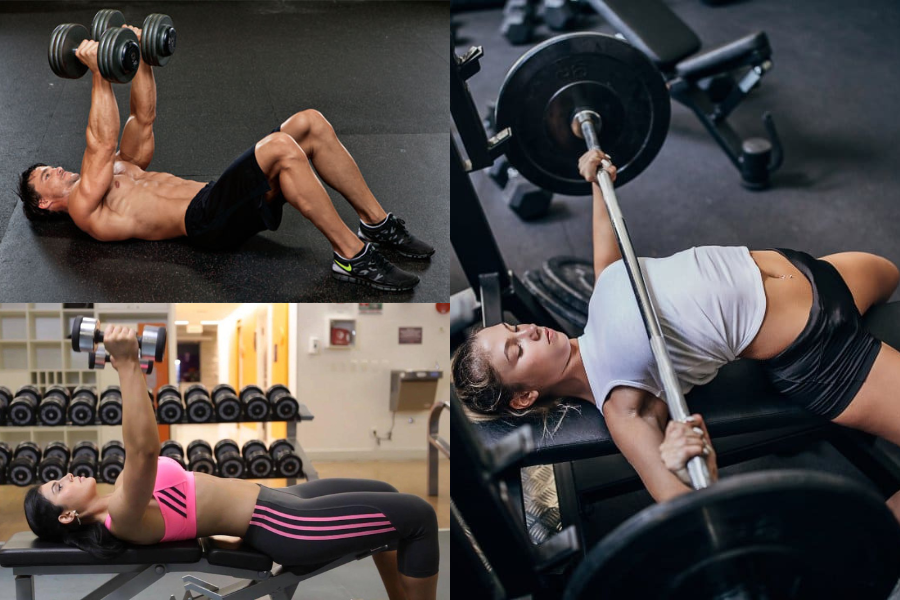
Dumbbell squeeze press
- Setup: Lie on the floor or a bench if you have one, press two dumbbells together over your chest, and lower them as one unit.
- Targets: Chest with strong constant tension.
- Why it works: Squeezing the dumbbells together forces your pecs to stay engaged from start to finish.
Floor or decline-style dumbbell press
You can mimic a decline dumbbell bench press, which is highly effective for targeting the lower chest, even without a bench.
- Glute bridge decline press:
- Lie on your back on the floor, bend your knees, plant your feet, and lift your hips into a glute bridge.
- Press dumbbells up from chest level.
- This position mimics a decline angle that emphasizes the lower chest.
- Benefit: You only need dumbbells and a small patch of floor, no bench.
Decline chest flies in a glute bridge
- Setup: Same glute bridge position as above, arms extended over your chest with dumbbells.
- Movement: Lower your arms out in an arc until your hands are nearly parallel with the ground, then bring them back together.
- Targets: Lower chest fibers while also challenging shoulder stability.
- Benefit: Great way to focus on the lower chest in limited space without big machines.
Suspension and dip options
If you have a couple of specific tools, you can add more variety without needing a full gym.
TRX chest fly
- Setup: Use TRX straps or similar suspension trainers anchored securely overhead or to a doorway.
- Movement: Step forward, lean into the straps, open your arms into a fly, then bring your hands back together.
- Targets: Chest with added instability that recruits stabilizer muscles.
- Resistance tweak: Walk your feet closer to the anchor point to increase difficulty or step back to reduce it.
- Space required: A narrow strip of floor and a safe anchor point.
Chest dips with limited space
Chest dips are one of the best options for building chest depth and width.
- Setup: Use parallel bars or two very stable, equal-height surfaces like flat stools or sturdy chairs.
- Technique: Lean slightly forward as you dip to emphasize your chest.
- Benefit: Strong chest and triceps work without dumbbells or machines.
- Safety note: Make sure surfaces are steady and secure before you start.
Target upper, mid, and lower chest
You cannot truly isolate one exact part of the chest, but you can emphasize areas through angles and exercise selection.
Focus on upper chest
- Use decline push-ups with feet elevated on a chair or step.
- Perform loop band standing presses with hands moving slightly upward from your chest.
- Lean slightly forward from the toes during TRX chest fly variations.
These all place more load on the upper region of the pectoral muscles.
Emphasize the mid chest
- Regular push-ups with a wide grip.
- Standard dumbbell chest press on the floor.
- Loop Band Push Up on Knees if you are building baseline strength.
These are your classic go-to moves for general chest mass and strength.
Hit the lower chest in a small space
Research highlighted several effective lower chest options you can use at home:
- Decline dumbbell bench press
- With a bench set to about a 15 to 30 degree decline when available.
- Or by lying in a glute bridge on the floor to mimic a decline angle.
- Decline chest flies in a glute bridge position.
- Incline push-ups
- Hands elevated on a bench or step place more load on the lower chest.
- Dips with a forward lean
- Performed between parallel surfaces like two stable chairs.
You can also improve results by using a strong mind-muscle connection, focusing on squeezing and contracting the lower chest fibers as you press your arms down and slightly across your body.
Build a small space chest workout routine
Now you can put everything together into a simple, repeatable plan. This sample covers strength, muscle growth, and a touch of conditioning, all in a tight footprint.
No equipment daily chest routine
Use this when you only have floor space, no gear.
Perform 2 to 3 rounds:
- Incline push-ups
- 10 to 15 reps, hands on a couch or bench
- Easier start and activates lower chest
- Regular push-ups
- 8 to 12 reps
- Use a wide hand position for more chest involvement
- Decline push-ups
- 5 to 10 reps, feet on a chair
- Emphasis on upper chest
- Diamond push-ups
- 6 to 12 reps
- Strong triceps and inner chest focus
- Isometric push-up hold
- 15 seconds at elbows bent to 90 degrees
- Builds time under tension
Rest 30 to 45 seconds between moves. If you want a more cardio focused day, you can pair this type of push-up circuit with moves like star jumps or mountain climbers, similar to no-equipment programs that combine push-ups and cardio for strength and endurance.
Small space band-based chest session
If you own a loop band and a chair or bench, try this on alternate days.
Perform 3 rounds:
- Loop Band Standing Chest Press
- 10 to 15 reps
- Control both the press and the return
- Loop Band Push Up on Knees
- 8 to 12 reps
- Focus on steady, full range motion
- Incline push-ups
- 10 to 15 reps
- Hands on a stable surface, slow tempo
- Deficit push-ups
- 6 to 10 reps using low platforms
- Go as low as you can with good form
Rest 45 to 60 seconds between rounds.
Dumbbell-focused lower chest workout
This setup fits in any room where you can lie on the floor.
Perform 3 to 4 rounds:
- Glute bridge decline dumbbell press
- 8 to 12 reps
- Squeeze the lower chest at the top of each rep
- Decline chest flies in glute bridge
- 10 to 15 reps
- Move slowly and avoid bouncing at the bottom
- Dips using two chairs
- 6 to 10 reps
- Slight forward lean, keep shoulders down and away from your ears
- Incline push-ups
- 10 to 15 reps to finish the set
Rest 60 seconds between rounds. Start with light dumbbells and increase weight gradually as your form and strength improve.
Plan weekly training for growth
For strength and muscle gain, your small space chest workout should be planned just like a gym routine.
How often to train
- Aim to train your chest about twice per week.
- For lower chest emphasis in particular, 4 to 12 total sets per week, using 2 to 4 exercises, is often recommended for hypertrophy and balanced development.
- You can repeat a similar session or rotate different exercise variations to keep your joints feeling good and your muscles challenged.
Example weekly structure
- Day 1
- No equipment push-up focused routine
- Emphasize mid and upper chest
- Day 3 or 4
- Dumbbell and lower chest session
- Emphasize decline style movements and dips
- Optional Day 6
- Lighter recovery session with incline push-ups, Loop Band Push Up on Knees, and isometric holds
Always leave at least one full rest day between harder chest sessions so your muscles can recover and grow.
Adjust for your experience level
You can scale your small space chest workout up or down by adjusting angles, reps, and exercise choices.
If you are a beginner
- Start with:
- Incline push-ups
- Loop Band Push Up on Knees
- Regular push-ups on the floor if possible
- Use lower rep ranges, like 6 to 10 reps, and focus on form.
- Rest longer between sets, up to 60 to 90 seconds.
- Gradually lower your incline or move from knees to toes as you gain strength.
If you are more advanced
- Use:
- Decline push-ups
- Offset and one-leg push-ups
- Deficit push-ups
- Weighted dips or band-resisted push-ups
- Slow your tempo or add isometric holds at the bottom of a rep.
- Aim for higher total volume over the week, while still respecting recovery.
Keep your routine consistent
A small space chest workout is effective when you keep your setup simple and your sessions repeatable. You do not need a large room or heavy machines. By combining push-up variations, band presses, dumbbell work on the floor, and occasional dips or TRX moves, you can build a strong, defined chest right where you are.
Choose one routine to try this week and stick with it for a few sessions. As the exercises begin to feel easier, add a few reps, another round, or a slightly harder variation so your progress never stalls.
About the Author