Understand why bench press variations matter
If you want serious chest gains, you cannot rely on a single movement. Using different bench press variations for chest lets you overload the muscles in different positions, improve weak points, and keep progress moving when a flat barbell bench alone stalls.
The classic barbell bench press is still your main mass builder. It targets your pecs, triceps, and front delts through a fixed path and makes progressive overload simple, so you can keep adding weight over time. By combining it with smart variations, you get more complete chest development, better balance, and stronger pressing overall.
Below, you will see how each variation works, what it is best for, and how to use it in your own training.
Use the flat barbell bench as your base
The flat barbell bench press should usually sit at the center of your chest workout. It lets you press roughly 20 percent more weight than a dumbbell bench, which makes it ideal for building pure strength and size.
How to do the flat bench press
- Lie flat on the bench with your eyes under the bar.
- Grip the bar just outside shoulder width.
- Pull your shoulder blades together and down to create a stable base.
- Keep your feet planted and some arch in your lower back.
- Unrack the bar and hold it over your mid chest.
- Lower the bar to about mid chest with your elbows tucked in, not flared.
- Press back up, keeping your elbows under the bar.
You will feel your pecs doing most of the work, with help from your front delts, lats, and triceps.
When to use flat bench
Use flat bench early in your workout when you are fresh. It is the lift where you will likely push the most weight so you want your best energy here. Most lifters do well with:
- 3 to 5 sets
- 4 to 8 reps for strength
- 8 to 12 reps for size
Once this base is in place, you can layer in other bench press variations for chest to hit different angles and ranges of motion.
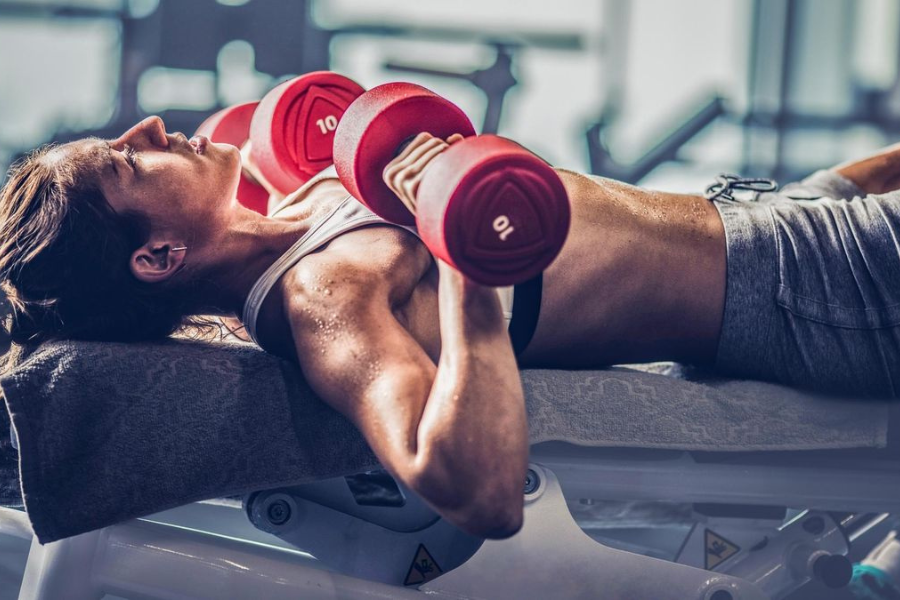
Add dumbbell bench for range and balance
The dumbbell bench press looks similar to the barbell version, but it offers a few important advantages for chest growth.
Why dumbbells work so well
With dumbbells, your hands are not locked on a bar. You can lower the weights deeper and bring them slightly toward each other at the top. This gives you:
- Greater range of motion and a deeper stretch
- More adduction, as your hands move toward each other, which is a key chest function
- Longer time under tension through the full rep
That extra stretch and control can boost hypertrophy, or muscle growth, especially when you focus on the eccentric, or lowering phase. Since each arm works independently, dumbbells also help fix imbalances and improve strength symmetry.
The trade off is that dumbbells demand more shoulder stability and core control, which can make them harder to manage, especially with heavy weights.
How to do the dumbbell bench press
- Sit on the end of the bench with a dumbbell on each knee.
- Lie back and bring the dumbbells directly over your chest, palms facing forward.
- Set your shoulder blades like you would on a barbell bench.
- Lower the dumbbells until your elbows are slightly below the bench and your chest is stretched.
- Press back up and, if comfortable, bring the dumbbells slightly toward each other at the top without clanking them.
When to use dumbbell bench
You can use dumbbell bench right after your barbell bench, or on a separate chest day. For most lifters:
- 3 to 4 sets
- 8 to 12 reps
A simple approach is to build strength with barbell bench, then use dumbbell bench for controlled, higher rep work to pack on size.
Target your upper chest with incline variations
If your upper chest looks flat compared to the rest of your chest, incline bench variations should be high on your list.
Why incline bench helps your upper chest
Incline bench press shifts more of the load to the upper portion of your pecs. That is especially helpful if this area is lagging behind the rest of your chest.
Typical setups use a bench angle between 30 and 45 degrees. Research highlighted by Ativafit notes that an incline bench at 30 degrees can increase activation of the pectoralis major by 14.5 percent compared to flat pressing.
You still involve your shoulders and triceps, so you get a strong upper body pressing movement, not just an isolation exercise.
How to do the incline barbell bench press
- Set the bench to roughly 30 degrees to start.
- Lie back with your eyes under the bar and grip just outside shoulder width.
- Pull your shoulders down and back to keep tension on your chest, not just your shoulders.
- Unrack the bar and hold it above your upper chest.
- Lower the bar to your lower chest or upper ribcage, keeping elbows tucked.
- Press up and slightly back so the bar finishes above your upper chest.
If you are new to incline pressing, start with light weight. Choose a load that lets you do 12 to 20 reps per set while keeping the effort in your chest, not just your arms or shoulders. As those sets feel easy, slowly increase the weight.
Try incline dumbbells for safety and control
If you train alone or want more freedom of movement, the incline dumbbell bench press is a strong option. It offers the same upper chest focus as the barbell version, with the added benefits of:
- Greater range of motion and tension
- Easier escape if you miss a rep, because you can drop the bells to the side
- Slightly more shoulder stability work, which can improve control over time
For many home or solo lifters, incline dumbbells are the safer way to push close to failure without a spotter.
Build a thick lower and mid chest with angle and floor work
While most people focus on upper chest, your middle and lower chest matter just as much for a full, balanced look. Some bench press variations for chest let you put special emphasis on these areas.
Use decline bench for lower chest
On a decline bench, your head is lower than your feet. This position shifts more work to your lower chest while still involving your triceps and shoulders.
The setup is similar to flat bench. You lock your feet in, lie back, grip just outside shoulder width, and lower the bar to your lower chest before pressing back up.
Try the floor press for mid chest and triceps
The floor press is like a bench press done on the ground. You lie on the floor with your knees bent and press a barbell or dumbbells.
Because your elbows hit the floor, your range of motion is limited. That means:
- Less shoulder stress
- More focus on the mid range and lockout
- Extra emphasis on your triceps and mid chest
You never let the bar or bells touch your chest, so each rep starts with your upper arms on the floor, elbows bent at about 90 degrees. This makes it a solid choice if you want to build pressing volume while giving your shoulders a bit of a break.
Strengthen triceps and technique with close grip benching
A stronger bench press needs strong triceps. Close grip benching is one of the best tools for that and it also sharpens your overall technique.
Why close grip bench is so effective
Using a grip about shoulder width apart increases how far the bar travels and puts more work on your triceps. That longer range of motion means more work per rep and often more strength and muscle gain over time.
Close grip bench also:
- Forces you to keep your elbows under the bar
- Challenges you to maintain tightness in your lats and upper back
- Teaches better bar path and control
Experiments with multiple lifters have shown that with enough practice, many people can match or even exceed their wide grip bench press max with a close grip as of April 2022.
How to set up close grip bench
- Lie on the bench as usual with good upper back tightness.
- Grip the bar with your hands around shoulder width, not touching.
- Keep your elbows tucked so they track under the bar.
- Lower the bar to your lower to mid chest.
- Press back up without letting your elbows flare.
When to use close grip
You can use close grip as a main variation or as an accessory movement after your regular bench work. It pairs especially well on days when you want extra triceps focus.
- 3 to 4 sets
- 6 to 10 reps
This keeps the load heavy enough to build strength, but with enough volume to drive triceps hypertrophy.
Hit specific chest regions with smart grip changes
Small grip changes can shift where you feel the bench press without overhauling your whole program.
Wide grip for more chest stretch
Moving your hands out wider increases the stretch on your pecs and can increase pec engagement. Because the bar does not travel as far, you may lift a bit more weight, but your shoulders can take more stress.
Use wide grip carefully, and avoid extreme positions if you have a history of shoulder issues.
Reverse grip for upper chest emphasis
With a reverse grip, your palms face toward your head and your knuckles face your feet. This grip tucks your elbows more and changes how your upper chest and delts work.
Studies show that reverse grip bench can increase upper chest activation by about 30 percent compared to a traditional flat bench with a regular pronated grip. That makes it a powerful, although advanced, choice for upper chest focus.
Narrow floor press for safer upper chest work
A narrow grip floor press with a neutral grip, palms facing each other, can also target your upper chest while removing your legs from the movement. Because your arms stop on the floor, the risk of over stretching your shoulders is lower, which can make this variation feel safer and more controlled.
Use power and overload variations to break plateaus
Once you have a base of flat, incline, and dumbbell benching, you can add specialized variations to push through sticking points and add extra size.
Dead bench for power off the chest
The dead bench press starts with the bar resting on pins in the rack. There is no negative phase. You press the bar from a dead stop.
This focuses on:
- Explosive power in the bottom part of the lift
- Stronger initial drive off your chest
- Reduced stretch on the shoulders
Gains here usually carry over to a stronger regular bench press, especially if you tend to struggle at the bottom of the movement.
Smith machine overload press for heavy negatives
On a Smith machine overload press, you use the fixed path of the bar to handle much heavier weights on the way down.
Because the bar is guided, you can lower 40 to 60 percent more weight than you could press on your own. This eccentrically overloads your middle chest, which can be a strong driver of muscle growth when used sparingly.
You would typically:
- Use a spotter or safety stops.
- Lower the heavy bar slowly and under control.
- Use help to get the bar back up if it is above your actual max.
Board presses and JM presses for triceps
If you miss bench presses near the lockout, stronger triceps will usually fix it.
- Board presses reduce range of motion by stopping the bar on boards placed on your chest. This keeps tension in the top half of the lift and reduces shoulder and pec stress.
- JM presses blend a skull crusher and close grip bench. You keep your elbows in and lower the bar toward your throat or upper chest, then press it back up. This heavily targets your triceps without needing ultra heavy loads.
These movements build pressing strength where you need it most, and that often translates into new personal records on your main bench press.
Combine barbell and dumbbell work for best results
You do not need to choose between barbell and dumbbell bench pressing. In fact, using both usually gives you the best chest development.
According to Ativafit, the barbell bench press is the overall winner for chest training because you can load it the heaviest and progress it most easily. The dumbbell bench press adds a deeper stretch, more adduction, and better balance between sides. This combination of overload and control is ideal for size and strength.
For an extra hypertrophy boost beyond benching alone, pairing your press work with an exercise that overloads adduction, like a cable or band crossover, will help you squeeze even more out of your chest training.
Sample chest focused bench workout
You can use this template as a starting point and adjust sets or reps based on your experience:
- Flat barbell bench press
- 4 sets of 4 to 6 reps
- Incline dumbbell bench press
- 3 sets of 8 to 12 reps
- Close grip bench press
- 3 sets of 6 to 8 reps
- Dumbbell or cable fly or crossover
- 3 sets of 12 to 15 reps
If you want more power and overload work, rotate in dead bench or board presses every few weeks in place of close grip, not on top of everything.
Key takeaways for bigger chest gains
- Center your program on the flat barbell bench to take advantage of heavy progressive overload.
- Add dumbbell bench variations for extra range of motion, control, and balance between sides.
- Use incline pressing and reverse grip to emphasize upper chest, and decline or floor work to fill out the mid and lower chest.
- Rely on close grip bench, board presses, and JM presses to build the triceps strength that drives a bigger bench.
- Experiment with power and overload variations like dead bench and Smith machine overload presses if you are past the beginner stage and want to break plateaus.
Start by adding just one or two of these bench press variations for chest into your current routine. Once you feel how each one hits your chest differently, you can fine tune your training around the variations that give you the best mix of strength and size.
About the Author